Showing posts with label Papuan Provinces. Show all posts

Tuesday, May 11, 2021

Papua (Indonesian): This is What State Terror Looks Like.

by Elizabeth Kendal 

On Sunday 25 April a small detachment of Indonesian security personnel was patrolling a crime scene in Puncak Regency, in the Central Highlands of Papua Province, when it was ambushed by Papuan rebels. A firefight ensued and Indonesian Armed Forces (TNI) provincial intelligence chief Brig. Gen. I Gusti Putu Danny Karya Nugraha was shot dead in what appears to have been a planned assassination

Indonesian President Joko Widodo immediately called for retaliation. 

On Thursday 29 April, police claimed to have killed nine Papuan fighters in Puncuk district on Tuesday 27 April in retaliation for Nugraha’s killing. However, the spokesman for the rebel group, Sebby Sambom denied the claim, calling it a “big lie” and “propaganda” designed to boost the Indonesian military’s (TNI) morale.  

FROM SEPARATISTS TO TERRORISTS

On 29 April, Coordinating Political, Legal and Security Affairs Minister Mahfud MD announced that Papuan armed criminal groups (Kelompok Kriminal Bersenjata: KKB) would now be categorized as ‘terrorists’ in line with Counterterrorism Law No. 8/2018. The Counterterrorism Law grants security forces the power to authorise massive disproportionate surveillance, and detain suspects for longer periods without charge, increasing the risk that suspects will be abused and tortured. 

Papuan Governor Lukas Enembe immediately urged the government to reconsider. He warned that, rather than helping the situation, the “terrorist” designation could instead bring much harm. Governor Enembe “reiterated the Papua administration’s demand for the central government to tone down its heavy-handed approach in tackling problems in the province. ‘We want the security approach in Papua to be conducted in a more humane [manner], with an exchange of words and ideas, not an exchange of bullets,’ he said on Thursday [29 April]. He also urged the Indonesian Military (TNI) and the National Police to thoroughly assess the armed groups’ strength, location and characteristics to avoid civilian casualties or wrongful arrests.”

Numerous human rights organisations and advocates – including Human Rights Watch (HRW), Amnesty International, and the Institute for Policy Analysis of Conflict (IPAC) – similarly denounced the move and expressed concerns that the terrorist designation could trigger racist violence against Papuans outside of Papua, and be used to justify mass, gross human rights abuses, including arbitrary arrests, torture and killings, much of it compounded by the extreme racial-religious hatred so many Javanese Muslims (especially in the Indonesian military) have for their Melanesian predominantly Christian compatriots. 

Amnesty International Indonesia executive director Usman Hamid said that the designation only showed the government’s failure to address the root of Papua’s problems and most probably will hurt rather than help that Papuans. “Based on our monitoring, military and police personnel allegedly often justify the killing of Papuan people by claiming that they were members of the Free Papua Movement [OPM] or ‘armed criminal groups’ without providing clear evidence – claims that are often denied by local residents and church leaders,” he said in a statement. “The [new] ‘terrorist’ label will only serve as further justification for such terrible human rights abuses.” (Jakarta Post, 2 May)

STATE TERROR: HELL UNLEASHED

On Sunday 2 May, Indonesian media reported that the Indonesian military (TNI) had deployed its 400-strong elite Infantry 315/Garuda Battalion to Papua. Video footage has been released of the battle-hardened battalion – which earned its nickname “Satan’s Forces” (pasukan setan) in East Timor where it came to known for its brutal methods – performing military drills in Papua in 1 May.  

'Satan's Forces' perform military drills in Papua, 1 May 2021


On 4 May, Papuan leader-in-exile Benny Wenda issued a statement in which he warned: “huge Indonesian military operations, some of the largest in years, are imminent in West Papua. The internet is being cut off, hundreds more troops are being deployed, and we are receiving reports that West Papuan civilians are fleeing from their villages in Intan Jaya, Puncak Jaya, and Nduga regencies . . . This looks like it will be the biggest military operation in West Papua since the late 1970s. . .” 

UK-based Wenda warned that along with Satan’s Forces, the Jala Mangkara Detachment (Denjaka), elite troops of the Indonesian Navy, are also being deployed for what he insists is “state terrorism”. 

On 6 May Reuters confirmed that internet services have been disrupted in the provincial capital of Jayapura and nearby Sentani (40km to the west) since 30 April. Exiled Indonesian rights activist Victoria Koman, said she had received reports that mobile and internet services in Puncak have also been disrupted. Papua has gone dark!

Andreas Harsono, a researcher with HRW’s Indonesia office is not alone in his assessment that, “The underlying problem in Papua is racism: racism against the dark skinned and curly haired people, and of course those that do most of the human rights abuses against ethnic Papuans, these dark-skinned, curly-haired people who are predominantly also Christian in Muslim-majority Indonesia, are Indonesian soldiers and police officers.” (RNZ, 7 May)

As tensions soared, Harsono urged the Indonesian government to put the threat posed by Papuan KKB into perspective. “According to Indonesian military estimate, they only have (around) 200 weapons. It is tiny, it is insignificant. Of course they are criminal, they kill people. Of course the police should act against them. But branding them as a terrorist organisation, these people who live in the forest who try to defend their forest, their culture, and their own people, mostly using bows and arrows, this is going to be ridiculous. This is going to affect these indigenous people so much.” 

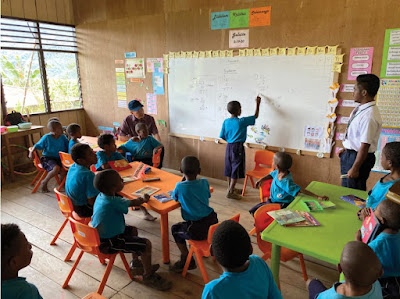
What do children at this Christian school in Papua
want to be when they grow up?
A Pastor, a missionary, a pilot . . . 
Photo by Jeremy Weber, for his article, 
Life and Death in ‘The Land of the Clouds’,
Christianity Today, November 2020.

Which brings us to the truth

The real goal of this totally disproportionate military offensive is not security! The real goal is not to neutralise an existential terrorist threat, for there isn’t one! To the contrary, the real goal of state terror is always political! The real goal is to eliminate resistance to Indonesian rule by massively increasing the cost. The real goal is to spiritually crush and intimidate into silence every indigenous, ethnic Melanesian, predominantly Christian Papuan who has ever so much as dreamt of Papuan freedom! 

USEFUL ENEMIES

In his book Useful Enemies: When Waging Wars is More Important than Winning Them, (Yale University Press, 2012), Professor David Keen explains how war and violence can have a political function. “This is war’s possible function in intimidating a broad swathe of the population – well beyond the rebels or named enemy.”  

Keen quotes Shelton David who wrote concerning Guatemala: “Most observers are in agreement that the purpose of the Guatemalan army’s counterinsurgency campaign was as much to teach the Indian population a psychological lesson as to wipe out a guerrilla movement that, at its height, had probably no more than 3,500 trained people in arms.” 

Keen also quotes a donor who told him, “There was never a huge guerrilla movement [in Guatemala] – it was more used by the army so they could do what they wanted.” 

What’s more, Keen adds, the counterinsurgency narrative “provided cover and legitimacy for violence against a broad range of political activists and human rights workers”.

Critically, Keen quotes the Guatemalan Commission for Historical Classification which assessed that, “at no time during the internal armed confrontation did the guerrilla groups have the military potential necessary to pose an immanent threat to the State. The number of insurgent combatants was too small to be able to compete in the military arena with the Guatemalan Army, which had more troops and superior weaponry, as well as better training and coordination . . .  The State deliberately magnified the military threat of the insurgency, a practice justified by the concept of the internal enemy. . . [an identification which] served to justify numerous and serious crimes . . . the vast majority of the victims of the acts committed by the State were not combatants in the guerrilla groups, but civilians.” 

While these excerpts (which are taken from pages 112-113), relate to the conflict in Guatemala (1969-1996), they could just as easily be written today in relation to the conflict in Papua (1969 – ongoing). For as was the case in Guatemala (and numerous other conflicts), the Indonesian State is intentionally exaggerating the threat so it can target “politically inconvenient opponents under the cover of a wider war”. 

And make no mistake, this is a war

On 11 May, the Guardian quoted Lanikwe, a women’s community leader, from Wamena, near Puncak, who said the situation for local people was dire. “Thousands are displaced in Puncak, five villages fled into the jungle. Health clinics and schools have been taken over by the military. Soldiers are everywhere. We are living in a war zone.”

VICTOR YEIMO ARRESTED IN JAYAPURA

On Sunday 9 May, Indonesian police in Papua’s provincial capital, Jayapura, arrested Victor Yeimo (38), one of the most prominent leaders inside Papua. 

The Indonesian government is accusing Yeimo of treason, which as UK-based Wenda explains, is ridiculous. “He is accused of ‘masterminding’ the 2019 West Papua Uprising, which was started by Indonesian racism and violence [RLM (27 Aug 2019)] and ended in a bloodbath caused by Indonesian troops” [RLPB 521 (24 Sept 2019)]. 

Human rights lawyer Veronica Koman said the case against Yeimo “feels forced and baseless, but if it goes to court, there is a high chance that judges will find him guilty – even with weak evidence.” 

It might be ridiculous and it might be a sham, but as People’s Consultative Assembly (MPR) Speaker, Bambang Soesatyo so shamelessly explained at the outset, the real goal is to ‘destroy them first’ and ‘discuss human rights matters later’. 

------------------------------------------------

Elizabeth Kendal is an international religious liberty analyst and advocate. She serves as Director of Advocacy at Canberra-based Christian Faith and Freedom (CFF) and is an Adjunct Research Fellow at the Arthur Jeffery Centre for the Study of Islam at Melbourne School of Theology.

She has authored two books: Turn Back the Battle: Isaiah Speaks to Christians Today (Deror Books, Melbourne, Australia, Dec 2012) which offers a Biblical response to persecution and existential threat; and After Saturday Comes Sunday: Understanding the Christian Crisis in the Middle East (Wipf and Stock, Eugene, OR, USA, June 2016).

See www.ElizabethKendal.com 

Tuesday, October 8, 2019

Indonesia: Mobilizing Civilian Militias for National Defense


-- implications for security in the Papuan provinces

On the afternoon of Thursday 26 September, with only 73 of 283 members of parliament in the House, the Indonesian parliament passed a profoundly controversial Bill.

Agus Hermanto, the Deputy Speaker of the House of Representatives, chaired the session.

When he asked, “Can the second level discussion of decision making on the Draft Bill on Management of National Resources (PSDN) for National Defense be approved as a law?” all members present said, “Agree.”

With that, and a clap of the hammer, the Bill on Management of National Resources (PSDN) for National Defense officially became law.

The PSDN Bill 2019 on National Defense contains several controversial articles. However, the one that will trigger alarm bells for Christians is Chapter 4, Article 27 which makes it legal for the Indonesian military (TNI) to mobilise civilian forces for national defense.

[NOTE: I apologise from the outset that all the news reports referenced in this post are Indonesian language news reports. It seems this news is not being reported in English! My English translations come courtesy of Google Translate, albeit with some tweaking.]

The full text of the law on
Management of National Resources (PSDN) for National Defense
can be found here: PSDN Bill 2019 – full text, in Indonesian, pdf.

Article 1 provides some essential definitions.
Excerpts

In this Act we mean:

1. National Defense is all efforts to maintain state sovereignty, territory of the Unitary State of the Republic of Indonesia, and the safety of the nation from threats and interference towards the integrity of the nation and state.

2. National Resources are human resources, natural resources, and artificial resources.

6. The Main Component is the Indonesian National Army [TNI] that is already used to carry out defense duties.

7. The Reserve Component is a National Resource that has been prepared to be mobilized through mobilization to enlarge and strengthen the strength and capabilities of the Main Components.

8. Supporting Components are National Resources that can be used to increase the strength and ability of the Main Component and Reserve Component.

10. Mobilization is an act of mobilization and uses, simultaneously, National Resources and Facilities and Infrastructure that have been prepared and fostered as components to strengthen the National Defense. [Resources are] to be used appropriately, integrated, and directed for overcoming every threat – both threats from abroad as well as threats to national unity and the survival of the Unified State of Republic of Indonesia [NKRI].

Chapter 4, Article 27 [BAB IV, Pasal 27]

(1) The Proposed Components include:
a. Citizens;
b. Natural Resources;
c. Artificial Resources; and
d. National Utilities and Infrastructure.

(2) The Proposed Components as referred to in paragraph (1) may be utilized in the service of National Defense.

(3) The Proposed Components as referred to in paragraph (1) may be utilized to assist with internal, State Defense efforts.

CONTROVERSY

For most Indonesians, the most controversial element of this article was the prospect that citizens would be conscripted into a Reserve Component. Controversy raged about whether the government was introducing compulsory military service or whether this law would result in the militarization of civil society.

In response, the Chairman of the Working Committee on the PSDN Bill for National Defense, Satya Widya Yudha, assured the public that, “Conscription for civil society is voluntary. This is clear, there is no coercion in the PSDN Act.

Chairman of the House of Representatives Commission, Abdul Kharis Almasyhari, also confirmed that citizen participation in Support Components and Reserve Components would be voluntary, adding that the law was made to strengthen Indonesia’s national defense, not to force citizens into military service. According to Abdul Kharis, precisely because the TNI and Polri (police) cannot be everywhere at once, they should not be expected to carry the whole burden of security. Now, with this regulation, community mobilization – if it is needed – will be legal.

ALARM

While these assurances might comfort most Indonesian citizens, Christians with memories of the violence in East Timor and the jihad in the Maluku Islands -- especially those in the Papuan provinces -- will be deeply alarmed.

Islamic jihadi and merah putih (red and white, ultra nationalist) militias have long served as proxies for the TNI which is known to arm militias and then turn a blind eye to their violence. By using the militias as proxies, the TNI has been able to maintain plausible deniability of gross human rights abuses. And deniability is essential if the TNI is to continue receiving weapons and training from the West.

Now however, with the passing of the PSDN Bill, the TNI will be able to mobilize civilian militias which will now be known now as Reserve Components. These militias/Reserve Components will now fight alongside and cooperate with the TNI for the purpose of “national defense” as defined by the Bill. Of course, they will be fighting not predominantly Christian (infidel) indigenous Papuans (“monkeys”) but “separatists”! And what could be more Islamic than defending the unity of Indonesia? For as far as Islam is concerned, Indonesia – including the Papuan provinces – is all part of the dar al-Islam (House of Islam).

PAPUAN PROVINCES: LOOMING NATIONALIST JIHAD

Since the 23 September riots in Wamena – in which at least 27 Muslim settlers died at the hands of invading marauding highlanders – several Java-based jihadist groups have begun calling for jihad. [For background see: Religious Liberty Prayer Bulletin (RLPB) 523 (9 Oct 2019).]

Islam Jihad Front (FJI) and Islamic Defenders Front (FPI) have both begun raising funds and enlisting recruits for jihad in the Papuan provinces.

A banner at an FJI recruitment post reads: “Islamic Jihad Front opens registration for Islamic paramilitary groups throughout Indonesia to send Islamic holy war fighters/militias [jihad qital] to Wamena, Papua, to defend Muslim brothers in Papua who were slaughtered by the waring infidels [kafir harby] and to maintain the integrity of the NKRI [Unitary State of the Republic of Indonesia] from the OPM [Organisasi Papua Merdeka / Free Papua Movement] separatist hordes.”

According to Indonesian human rights researcher Andreas Harsono (7 Oct), several “aggressive”, Islamist groups already have a foothold in the Papuan provinces. “We have one in Sorong; we are also seeing Laskar Jihad, a militant Muslim group, setting up a base in Keerom; also in Wamena . . .”

Further to this, previously, on 5 September, Defense Minister Ryamizard Ryacudu informed members of the House of Representatives, “There is a group affiliated with the Islamic State [operating] in Papua that has called for a jihad there.” National Police spokesman Brig. Gen. Dedi Prasetyo confirmed Ryamizard’s statement and identified the IS-affiliated group as Jamaah Ansharut Daulah (JAD) – the group believed to be responsible for a string of terror attacks in and around Surabya, including suicide-bombings at three churches on Sunday 13 May 2018.

The PSDN Bill 2019 for National Defense changes the dynamic of the Papuan conflict dramatically. It seems the TNI, which is heavily invested in the Papuan provinces, will have no shortage of volunteers willing to serve in a Reserve Component.

As one observer ominously warns, “The possibility that all this could turn into a widespread, government supported ethnic cleansing in the guise of a religious war is now very real.”

------------------------------------------------------------

Elizabeth Kendal is an international religious liberty analyst and advocate. She serves as Director of Advocacy at Canberra-based Christian Faith and Freedom (CFF) and is an Adjunct Research Fellow at the Arthur Jeffery Centre for the Study of Islam at Melbourne School of Theology.

She has authored two books: Turn Back the Battle: Isaiah Speaks to Christians Today (Deror Books, Melbourne, Australia, Dec 2012) which offers a Biblical response to persecution and existential threat; and After Saturday Comes Sunday: Understanding the Christian Crisis in the Middle East (Wipf and Stock, Eugene, OR, USA, June 2016).

See www.ElizabethKendal.com

Tuesday, August 27, 2019

Papuans have had enough of racial-religious hatred and persecution.


By Elizabeth Kendal


Every 15 August, Papuans (mostly Christian Melanesians) hold demonstrations to protest the unjust New York Agreement, signed on 15 August 1962, which paved the way for West Papua and Papua (formerly known as Irian Jaya) to come under Indonesian rule.

Every 17 August, Indonesians (in particular, the mostly Javanese Muslims) celebrate Indonesia's 17 August 1945 Proclamation of Independence.

Unsurprisingly, every year there are clashes and arrests. Indeed, this year more than 100 Papuans were arrested, including “a 9-year old kid whose only crime was marching with his fellow West Papuans”.

What’s more, this year footage went viral which showed Indonesian soldiers using excessive force as police and radicals aligned with various nationalist and Islamist militia groups yelled racist abuse and threats at Papuan students in Surabaya, East Java.

Fed up and infuriated, Papuans rallied in 30 cities across Indonesia, including in Jakarta, in protest of years of unrelenting racial-religious hatred and persecution.

To appreciate the seriousness of incident in Surabaya, a report in the Jakarta Post is worth quoting at length.

Papuan students on Java face increased pressures from Islamist, nationalist groups
By Ivany Atina Arbi, Wahyoe Boediwardhana, and Benny Mawel
The Jakarta Post Jakarta, Surabaya, and Jayapura, Monday, August 19, 2019

Excerpt:

"Papuan students on Java Island have repeatedly become the target of intimidation by Islamist and nationalist groups.

"In the latest incident on Friday afternoon [16 Aug], scores of security forces along with civil militias from hard-line group Islam Defenders Front (FPI) and youth organization Pemuda Pancasila (PP) reportedly went to a Papuan student dormitory on Jl. Kalasan in Surabaya, East Java, and launched physical and verbal attacks against the students, following the finding of an Indonesian flag discarded near the dorm.

"According to the Surabaya Legal Aid Institute, which cited the account of a student staying in the dormitory, Indonesian Military (TNI) soldiers allegedly banged on the door of the dorm while uttering curse words such as 'monkey', 'dogs' and 'pigs' aimed at the students inside the dormitory.

"Dozens of FPI and PP members reportedly came not long after.

"Human rights lawyer Veronica Koman, who is also a representative of the National Committee for West Papua (KNPB), said Sunday that the angry mob purportedly damaged the dorm’s gate and threw stones at the building while chanting 'Kick out Papuans!' and 'Slaughter Papuans!' for hours, restricting the students’ movement.

"Two good Samaritan Indonesian students, who at midnight delivered food to the students trapped inside the dorm, claimed to have been assaulted and later arrested by police who were guarding the area.

"'This is beyond my comprehension, what could possibly be the crime of delivering food and water? Even prisoners have a right to eat,' Veronica said, adding that the pressure continued on the following day with the police shooting teargas into the dorm and arresting all 43 students inside the building.

"'[All the teargas and violence] is totally unnecessary. They are only unarmed, hungry, thirsty and tired students who have been rounded up by hundreds of racist civil militias and security forces for more than 24 hours,' she said."

Australia’s ABC reported that the police stormed the ‘dormitory full of Papuan students, firing around 20 tear gas canisters into the building, causing injuries, arrested 43 (later released) around nine hours after without charge, over claims that the Indonesian flag was found in the gutter by the building.’ They claim to have been concerned that the crowd/mob was ‘close to attacking’, and thus only acted to stabilise the situation.

Protests erupt in West Papua and Papua

On Monday 19 August, thousands of Papuans protested in West Papua’s Manokwari (where local parliament was torched,) and Sorong (where 250 inmates escaped after the jail was torched), as well as in Papua’s capital Jayapura.

Clashes have been reported in Fakfak, a Papuan regency known to harbour Indonesian nationalist and Islamist militias.

Several protesters were injured and dozens detained as Indonesian authorities cracked down on the Papuan “separatists”.

Victor Yeimo, a spokesperson for the West Papua National Committee (KNPB), told Al Jazeera that a member of his organisation has confirmed reports of injuries sustained by several West Papuans, some of whom were taken to a local hospital.

John Djonga, a prominent Catholic priest in Papua province, told Al Jazeera that he had sent an emissary to Fakfak, who confirmed that some injured protesters were being treated in a hospital there.

The police, however, deny that dozens were wounded in the crackdown, asserting that reports of injuries are nothing but “hoax news”.

Troops deployed; Internet shut down

The Indonesian government has deployed an additional 1,200 troops to Papua Province, a region long-closed to outsiders.

According to a report by Pacific Media Watch, Indonesia’s police chief, Tito Karnavian, has focused blame for the destruction in Manokwari on the people who posted about the Surabaya incident on social media, describing their posts as “hoax news”. Further to that, in a statement, the Ministry of Communication and Information said it had acted to “throttle” access to the internet in several areas because of the potential for disinformation to create social disorder. “We can say that the purpose of throttling is to prevent the wide spread of hoax (fake news) that trigger action,” the ministry said.

On Thursday 22 August, Indonesia’s Ministry of Telecommunication “temporarily” shut down the internet across Papua Province allegedly “to accelerate government efforts to restore order”. Of course, this not only prevents the flow of news into Papua, it also makes it very difficult to get news out.

CBC News 23 Aug 2019
 'Indonesia deploys thousands of troops to Papua region to quell protests'
(includes interview with exiled Papuan leader, Benny Wenda)

Protests continue; calls for referendum

On Monday 26 August, some 5000 Papuans took to the streets of Deiyai, a highlands town about 500 km south-west of Jayapura, carrying four banned Morning Star flags.

Papuans are calling for a new, fair and just referendum on Papuan Independence.

As Indonesian expert on Papua issues, Darmawan Triwibowo, told the Jakarta Post, “Papuans are often depicted [by the government and mass media] as anti-nationalists who want to separate themselves from the country. The media, however, fail to present the reason behind such aspiration. There’s a human rights issue behind the desire, which is a political problem that should also be addressed using a political approach instead of a security or economic approach.”

According to the Jakarta Post, “[Triwibowo’s] voice was echoed by Papua Peace Network coordinator Adriana Elisabeth, who said various human rights violations that occurred in Papua had not been resolved to this day, despite President Joko ‘Jokowi’ Widodo’s 2014 campaign promise to do so.”

As Human Rights Watch declared, “The Indonesian government has a responsibility to ensure security in West Papua and Papua and to respect the human rights of everyone, including protesters. President Joko ‘Jokowi’ Widodo, who plans to visit Papua, should condemn racist remarks and actions, promote tolerance, and direct the police to impartially investigate abusive militias and officers.”

President Widodo's shame 

To date, all President Widodo has done is call on Papuans to stay calm and forgive their fellow citizens. 

“I know that there are hurt feelings,” Widodo told a media conference, “but as fellow citizens the best thing is to forgive each other. It is okay to be emotional but forgiving is better. Being patient is also better. And be confident that the government will continue to safeguard your dignity and prosperity.”

But, as Evi Mariani observed in the Jakarta Post (19 Aug), “Papuans have long endured racial discrimination from the majority Javanese.” 

She notes that in July last year, Amnesty International Indonesia released a report which described Papua as “one of Indonesia’s black holes for human rights . . . a region where security forces have for years been allowed to kill women, men and children, with no prospects of being held to account."

Mariani continues, “Under the pretext of nationalism, [many Indonesians] may think Papuans have no right to be outraged. After all, some would say: ‘We give them roads, development and a lot of special autonomy funds. . .’

“However, we fail to give the Papuans respect they deserve and recognition that they are equal to us. As citizens of Indonesia, they have equal opportunity to protest when they think they are being treated unfairly. Of course, such failure only amounts to racism.

“Non-Papuans, the majority, would say Papuans, the minority, have no right to call for justice or determine their future after the relentless acts of violence, injustice and racism they have endured for decades. Unless they find peace, justice and prosperity, they will consider living in the Unitary State of the Republic of Indonesia merely a rhetorical statement.

“Papuans deserve peace and prosperity on their rich land and without eradicating our racism against them, there would never be peace in Papua.”

“Racism,” she concludes, will only fuel the Papuan “struggle for independence from ‘Indonesian occupation'.”

Indeed; Papuans have had enough of genocidal racial-religious hatred and persecution.

------------------------

On 30 August, East Timor will celebrate the 20th anniversary of the 1999 UN-managed referendum through which the mostly Catholic East Timorese people voted overwhelmingly to separate from Indonesia. As Jose Ramos Horta explains, ‘Between 150,000 and 200,000 people out of a population of 700,000 died during the 24-year Indonesian reign.’

Though marked by violence which saw more than 1500 East Timorese murdered at the hands of Indonesian nationalist and Islamist militias – violence ultimately subdued by troops from an International Force (INTERFET) organised and led by Australia – the 1999 referendum paved the way to independence. Today Jose Ramos Horta is incredibly proud of East Timor, and incredibly grateful for the referendum which has enabled the East Timorese to create ‘a new country, free of revenge and violence, a vibrant democracy with the freest media in the region’.

Do the Papuans deserve any less?

-------------------------------------------------------------

Elizabeth Kendal is an international religious liberty analyst and advocate. She serves as Director of Advocacy at Canberra-based Christian Faith and Freedom (CFF) and is an Adjunct Research Fellow at the Arthur Jeffery Centre for the Study of Islam at Melbourne School of Theology.

She has authored two books: Turn Back the Battle: Isaiah Speaks to Christians Today (Deror Books, Melbourne, Australia, Dec 2012) which offers a Biblical response to persecution and existential threat; and After Saturday Comes Sunday: Understanding the Christian Crisis in the Middle East (Wipf and Stock, Eugene, OR, USA, June 2016).

See www.ElizabethKendal.com 

Sunday, April 14, 2019

Papua: The Christian Crisis in Eastern Indonesia

(NOTE: The western half of the island of New Guinea, Papua was formerly known as Irian Jaya)
-- by Elizabeth Kendal

The U.N. High Commissioner for Human Rights, Michelle Bachelet was taken by surprise on Friday 25 January when exiled Papuan independence leader Benny Wenda walked into her office.

The delegation from Vanuatu, which was in Geneva for a scheduled Universal Periodic Review (UPR), had requested and been granted a private meeting with Ms Bachelet.  Ravina Shamdasani, deputy spokeswoman at the U.N. Human Rights Office, explains what took place:

“During this meeting, one member of the Vanuatu delegation, Mr. Benny Wenda, presented the high commissioner with a petition. This was not actually a meeting arranged with Mr. Wenda for that purpose,” she said, adding that Ms Bachelet “was not aware” in advance.

The petition, which Indonesia has banned, carries over 1.8 million Papuan signatures collected in secret and at great risk.

As Australian journalist and author John Martinkus explains, the petition “calls on the UN to review the controversial 1969 vote that transferred control of West Papua to Indonesia. The Act of Free Choice vote, often referred to as the Act of No Choice by its detractors, saw 1026 people – selected by the Indonesian military – vote on behalf of their fellow West Papuans to give up sovereignty for Indonesian citizenship.

“The petition also asks for West Papua to be placed back on the UN decolonisation list. This would mean the possibility of a referendum on Papuan sovereignty, which Papuans have been hoping for since a similar referendum in East Timor, now Timor-Leste, resulted in its independence from Indonesia in 1999.”

In September 2017, Benny Wenda took the petition to New York, where the UN General Assembly was in session, with the hope of getting it into the hands of the United Nations Special Committee on Decolonisation.

Unfortunately, the committee’s chair, Rafael Ramirez (Venezuela), claimed not to have received the petition, before adding that it could not be accepted anyway, as Papua “is not on the agenda” and “Indonesia is a very good friend of ours”.

See: Papua (eastern Indonesia): a desperate and risky plea
Religious Liberty Prayer Bulletin (RLPB) 426, 4 Oct 2017.

Needless to say, Mr Wenda’s 25 January coup has infuriated Indonesia. Indonesia’s Ambassador to the UN, Hasan Kleib, strongly condemned Vanuatu for essentially sneaking Wenda in and helping him get access to Bachelet.

“(They) deliberately deceived the High Commission by taking manipulative steps through the infiltration of Benny Wenda into the Vanuatu delegation,” Kleib fumed.

Mr Wenda with petition (25 January 2019, Geneva) Image: twitter

Unfortunately, in this battle for human rights, the Papuans have very few international friends. Australia, America and the United Kingdom – economically influential democracies that should be advocating for human rights in Papua – are more interested in keeping Indonesia out of China’s sphere of influence. And so the human rights of the mostly-Christian indigenous Papuans are sacrificed on the altar of good relations with Indonesia, for geo-strategic and economic gain.

The Trans-Papua Highway

One of Indonesia most controversial development projects is the Trans-Papua Highway, or Trans-Papuan Economic Corridor. The enormously expensive Trans-Papua Hwy will traverse Papua’s long-untraversable highlands, linking industries, mines and oil and gas hubs, while ploughing through pristine tropical rainforest, the world heritage listed Lorentz National Park and vast tracts of customary lands belonging to indigenous Papuans.

short film: Global Roadmap
For more information see:
Ill-advised' Papua highway imperils indigenous rights, rainforests
Rina Chandran, Thomson Reuters Foundation, 4 Feb 2019
also: Yale Environment 360

Writing in The Saturday Paper (9 Feb 2019), Australian journalist and author John Martinkus gives voice to Papuan fears.  “The 4000-kilometre road, will stretch from West Papua’s largest city, Sorong, through the Papuan mountains and forest to the town of Merauke in Indonesia’s east. Indonesian president Joko Widodo claims the road, the Trans-Papua Highway, will bring commerce and development to these remote regions. However, the highlanders see the road as a threat, which will bring Indonesian migrants and the military to the region. Many fear greater access to the highlands will destroy their way of life, as they believe it did for lowlanders living on the coast. As construction of the highway has progressed, it has catalysed many West Papuans to take up arms in opposition.”

And as Martinkus notes, “This escalation of the independence movement, one of the world’s longest-running insurgencies, brings with it the potential of an even deadlier conflict, for both sides.”

Martinkus explains that when he was in Papua in 2002, independence fighters were armed mostly with sticks, spears, bows and arrows, and maybe the odd hunting rifle. “Today,” he warns, “many West Papuan fighters are armed with Indonesian-produced weapons, bought or stolen from Indonesian soldiers.”

The fighters, he explains, are “the children of those killed, imprisoned and forced to flee during deadly confrontations with the Indonesian military in Papua’s remote central highlands. Growing up, these young Papuans also watched on as Grasberg – the world’s largest goldmine – has wreaked havoc on the environment of West Papua while generating billions for its co-owners, Freeport-McMoRan and the Indonesian government. Now adults, they have deeply held frustrations about perceived exploitation of their lands by the Indonesian government.”

Bloodshed in Nduga

On 2 December 2018, rebels affiliated with the West Papua Liberation Organization (WPLO) – a militant wing of the Free Papua Movement – abducted 25 construction workers working on the Trans-Papua Hwy in Nduga province, in the central highlands, north of the Freeport Grasberg mine. The next day the rebels took their captives to a nearby hilltop and shot them, killing 19 and injuring 4, who pretended to be dead to escape.

The WPLO claim that the laborers were actually armed Indonesian soldiers (TNI) who had attacked them. Reportedly, on 1 December, Papuans had spotted one of the laborers taking photographs of the Papuans as they raised the banned Morning Star flag in commemoration of the 1 December 1971 declaration of Papuan independence.

As would be expected, a heavy influx of TNI forces descended on Nduga province; retaliation has been swift and hard. While the military claims to be hunting the rebels responsible for the killings, the crackdown has forced some 32,000 mostly-Christian indigenous Melanesian Papuans to flee their homes. Many are struggling to survive in the jungle; at least nine women have given birth. In the Mbua district, two school children were shot dead by Indonesian security forces (TNI). Across Nduga region, the TNI has damaged or destroyed at least 34 schools and churches; it has also seized the SION GKI Mapenduma church for use as a military base. Those who have fled say they are too afraid to return to their homes.  Women and children are dying in the forest and camps for want of food and medical treatment.

Reports and photos have emerged of victims with deep burns. Canisters have been found which lend support to local claims that the TNI has been dropping explosive devices containing white phosphorous from helicopters.

As Chairman of the United Liberation Movement for West Papua (ULMWP), Benny Wenda has condemned the use of chemical weapons by the Indonesian military on Papuan civilians. He said the ULMWP has received numerous reports regarding the use of chemical burn-causing weapons on villages in the Nduga region. “We have photos of burned limbs, dead bodies and empty munitions canisters.”

Naturally the TNI denies this. In fact the TNI is denying there has been any destruction at all, claiming it is all a ‘hoax’.

Father John Djonga has called for the Indonesian government to allow access to media, humanitarian organisations and a UN human rights mission.

Benny Wenda urged all Papuans to boycott the general elections on 17 April. “We respect Indonesia’s right to hold elections in its own territory,” he said, “but we will oppose the elections of the coloniser when they are forced upon us. We have tried participating in the elections of the colonial master before – but we are still killed, tortured and discriminated against every day.”

Recommended: War in West Papua
By John Martinkus, The Saturday Paper, 9 February 2019

Papua’s Christian Crisis 

As Indonesia drifts from Pancasila to Islamisation, the human rights situation in Papua takes on a whole new urgency. These are watershed days. The future of a Christian people is in the balance.

--------------
Post-script

While searching for more details on the situation in Papua, I came across the following feature article in the Jakarta Globe. It might represent a still small Indonesian voice, but it is encouraging.  It also offers some insight into Papua for those who are unfamiliar with this closed land.

Giving Hope to the Children of Papua
By Primus Dorimulu, Jakarta Globe, 6 March 2019

And for a wonderful article on this ministry by Christianity Today's Jeremy Weber, see:

In the mountains of Papua, missionaries and Indonesian professionals serve the lost together.
JEREMY WEBER
Christianity Today, 23 NOVEMBER 2020

YPHP founder James Riady joins Mek students in Nalca for a math class.
image: Jeremy Weber

-------------

Elizabeth Kendal is an international religious liberty analyst and advocate. She serves as Director of Advocacy at Canberra-based Christian Faith and Freedom (CFF), and is an Adjunct Research Fellow at the Arthur Jeffery Centre for the Study of Islam at Melbourne School of Theology.

She has authored two books: Turn Back the Battle: Isaiah Speaks to Christians Today (Deror Books, Melbourne, Australia, Dec 2012) which offers a Biblical response to persecution and existential threat; and After Saturday Comes Sunday: Understanding the Christian Crisis in the Middle East (Wipf and Stock, Eugene, OR, USA, June 2016).

See www.ElizabethKendal.com 

Wednesday, July 9, 2014

Papua, Indonesia: Time for Change


-- the status quo will end in genocide.

The following post provides supplementary material for:

Religious Liberty Prayer Bulletin | RLPB 268| Wed 9 July 2014
PAPUA, INDONESIA: DESPERATE FOR CHANGE
By Elizabeth Kendal

As noted in RLPB 268, "Papua's predominantly Christian, indigenous ethnic Melanesians desperately need change. However, it is highly unlikely that Islamists or the TNI or all the corrupt business and political elites who reap financial gain from Islamist and TNI business in Papua, will simply give up their ambitions and economic rewards for the sake of those often regarded merely as 'black infidels'.

courtesy: World Team
"If change is to come to Papua, it will require profound conviction and commitment in Jakarta backed (or even generated) by a profoundly convicted and committed 'international community', for as in 2000 [under President Wahid], any reform would face considerable opposition [see RLPB 268].

"On the other hand, if there is no reform, if things just quietly go on as they are, then the demise -- the genocide -- of Papua's indigenous peoples is within sight. Of course for many that merely spells 'problem solved'. Such thinking is an evil the Church cannot abide. For 'the Lord's portion is his people', they are 'the apple of his eye' (see Deuteronomy 32:9-11).

Recommended reading

INDONESIA

INDONESIA ELECTIONS, JOKOWI, AND PRABOWO
Lowy Institute for International Policy

Prabowo and human rights
Inside Indonesia (April-June 2014)
Jakarta 1998 was bad, but Prabowo likely had more blood on his hands in East Timor
By Gerry van Klinken

The business of politics in Indonesia
Inside Indonesia (April-June 2014)
Democratic institutions are increasingly burdened by the illicit transactions and collusive practices of politico-business elites
By Eve Warburton

--------------------------
INDONESIA-PAPUA: prospects for reform

Otsus Plus

OTSUS PLUS: THE DEBATE OVER ENHANCED SPECIAL AUTONOMY FOR PAPUA
IPAC (Institute for Policy Analysis of Conflict) Report No. 4
25 November 2013

‘Otsus Plus’ for Papua: What’s the point?
Cillian Nolan (IPAC), Jakarta | Opinion | 7 March 2014

----------------------
PAPUA

For background see Religious Liberty Monitoring, label: Papua
in particular:
Islamising Papua
By Elizabeth Kendal for WEA RLC, July 2008

Article:
West Papua Report, December 2013
PERSPECTIVE: Religious Changes Afoot in Papua
by Charles Farhadian, PhD
Excerpt 
"Islam is growing so rapidly not only because of the large numbers of Muslim transmigrants arriving daily to the region, but also because of conversion of Christian Papuans to Islam. . . . Muslim missionaries have made great strides in compelling Christian Papuans to change their religion, despite Indonesian laws that prohibit proselytization. At least two villages in the highlands of West Papua have converted from Christianity en masse to Islam.'

Documentary: Papua's New Dawn? 
By Mark Davis for SBS Dateline, 3 June 2014
(27 minutes, transcript available)
Includes a meeting with outspoken church leaders, Socrates Yoman and Benny Giay.

Islamisation of Papuan children

Lured with promises with free education, Papuan children are transported to Java, held captive in Islamic boarding schools, forcibly converted to Islam, given Muslim names and indoctrinated in puritanical Salafi Islam. Years later, only once fully Islamised, these Papuan youths are then returned to Papua as Muslim missionaries. Those who have escaped tell of harsh conditions and cruel punishments. Investigative journalist Michael Bachelard believes the number of children affected is in the thousands.

They're taking our children
Michael Bachelard, Sydney Morning Herald, 4 May 2013
Excerpts:
"A six-month Good Weekend investigation has confirmed that children, possibly in their thousands, have been enticed away over the past decade or more with the promise of a free education. In a province where the schools are poor and the families poorer still, no-cost schooling can be an irresistible offer.
"But for some of these children, who may be as young as five, it's only when they arrive that they find out they have been recruited by 'pesantren', Islamic boarding schools . . .

"These schools have one aim: to send their graduates back to Christian-majority Papua to spread their muscular form of Islam.

"Ask the 100 Papuan boys and girls at the Daarur Rasul school outside Jakarta what they want to be when they grow up and they shout, "Ustad! Ustad! [religious teacher]." . . .


Papuan children taken to Jakarta to be converted to Islam
Michael Bachelard, Sydney Morning Herald, 2 March 2014

This report includes video footage of interviews with two young Papuan boys who had escaped the pesantren and made their way back to Papua, scarred and confused. They report forced conversions, harsh conditions in captivity and cruel punishments.

Excerpts:
"Their story is more evidence that Christian children are being taken from West Papua and converted to Islam - a practice officially denied after being revealed in Fairfax Media's Good Weekend magazine last year. It also makes clear for the first time that knowledge of the practice reaches high into the upper echelons of Indonesia's political elite. . .

"On arrival at the port in Jakarta, Demianus says the group was taken to a nearby mosque. The children were made to dress in Islamic clothes and taught to say the 'syahadat', the prayer to convert them to Islam. From then on, Demianus was told, his name would be 'Usman'. His original name was 'haram,' or forbidden, the clerics told him.

"From the port, the children were taken to different Islamic boarding schools - pesantrens - in Jakarta and the nearby city of Bogor. . .

"As the ethnic Melanesian Christian majority in West Papua is gradually outnumbered both economically and socially by migration from other parts of Indonesia, Papuans see the removal and Islamisation of children as a direct assault on their identity.

"But a Muslim bloc within Indonesia's national human rights organisation, Komnas HAM, has made it difficult for the body to mount a full investigation of the issues raised by Fairfax Media - including the existence of a small but active network of agents and middlemen who seek out vulnerable children and bring them to pesantren. It's unclear if these men are paid for their work, or who might be funding it, but there is a suspicion that oil money from Saudi Arabia may play a role."

According to one of the traffickers, "All the children are Christian, [and they are] destined for conversion."

----------------

Finally, the following piece in the Melbourne AGE not only sets out the appalling situation faced by Papuans, but recommends policy changes.

Time for Jakarta to afford Papuans the dignity they deserve
By Bobby Anderson, The Age, 4 July 2014

Excerpts: 
Papua has "the last great remaining tracts of virgin forest in south-east Asia. Its wealth in coal, gold, copper, oil, gas and fisheries is colossal. A single mine there is Indonesia’s largest taxpayer.

"Migrants from across the archipelago flock to Papua, which hosts the highest economic growth rate in Indonesia. They fill unplanned cities like Jayapura and Timika to bursting; they drive the machinery, staff the hotels and shops, and work the plantations that are transforming once-virgin land into deceitfully green circuit boards.

"Papua's wealth does not, however, accrue in the lives of its daughters and sons. The indigenous population generally lacks access to health and education services. Papuans have the lowest life expectancies in Indonesia, the highest maternal and child mortality rates, the lowest educational levels, the highest rates of tuberculosis, and an HIV infection rate that is 10 times the national average and climbing. They are the poorest, the sickest, and the quickest to die. . .

". . . Papua’s indigenous population is perhaps 2 million: 1.25 per cent of the population of Indonesia. The next president may have a hard time diverting attention to Papua. But he needs to. A ministerial-level government development body that assumes responsibility for myriad national, provincial, and district-level services is needed in order to centralise health, education, and other services at provincial levels. This entity would play a co-ordinating role in leading other urgent reforms: curbs on migration are urgently needed, and some migrants may need to be sent back. A moratorium on pemekaran [the splitting of territories] is required. The religious foundations providing health and education services need to be legitimised and funded. The corporate social responsibility portfolios of companies involved in extractive industries require oversight from and synchronisation with such an entity, in order that Papua’s wealth may accrue palpably in Papuan lives.

"This entity must also issue sensitive policy recommendations: on the legality of separatist symbols, on the Papuanisation of the police, on lifting unofficial curbs on Papuan military enrolments, and on changing the military’s territorial command structure, which is completely inappropriate for Indonesia’s modern defence environment. The insurgency is so small that it is a law-and-order issue.

"Such an entity would report to the governors of Papua and Papua Barat, as well as to the president. It would be staffed by technocrats, and driven by Papuans. My experience shows that for every few no-show civil servants, there exists a responsible one. Papua’s rural schools may be absent of teachers, but they also host unpaid volunteers. Such people not only need inclusion, they need authority.

"This entity would also play a role in reconciliation. . .

"But the dead need naming. Suffering must be acknowledged. For Jakarta, this is the least expensive step, and the most politically costly. In the absence of such a truth-telling exercise, fictitious claims will remain credible, especially given government restrictions on foreign reporters. Many a politician naively hopes that this national wound will heal itself. It will not. Papua’s Memoria Passionis compounds over time.
Or the incoming president can ignore the issue. Perhaps the problem will fade; not with a bang, but a whimper. Immigration has already rendered Papuans a minority in their land, and more migrants arrive daily.

The longstanding failure of health and education services in indigenous areas will hasten their demise. Many believe that this is policy. Or perhaps Papuan frustration will foment into a new insurgency, and the current amateurs will be sidelined by an entity that can raise funds and access quality weapons: an era of roadside bombs and burning fuel depots.

"If the next president is serious about Papua, then he must treat Papuans with both the seriousness they deserve and the dignity that they have been denied. For there exist no military tactics that can defeat insurrections in human hearts: another way is needed."

Bobby Anderson works on health, education, and governance projects in eastern Indonesia and travels frequently in Papua province.

-------------------------------------

Elizabeth Kendal is the author of
Turn Back the Battle: Isaiah speaks to Christians today
(Deror Books, Dec 2012)

Thursday, November 10, 2011

PAPUA, INDONESIA: Racial and religious hatred in action

By Elizabeth Kendal

More footage has emerged of the Indonesian Army's violent crackdown on the Third Papuan People's Congress in Zakeus Field, Abepura, on the outskirts of Jayapura, on 19 October. (For background, see Religious Liberty Monitoring: 27 Oct 2011 )

Many will find this footage quite upsetting. It shows plain clothed and uniformed security personnel shooting hundreds of rounds of ammunition into the crowd; beating, brutalising and humiliating scores of participants, and violently attacking the elected President of the West Papuan Transitional Government, Forkorus Yaboisembut.

More Brutal Footage emerges from Congress crackdown
West Papua Media 11 Nov 2011

The level of violence was more than disproportionate; it was totally unnecessary, for the participants were all unarmed civilians. The brutality was thus nothing more than raw racial and religious hatred in action. The footage will give viewers a clearer picture of what the Papuans have to live with.

------------

In addition to this, another article provides further testimony from those who endured the military raids on the nearby religious institutions.

Papuan Church No Longer a Save Haven
By Engage Media 3 Nov 2011

On the afternoon of 19 October, after breaking up the Congress, armed police officers, Mobile Brigade officers and TNI soldiers stormed nearby religious institutions in search of fleeing Congress participants.

According to the above article, Father John Jehuru OSA, Rector of the Inter-diocesan Seminary, was watching the events unfold in Zakeus Field from in his study room in Fajar Timur School of Theology when a bullet flew through his window, only narrowly missing him.

Eye witnesses report that armed soldiers went room to room, ransacking the facilities and screaming at the "stupid priests" who had been providing refuge to Congress participants.

Several priests -- including Father Gonsa Saur and Father Yan You -- displayed immense courage and spiritual integrity in the face of serious intimidation and threats to their life. Likewise, many seminary students risked their lives to protect others. One student was violently attacked as he was trying to help a participant who had been shot. Soldiers struck the seminary student with the butt of a rifle, fracturing his arm. They also struck him in the face with a rubber batten, causing his nose swell. Finally they dragged him off to prison and held him in detention overnight. Only after being released the next day was the student able to seek medical attention for his broken bones and other injuries.

Once again -- this was not about putting down a coup or defending the integrity of Indonesia. Rather, this was nothing other than pure racial and religious hatred in action. It was armed Javanese Muslim soldiers given free range to do whatever they liked to unarmed Melanesian Christian civilians.

----------------------------

On 8 November, Aljazeera ran an excellent feature on Papua. Author, William Lloyd George, cut straight to the chase with his opening line: "While the international community is fixated on events taking place across the Middle East, they are turning a blind eye to desperate cries for help by the Papuan people."

West Papua's cry for help
By William Lloyd George, for Aljazeera, 8 Nov 2011

After providing an overview of contemporary Papuan history and suffering, William Lloyd George concludes by giving voice to the Papuan cry: "Why can Indonesia get away with shooting unarmed people, but other governments cannot?"

"The difference between us and the Middle East," one local Papuan told George, "is that we're not fighting a dictator. We’re fighting invading neo-colonialists who have stolen our land. If the international community doesn’t help us, West Papuan people will slowly perish while fighting for the independence we deserve."

But as Religious Liberty Monitoring has noted -- it really is not that simple. It is not that neo-colonialists can get away with murder but dictators can't. The sad reality is this: as much as we hate to admit it, foreign policy is dictated by economic and strategic interests, not human rights.

Unfortunately for the Papuans it is not in the interests of the "international community" (and by that they mean the West) to help them. For Papua is a resource-rich land and Indonesia is a highly strategic nation in a world where international politics has nothing to do with advancing what is right and just but everything to do with pursuing wealth and power. In such a depraved system, human beings are an inconvienience to be dealt with, while human rights are an obstacle to be navigated.

Consequently, it is imperative that men and women of conscience lift their voices and their prayers for, and be prepared to stand in costly solidarity with, such "inconvenient peoples". For the powers of this world -- even powers we have long trusted -- will only betray them, at least until it is in their political interests not to!

Thursday, October 27, 2011

Papua, Indonesia: from 'Peace Child' to genocide. Indonesian Army storms Third Papuan Congress; 6 dead, dozens wounded, hundreds arrested.

The indigenous ethnic Melanesians of Papua (formerly Irian Jaya) turned from shamanism to Christ in the early part of the 20th Century as Missionary Aviation Fellowship (MAF) USA opened the mountainous region up for courageous pioneer missionaries, several of whom shed their blood, becoming martyrs for Christ, that these remarkable people might know the LORD. It is one of the great missionary stories of the 20th Century.

Unfortunately, however, the story doesn't end there.

In 1962, the US convinced the Netherlands (the colonial power in Dutch/West New Guinea, which had wanted West New Guinea to be independent) to cede the territory to Indonesia in order to prevent Indonesia moving into the Soviet sphere of influence. The treaty between the Republic of Indonesia and the Kingdom of the Netherlands is known as the New York Agreement.

In 1963, Indonesia invaded and occupied Papua, ultimately annexing the territory in 1969 after a rigged plebiscite, the ironically named "Act of Free Choice". [NOTE: The 1969 "Act of Free Choice" may yet be challenged at the International Court.]

Since then the government of Indonesia has facilitated the rapid colonization of Papua by Javanese Muslims for political and geo-strategic purposes. The result: the Papuans have suffered decades of exploitation, increasing political marginalisation, Islamisation, racial and religious hatred, discrimination and violent persecution -- all of which, in many estimates, is amounting to genocide.

So the great missionary tale that starts with Dutch missions, expands through the sacrificial ministry of MAF USA and Australian missionaries, and blossoms -- thanks to God's preparation of the people -- with mass conversions to Christ, may yet end in tragedy.

But the story that goes from "Peace Child" (Part 1, Part 2) to genocide within a century involves not just the victims (the Papuans) and not just the killers (the Indonesians), but all those who, on account of greed, arrogance, power-lust and/or indifference, have betrayed and abandoned the Papuans to their terrible fate.

THE PAPUAN CONGRESS

On 16-19 October 1961, before the Papuan people found themselves being traded like a common commodity they held a historic Papuan Congress. Richard Chauvel explains (SMH, 23 Oct): "The political manifesto of October 19, 1961, was issued at the time when the United Nations was debating a Dutch proposal to internationalise the administration of West Papua, then Netherlands New Guinea, and secure the UN's support for Papuan self-determination.

"Papuan leaders who formulated the manifesto supported the Dutch proposal, but they wanted to introduce a Papuan voice into a decade-long dispute between Indonesia and the Netherlands about their homeland and their future."

At that first Papuan Congress, a declaration of Independence was read and the Morning Star flag raised.

The event was re-enacted on 16-19 Oct 2000, when Abdurrahman Wahid was president of Indonesia and the prospects for Papuan autonomy were good, the mood was positive and hopes were high.

To mark the 50th anniversary of the first Papuan Congress, a Third Papuan Congress was held -- with government approval -- in Jayapura, Papua from 17-19 October 2011. Of course today the overwhelming sentiment in Papua is despair: despair at the total failure of Special Autonomy; despair at the creeping systematic genocide; despair at living with daily anxiety on account of the perpetual gross human rights abuses being committed at the hands of the Indonesian military -- abuses committed with impunity and in darkness as Papua remains closed to the outside world.

THIRD PAPUAN CONGRESS

After failing to get permission to use either Cenderawasih University auditorium or the GOR sports stadium in Jayapura, the Third Papuan Congress opened not on 16 October as planned, but on 17 October in the open air at Lapangan Sakeus (Sakeus Field, also spelled Zakeus). The event had the approval of the central government.

Opening with prayers, the congress included several Christian leaders amongst the speakers, including Rev Benny Giay, Rev Socrates S. Yoman and Rev Yemima Krey. The theme of the congress was: “To uphold the basic rights of the Papuan people now and in the future.”

It appears, however, that as far as Jakarta is concerned, the basic rights of the Papuan people exist within the confines of subjugation. For as it turned out, the Papuans would not be permitted to dream too vividly.

The Jakarta Globe reports: "Anxiety was apparent among the participants of the Third Papuan People's Congress on Wednesday [19 Oct] as they marched toward the event venue in Abepura, passing by lines of military and police officers in full combat gear and holding assault rifles.

"By 8 a.m. that morning, the final day of the three-day congress, security officers were standing at the ready. Five Barracuda armored jeeps were parked not far from the Zakeus oval, the site of the event, as were seven police trucks and three trucks from the region’s Cendrawasih Military Command."

See: At Papuan Congress, a Brutal Show of Force
Oktovianus Pogau, Jakarta Globe, October 22, 2011

WestPapuaMedia.info reported: "One Papuan video activist sent a text message to Engage Media this morning (19 Oct): 'Good morning, brother, I’m down at the field, and we’re surrounded by the military. Please pray so the congress is safe.'

The Jakarta Globe continues: "As the congress drew to a close, the 3,100 officers sprang into action, marching toward the venue with their fingers on the triggers of their Pindad SS1 assault rifles. As the prospect of a full-blown attack became evident, fear could be seen in the eyes of many congress-goers.

"Minutes later, the situation descended into violence.

"Soldiers from the Armed Forces (TNI) and police officers fired bullets into the air and ordered the participants to disband. Some of the officers pointed their weapons directly at the unarmed civilians.

"As the crowd dispersed in panic, the troops pressed forward."

At 3:30pm (Jayapura time) the Papuan video activist sent another text message: "Brother, they’ve opened fire … to us all."

The Jakarta Globe describes the violence and brutality wielded by the Indonesian police against these unarmed civilians.

As Chauvel (SMH, 23 Oct) reports, "At least six people were killed, more than 300 were taken into custody [pictured], the leaders accused of treason, and many others were beaten by police and soldiers."

See: RAW FOOTAGE OF THE ATTACK ON THE PAPUAN PEOPLE’S CONGRESS

The trigger for this heavy-handed crackdown? As in the 1961 and 2000, a declaration of independence was read and the now-banned Morning Star flag raised.

"On this day, 19 October 2011, we declare our complete Independence and Sovereignty as the Papuan people and the state of West Papua", read Prokorus Yaboisembut, the newly elected President of West Papua.

see: Report by GKI on Third Papuan Congress and Declaration of Independence
[Full translation by TAPOL of the report received from KPKC, Synod of GKI, Indonesian Christian Church on 21 October 2011]

With that, the military and police stormed the congress ostensibly to put down the "coup".

Armed soldiers also stormed a nearby monastery, terrorising the residents for two hours. Oktovianus Pogau reports that "Later, bullet holes could be seen in some of the walls, and bullet fragments were found in some bedrooms.

"'Dozens of officials forced their way into the monastery and walked back and forth for two hours in front of us,' the Rev. Adrianus Tuturu said. 'We were so afraid we hid in our rooms.'"

According to Pogau, the chairman of the House of Representatives commission on defense, Mahfudz Siddiq, said security forces "should have been firmer" and refused to issue a permit for the congress.

"The Jayapura Police chief said he would do whatever it took to quash subversion. 'Whoever supports separatism or subversion activity, I will do the same as yesterday [19 Oct]. I’ll finish them,' Adj. Sr. Comr. Imam Setiawan told state news agency Antara."

See also: Rights Bodies Grill the Police Over Beatings, Deaths at Papua Congress
Banjir Ambarita, Jakarta Globe, October 25, 2011

US SUPPORTS JAKARTA'S STRONG STANCE AGAINST "SEPARATISTS"

"While visiting Indonesia, U.S. Defense Secretary Leon Panetta reiterated the U.S. commitment to closer ties with Indonesia and voiced support for Indonesia's strong stance against a separatist movement in the eastern province of Papua.

"But U.S. Assistant Secretary of State Kurt Campbell says the warming relationship has not stopped the U.S. from speaking out against possible human rights abuses by the military in Papua.

"'We have made very clear where there are allegations of abuse or problems associated with excessive violence,' said Campbell. 'We want those circumstances thoroughly explored. And if there is indeed cause for subsequent remedial action, we would expect a legal process to be followed accordingly.'"

See: US Officials Back Indonesian Stand Against Papua Independence
Voice of America, 25 October 2011

But of course we have seen this before. For as was noted in Religious Liberty Prayer Bulletin 119 (3 Aug 2011) "On 24 January [2011] an Indonesian court sentenced three soldiers to eight, nine and ten months imprisonment for insubordination after video footage emerged showing the soldiers torturing Papuan civilians -- beating, burning, knifing and suffocating them. [See also, Papua: evidence of human rights abuses]. Whilst the US expressed regret over the leniency of the sentences, they praised the fact that the soldiers were tried at all, hailing it as 'progress'. (Without the trial, the US would have been obliged by its own laws to withhold military aid.)"

And the above was not an isolated incident, for TNI crimes and human rights abuses are routinely covered up or whitewashed so as to ensure that they do not negatively impact Indonesian or US mining or strategic interests.

On 23 Oct 2011, the Jakarta Globe featured a photo of Indonesian Defense Minister Purnomo Yusgiantoro smiling broadly with his counterpart Leon Panetta, US secretary of defense. "We clearly explained", said Purnomo, "that the [gathering] was a separatist movement. Everywhere it's the same -- separatism has to be put down. The Indonesian government will not tolerate separatists.”

And according to Purnomo, Panetta "completely agreed".

See: Jakarta Gives US Its Side of Story in Papua Deaths
Made Arya Kencana, Banjir Ambarita & Ulma Haryanto,
Jakarta Globe, 23 October 2011

It appears that US policy concerning whether "separatism" be put down (as were the Papuans in Papua) or supported (as were the Albanians in Serbia) depends entirely upon an assessment of US economic and strategic interests; nothing more.

The Jakarta Globe(23 Oct) continues: "A photograph of a body purported to be that of Daniel Kadepa, a 25-year-old university student, was obtained by the Jakarta Globe. It showed the body of a man lying face down with a wound to the back of his head.

"'I talked to the forensic doctor who checked the body and he told me that Daniel was killed by a gunshot to the head,' said Oktovianus Pogau, a member of the Papua Solidarity Society. 'A relative of his also told me that she saw with her own eyes a military officer shoot him.'

"Other photos showed bodies purported to be those of Max Asayeuw, 31, and Yacob Samonsabra, 54. Both men were part of the Papuan Caretaker Movement (Petapa) and were guarding the congress. Yacob had a gunshot wound to the chest, while Max’s face was bruised and bloodied."

The lone voice of moral outrage came from US Congressman Eni Faleomavaega, a Democrat from American Samoa.

The crackdown prompted the Congressman to ask Indonesia’s ambassador to the United States for guarantees of safety for those arrested last week.

"'It has been reported that the Indonesian Armed Forces [TNI] fired shots during the meeting where a crowd of thousands of defenseless and unarmed civilians were engaged in peaceful political assembly,' he wrote.

"Faleomavaega said the reports gave evidence of crimes against humanity, adding: 'I have very serious concerns in the matter and I do not condone the serious acts of violence by the TNI and police on the peaceful demonstration by unarmed civilians who were simply voicing their opinions about the failure of the government of Indonesia to seriously implement the Special Autonomy Law for West Papua.'" (Jakarta Globe, 23 OCt)

With six Congress leaders facing charges of treason, many Congress participants have fled into hiding.

See: Papua Congress participants hiding from Jayapura police
Interview with Ferry Marisan, director of the Institute of Human Rights Study and Advocacy in Papua. Radio Australia, October 20, 2011

Today, Friday 28 Oct 2011, ABC Lateline released an excellent video report.
See: Video shows aftermath of Papua crackdown
By Hamish Fitzsimmons, 28 Oct 2011

John Baransano, a Protestant minister in Jayapura who was at the rally, appealed through ABC Lateline for international help.

"I call on the churches around the world to care about this," he said. "I'm calling for an intervention for us because today's events show that we need a transitional government and this needs to happen to help the people of Papua," he said.

"We are now in a dangerous situation . . ."

Anglican minister Peter Woods, who lived in Indonesia for many years, was in Jayapura during the Congress and filmed interviews with many of the independence movement's leaders. Reverend Woods told ABC Lateline that he believes the violence on October 19 was premeditated.

For more on Papua;
See Religious Liberty Monitoring, label: "Papua"
Includes articles on Islamisation, colonisation, political marginalisation, gross human rights abuses, and Freeport McMoRan Copper and Gold Inc.
ALSO: Religious Liberty Prayer Bulletin, label: "Papua"