Showing posts with label Indonesia. Show all posts

Tuesday, May 11, 2021

Papua (Indonesian): This is What State Terror Looks Like.

by Elizabeth Kendal 

On Sunday 25 April a small detachment of Indonesian security personnel was patrolling a crime scene in Puncak Regency, in the Central Highlands of Papua Province, when it was ambushed by Papuan rebels. A firefight ensued and Indonesian Armed Forces (TNI) provincial intelligence chief Brig. Gen. I Gusti Putu Danny Karya Nugraha was shot dead in what appears to have been a planned assassination

Indonesian President Joko Widodo immediately called for retaliation. 

On Thursday 29 April, police claimed to have killed nine Papuan fighters in Puncuk district on Tuesday 27 April in retaliation for Nugraha’s killing. However, the spokesman for the rebel group, Sebby Sambom denied the claim, calling it a “big lie” and “propaganda” designed to boost the Indonesian military’s (TNI) morale.  

FROM SEPARATISTS TO TERRORISTS

On 29 April, Coordinating Political, Legal and Security Affairs Minister Mahfud MD announced that Papuan armed criminal groups (Kelompok Kriminal Bersenjata: KKB) would now be categorized as ‘terrorists’ in line with Counterterrorism Law No. 8/2018. The Counterterrorism Law grants security forces the power to authorise massive disproportionate surveillance, and detain suspects for longer periods without charge, increasing the risk that suspects will be abused and tortured. 

Papuan Governor Lukas Enembe immediately urged the government to reconsider. He warned that, rather than helping the situation, the “terrorist” designation could instead bring much harm. Governor Enembe “reiterated the Papua administration’s demand for the central government to tone down its heavy-handed approach in tackling problems in the province. ‘We want the security approach in Papua to be conducted in a more humane [manner], with an exchange of words and ideas, not an exchange of bullets,’ he said on Thursday [29 April]. He also urged the Indonesian Military (TNI) and the National Police to thoroughly assess the armed groups’ strength, location and characteristics to avoid civilian casualties or wrongful arrests.”

Numerous human rights organisations and advocates – including Human Rights Watch (HRW), Amnesty International, and the Institute for Policy Analysis of Conflict (IPAC) – similarly denounced the move and expressed concerns that the terrorist designation could trigger racist violence against Papuans outside of Papua, and be used to justify mass, gross human rights abuses, including arbitrary arrests, torture and killings, much of it compounded by the extreme racial-religious hatred so many Javanese Muslims (especially in the Indonesian military) have for their Melanesian predominantly Christian compatriots. 

Amnesty International Indonesia executive director Usman Hamid said that the designation only showed the government’s failure to address the root of Papua’s problems and most probably will hurt rather than help that Papuans. “Based on our monitoring, military and police personnel allegedly often justify the killing of Papuan people by claiming that they were members of the Free Papua Movement [OPM] or ‘armed criminal groups’ without providing clear evidence – claims that are often denied by local residents and church leaders,” he said in a statement. “The [new] ‘terrorist’ label will only serve as further justification for such terrible human rights abuses.” (Jakarta Post, 2 May)

STATE TERROR: HELL UNLEASHED

On Sunday 2 May, Indonesian media reported that the Indonesian military (TNI) had deployed its 400-strong elite Infantry 315/Garuda Battalion to Papua. Video footage has been released of the battle-hardened battalion – which earned its nickname “Satan’s Forces” (pasukan setan) in East Timor where it came to known for its brutal methods – performing military drills in Papua in 1 May.  

'Satan's Forces' perform military drills in Papua, 1 May 2021


On 4 May, Papuan leader-in-exile Benny Wenda issued a statement in which he warned: “huge Indonesian military operations, some of the largest in years, are imminent in West Papua. The internet is being cut off, hundreds more troops are being deployed, and we are receiving reports that West Papuan civilians are fleeing from their villages in Intan Jaya, Puncak Jaya, and Nduga regencies . . . This looks like it will be the biggest military operation in West Papua since the late 1970s. . .” 

UK-based Wenda warned that along with Satan’s Forces, the Jala Mangkara Detachment (Denjaka), elite troops of the Indonesian Navy, are also being deployed for what he insists is “state terrorism”. 

On 6 May Reuters confirmed that internet services have been disrupted in the provincial capital of Jayapura and nearby Sentani (40km to the west) since 30 April. Exiled Indonesian rights activist Victoria Koman, said she had received reports that mobile and internet services in Puncak have also been disrupted. Papua has gone dark!

Andreas Harsono, a researcher with HRW’s Indonesia office is not alone in his assessment that, “The underlying problem in Papua is racism: racism against the dark skinned and curly haired people, and of course those that do most of the human rights abuses against ethnic Papuans, these dark-skinned, curly-haired people who are predominantly also Christian in Muslim-majority Indonesia, are Indonesian soldiers and police officers.” (RNZ, 7 May)

As tensions soared, Harsono urged the Indonesian government to put the threat posed by Papuan KKB into perspective. “According to Indonesian military estimate, they only have (around) 200 weapons. It is tiny, it is insignificant. Of course they are criminal, they kill people. Of course the police should act against them. But branding them as a terrorist organisation, these people who live in the forest who try to defend their forest, their culture, and their own people, mostly using bows and arrows, this is going to be ridiculous. This is going to affect these indigenous people so much.” 

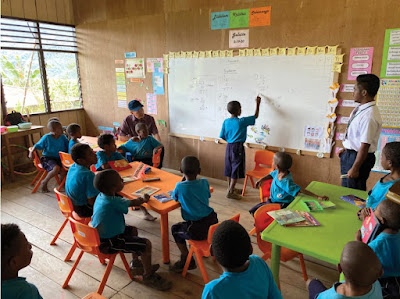
What do children at this Christian school in Papua
want to be when they grow up?
A Pastor, a missionary, a pilot . . . 
Photo by Jeremy Weber, for his article, 
Life and Death in ‘The Land of the Clouds’,
Christianity Today, November 2020.

Which brings us to the truth

The real goal of this totally disproportionate military offensive is not security! The real goal is not to neutralise an existential terrorist threat, for there isn’t one! To the contrary, the real goal of state terror is always political! The real goal is to eliminate resistance to Indonesian rule by massively increasing the cost. The real goal is to spiritually crush and intimidate into silence every indigenous, ethnic Melanesian, predominantly Christian Papuan who has ever so much as dreamt of Papuan freedom! 

USEFUL ENEMIES

In his book Useful Enemies: When Waging Wars is More Important than Winning Them, (Yale University Press, 2012), Professor David Keen explains how war and violence can have a political function. “This is war’s possible function in intimidating a broad swathe of the population – well beyond the rebels or named enemy.”  

Keen quotes Shelton David who wrote concerning Guatemala: “Most observers are in agreement that the purpose of the Guatemalan army’s counterinsurgency campaign was as much to teach the Indian population a psychological lesson as to wipe out a guerrilla movement that, at its height, had probably no more than 3,500 trained people in arms.” 

Keen also quotes a donor who told him, “There was never a huge guerrilla movement [in Guatemala] – it was more used by the army so they could do what they wanted.” 

What’s more, Keen adds, the counterinsurgency narrative “provided cover and legitimacy for violence against a broad range of political activists and human rights workers”.

Critically, Keen quotes the Guatemalan Commission for Historical Classification which assessed that, “at no time during the internal armed confrontation did the guerrilla groups have the military potential necessary to pose an immanent threat to the State. The number of insurgent combatants was too small to be able to compete in the military arena with the Guatemalan Army, which had more troops and superior weaponry, as well as better training and coordination . . .  The State deliberately magnified the military threat of the insurgency, a practice justified by the concept of the internal enemy. . . [an identification which] served to justify numerous and serious crimes . . . the vast majority of the victims of the acts committed by the State were not combatants in the guerrilla groups, but civilians.” 

While these excerpts (which are taken from pages 112-113), relate to the conflict in Guatemala (1969-1996), they could just as easily be written today in relation to the conflict in Papua (1969 – ongoing). For as was the case in Guatemala (and numerous other conflicts), the Indonesian State is intentionally exaggerating the threat so it can target “politically inconvenient opponents under the cover of a wider war”. 

And make no mistake, this is a war

On 11 May, the Guardian quoted Lanikwe, a women’s community leader, from Wamena, near Puncak, who said the situation for local people was dire. “Thousands are displaced in Puncak, five villages fled into the jungle. Health clinics and schools have been taken over by the military. Soldiers are everywhere. We are living in a war zone.”

VICTOR YEIMO ARRESTED IN JAYAPURA

On Sunday 9 May, Indonesian police in Papua’s provincial capital, Jayapura, arrested Victor Yeimo (38), one of the most prominent leaders inside Papua. 

The Indonesian government is accusing Yeimo of treason, which as UK-based Wenda explains, is ridiculous. “He is accused of ‘masterminding’ the 2019 West Papua Uprising, which was started by Indonesian racism and violence [RLM (27 Aug 2019)] and ended in a bloodbath caused by Indonesian troops” [RLPB 521 (24 Sept 2019)]. 

Human rights lawyer Veronica Koman said the case against Yeimo “feels forced and baseless, but if it goes to court, there is a high chance that judges will find him guilty – even with weak evidence.” 

It might be ridiculous and it might be a sham, but as People’s Consultative Assembly (MPR) Speaker, Bambang Soesatyo so shamelessly explained at the outset, the real goal is to ‘destroy them first’ and ‘discuss human rights matters later’. 

------------------------------------------------

Elizabeth Kendal is an international religious liberty analyst and advocate. She serves as Director of Advocacy at Canberra-based Christian Faith and Freedom (CFF) and is an Adjunct Research Fellow at the Arthur Jeffery Centre for the Study of Islam at Melbourne School of Theology.

She has authored two books: Turn Back the Battle: Isaiah Speaks to Christians Today (Deror Books, Melbourne, Australia, Dec 2012) which offers a Biblical response to persecution and existential threat; and After Saturday Comes Sunday: Understanding the Christian Crisis in the Middle East (Wipf and Stock, Eugene, OR, USA, June 2016).

See www.ElizabethKendal.com 

Tuesday, October 8, 2019

Indonesia: Mobilizing Civilian Militias for National Defense


-- implications for security in the Papuan provinces

On the afternoon of Thursday 26 September, with only 73 of 283 members of parliament in the House, the Indonesian parliament passed a profoundly controversial Bill.

Agus Hermanto, the Deputy Speaker of the House of Representatives, chaired the session.

When he asked, “Can the second level discussion of decision making on the Draft Bill on Management of National Resources (PSDN) for National Defense be approved as a law?” all members present said, “Agree.”

With that, and a clap of the hammer, the Bill on Management of National Resources (PSDN) for National Defense officially became law.

The PSDN Bill 2019 on National Defense contains several controversial articles. However, the one that will trigger alarm bells for Christians is Chapter 4, Article 27 which makes it legal for the Indonesian military (TNI) to mobilise civilian forces for national defense.

[NOTE: I apologise from the outset that all the news reports referenced in this post are Indonesian language news reports. It seems this news is not being reported in English! My English translations come courtesy of Google Translate, albeit with some tweaking.]

The full text of the law on
Management of National Resources (PSDN) for National Defense
can be found here: PSDN Bill 2019 – full text, in Indonesian, pdf.

Article 1 provides some essential definitions.
Excerpts

In this Act we mean:

1. National Defense is all efforts to maintain state sovereignty, territory of the Unitary State of the Republic of Indonesia, and the safety of the nation from threats and interference towards the integrity of the nation and state.

2. National Resources are human resources, natural resources, and artificial resources.

6. The Main Component is the Indonesian National Army [TNI] that is already used to carry out defense duties.

7. The Reserve Component is a National Resource that has been prepared to be mobilized through mobilization to enlarge and strengthen the strength and capabilities of the Main Components.

8. Supporting Components are National Resources that can be used to increase the strength and ability of the Main Component and Reserve Component.

10. Mobilization is an act of mobilization and uses, simultaneously, National Resources and Facilities and Infrastructure that have been prepared and fostered as components to strengthen the National Defense. [Resources are] to be used appropriately, integrated, and directed for overcoming every threat – both threats from abroad as well as threats to national unity and the survival of the Unified State of Republic of Indonesia [NKRI].

Chapter 4, Article 27 [BAB IV, Pasal 27]

(1) The Proposed Components include:
a. Citizens;
b. Natural Resources;
c. Artificial Resources; and
d. National Utilities and Infrastructure.

(2) The Proposed Components as referred to in paragraph (1) may be utilized in the service of National Defense.

(3) The Proposed Components as referred to in paragraph (1) may be utilized to assist with internal, State Defense efforts.

CONTROVERSY

For most Indonesians, the most controversial element of this article was the prospect that citizens would be conscripted into a Reserve Component. Controversy raged about whether the government was introducing compulsory military service or whether this law would result in the militarization of civil society.

In response, the Chairman of the Working Committee on the PSDN Bill for National Defense, Satya Widya Yudha, assured the public that, “Conscription for civil society is voluntary. This is clear, there is no coercion in the PSDN Act.

Chairman of the House of Representatives Commission, Abdul Kharis Almasyhari, also confirmed that citizen participation in Support Components and Reserve Components would be voluntary, adding that the law was made to strengthen Indonesia’s national defense, not to force citizens into military service. According to Abdul Kharis, precisely because the TNI and Polri (police) cannot be everywhere at once, they should not be expected to carry the whole burden of security. Now, with this regulation, community mobilization – if it is needed – will be legal.

ALARM

While these assurances might comfort most Indonesian citizens, Christians with memories of the violence in East Timor and the jihad in the Maluku Islands -- especially those in the Papuan provinces -- will be deeply alarmed.

Islamic jihadi and merah putih (red and white, ultra nationalist) militias have long served as proxies for the TNI which is known to arm militias and then turn a blind eye to their violence. By using the militias as proxies, the TNI has been able to maintain plausible deniability of gross human rights abuses. And deniability is essential if the TNI is to continue receiving weapons and training from the West.

Now however, with the passing of the PSDN Bill, the TNI will be able to mobilize civilian militias which will now be known now as Reserve Components. These militias/Reserve Components will now fight alongside and cooperate with the TNI for the purpose of “national defense” as defined by the Bill. Of course, they will be fighting not predominantly Christian (infidel) indigenous Papuans (“monkeys”) but “separatists”! And what could be more Islamic than defending the unity of Indonesia? For as far as Islam is concerned, Indonesia – including the Papuan provinces – is all part of the dar al-Islam (House of Islam).

PAPUAN PROVINCES: LOOMING NATIONALIST JIHAD

Since the 23 September riots in Wamena – in which at least 27 Muslim settlers died at the hands of invading marauding highlanders – several Java-based jihadist groups have begun calling for jihad. [For background see: Religious Liberty Prayer Bulletin (RLPB) 523 (9 Oct 2019).]

Islam Jihad Front (FJI) and Islamic Defenders Front (FPI) have both begun raising funds and enlisting recruits for jihad in the Papuan provinces.

A banner at an FJI recruitment post reads: “Islamic Jihad Front opens registration for Islamic paramilitary groups throughout Indonesia to send Islamic holy war fighters/militias [jihad qital] to Wamena, Papua, to defend Muslim brothers in Papua who were slaughtered by the waring infidels [kafir harby] and to maintain the integrity of the NKRI [Unitary State of the Republic of Indonesia] from the OPM [Organisasi Papua Merdeka / Free Papua Movement] separatist hordes.”

According to Indonesian human rights researcher Andreas Harsono (7 Oct), several “aggressive”, Islamist groups already have a foothold in the Papuan provinces. “We have one in Sorong; we are also seeing Laskar Jihad, a militant Muslim group, setting up a base in Keerom; also in Wamena . . .”

Further to this, previously, on 5 September, Defense Minister Ryamizard Ryacudu informed members of the House of Representatives, “There is a group affiliated with the Islamic State [operating] in Papua that has called for a jihad there.” National Police spokesman Brig. Gen. Dedi Prasetyo confirmed Ryamizard’s statement and identified the IS-affiliated group as Jamaah Ansharut Daulah (JAD) – the group believed to be responsible for a string of terror attacks in and around Surabya, including suicide-bombings at three churches on Sunday 13 May 2018.

The PSDN Bill 2019 for National Defense changes the dynamic of the Papuan conflict dramatically. It seems the TNI, which is heavily invested in the Papuan provinces, will have no shortage of volunteers willing to serve in a Reserve Component.

As one observer ominously warns, “The possibility that all this could turn into a widespread, government supported ethnic cleansing in the guise of a religious war is now very real.”

------------------------------------------------------------

Elizabeth Kendal is an international religious liberty analyst and advocate. She serves as Director of Advocacy at Canberra-based Christian Faith and Freedom (CFF) and is an Adjunct Research Fellow at the Arthur Jeffery Centre for the Study of Islam at Melbourne School of Theology.

She has authored two books: Turn Back the Battle: Isaiah Speaks to Christians Today (Deror Books, Melbourne, Australia, Dec 2012) which offers a Biblical response to persecution and existential threat; and After Saturday Comes Sunday: Understanding the Christian Crisis in the Middle East (Wipf and Stock, Eugene, OR, USA, June 2016).

See www.ElizabethKendal.com

Tuesday, August 27, 2019

Papuans have had enough of racial-religious hatred and persecution.


By Elizabeth Kendal


Every 15 August, Papuans (mostly Christian Melanesians) hold demonstrations to protest the unjust New York Agreement, signed on 15 August 1962, which paved the way for West Papua and Papua (formerly known as Irian Jaya) to come under Indonesian rule.

Every 17 August, Indonesians (in particular, the mostly Javanese Muslims) celebrate Indonesia's 17 August 1945 Proclamation of Independence.

Unsurprisingly, every year there are clashes and arrests. Indeed, this year more than 100 Papuans were arrested, including “a 9-year old kid whose only crime was marching with his fellow West Papuans”.

What’s more, this year footage went viral which showed Indonesian soldiers using excessive force as police and radicals aligned with various nationalist and Islamist militia groups yelled racist abuse and threats at Papuan students in Surabaya, East Java.

Fed up and infuriated, Papuans rallied in 30 cities across Indonesia, including in Jakarta, in protest of years of unrelenting racial-religious hatred and persecution.

To appreciate the seriousness of incident in Surabaya, a report in the Jakarta Post is worth quoting at length.

Papuan students on Java face increased pressures from Islamist, nationalist groups
By Ivany Atina Arbi, Wahyoe Boediwardhana, and Benny Mawel
The Jakarta Post Jakarta, Surabaya, and Jayapura, Monday, August 19, 2019

Excerpt:

"Papuan students on Java Island have repeatedly become the target of intimidation by Islamist and nationalist groups.

"In the latest incident on Friday afternoon [16 Aug], scores of security forces along with civil militias from hard-line group Islam Defenders Front (FPI) and youth organization Pemuda Pancasila (PP) reportedly went to a Papuan student dormitory on Jl. Kalasan in Surabaya, East Java, and launched physical and verbal attacks against the students, following the finding of an Indonesian flag discarded near the dorm.

"According to the Surabaya Legal Aid Institute, which cited the account of a student staying in the dormitory, Indonesian Military (TNI) soldiers allegedly banged on the door of the dorm while uttering curse words such as 'monkey', 'dogs' and 'pigs' aimed at the students inside the dormitory.

"Dozens of FPI and PP members reportedly came not long after.

"Human rights lawyer Veronica Koman, who is also a representative of the National Committee for West Papua (KNPB), said Sunday that the angry mob purportedly damaged the dorm’s gate and threw stones at the building while chanting 'Kick out Papuans!' and 'Slaughter Papuans!' for hours, restricting the students’ movement.

"Two good Samaritan Indonesian students, who at midnight delivered food to the students trapped inside the dorm, claimed to have been assaulted and later arrested by police who were guarding the area.

"'This is beyond my comprehension, what could possibly be the crime of delivering food and water? Even prisoners have a right to eat,' Veronica said, adding that the pressure continued on the following day with the police shooting teargas into the dorm and arresting all 43 students inside the building.

"'[All the teargas and violence] is totally unnecessary. They are only unarmed, hungry, thirsty and tired students who have been rounded up by hundreds of racist civil militias and security forces for more than 24 hours,' she said."

Australia’s ABC reported that the police stormed the ‘dormitory full of Papuan students, firing around 20 tear gas canisters into the building, causing injuries, arrested 43 (later released) around nine hours after without charge, over claims that the Indonesian flag was found in the gutter by the building.’ They claim to have been concerned that the crowd/mob was ‘close to attacking’, and thus only acted to stabilise the situation.

Protests erupt in West Papua and Papua

On Monday 19 August, thousands of Papuans protested in West Papua’s Manokwari (where local parliament was torched,) and Sorong (where 250 inmates escaped after the jail was torched), as well as in Papua’s capital Jayapura.

Clashes have been reported in Fakfak, a Papuan regency known to harbour Indonesian nationalist and Islamist militias.

Several protesters were injured and dozens detained as Indonesian authorities cracked down on the Papuan “separatists”.

Victor Yeimo, a spokesperson for the West Papua National Committee (KNPB), told Al Jazeera that a member of his organisation has confirmed reports of injuries sustained by several West Papuans, some of whom were taken to a local hospital.

John Djonga, a prominent Catholic priest in Papua province, told Al Jazeera that he had sent an emissary to Fakfak, who confirmed that some injured protesters were being treated in a hospital there.

The police, however, deny that dozens were wounded in the crackdown, asserting that reports of injuries are nothing but “hoax news”.

Troops deployed; Internet shut down

The Indonesian government has deployed an additional 1,200 troops to Papua Province, a region long-closed to outsiders.

According to a report by Pacific Media Watch, Indonesia’s police chief, Tito Karnavian, has focused blame for the destruction in Manokwari on the people who posted about the Surabaya incident on social media, describing their posts as “hoax news”. Further to that, in a statement, the Ministry of Communication and Information said it had acted to “throttle” access to the internet in several areas because of the potential for disinformation to create social disorder. “We can say that the purpose of throttling is to prevent the wide spread of hoax (fake news) that trigger action,” the ministry said.

On Thursday 22 August, Indonesia’s Ministry of Telecommunication “temporarily” shut down the internet across Papua Province allegedly “to accelerate government efforts to restore order”. Of course, this not only prevents the flow of news into Papua, it also makes it very difficult to get news out.

CBC News 23 Aug 2019
 'Indonesia deploys thousands of troops to Papua region to quell protests'
(includes interview with exiled Papuan leader, Benny Wenda)

Protests continue; calls for referendum

On Monday 26 August, some 5000 Papuans took to the streets of Deiyai, a highlands town about 500 km south-west of Jayapura, carrying four banned Morning Star flags.

Papuans are calling for a new, fair and just referendum on Papuan Independence.

As Indonesian expert on Papua issues, Darmawan Triwibowo, told the Jakarta Post, “Papuans are often depicted [by the government and mass media] as anti-nationalists who want to separate themselves from the country. The media, however, fail to present the reason behind such aspiration. There’s a human rights issue behind the desire, which is a political problem that should also be addressed using a political approach instead of a security or economic approach.”

According to the Jakarta Post, “[Triwibowo’s] voice was echoed by Papua Peace Network coordinator Adriana Elisabeth, who said various human rights violations that occurred in Papua had not been resolved to this day, despite President Joko ‘Jokowi’ Widodo’s 2014 campaign promise to do so.”

As Human Rights Watch declared, “The Indonesian government has a responsibility to ensure security in West Papua and Papua and to respect the human rights of everyone, including protesters. President Joko ‘Jokowi’ Widodo, who plans to visit Papua, should condemn racist remarks and actions, promote tolerance, and direct the police to impartially investigate abusive militias and officers.”

President Widodo's shame 

To date, all President Widodo has done is call on Papuans to stay calm and forgive their fellow citizens. 

“I know that there are hurt feelings,” Widodo told a media conference, “but as fellow citizens the best thing is to forgive each other. It is okay to be emotional but forgiving is better. Being patient is also better. And be confident that the government will continue to safeguard your dignity and prosperity.”

But, as Evi Mariani observed in the Jakarta Post (19 Aug), “Papuans have long endured racial discrimination from the majority Javanese.” 

She notes that in July last year, Amnesty International Indonesia released a report which described Papua as “one of Indonesia’s black holes for human rights . . . a region where security forces have for years been allowed to kill women, men and children, with no prospects of being held to account."

Mariani continues, “Under the pretext of nationalism, [many Indonesians] may think Papuans have no right to be outraged. After all, some would say: ‘We give them roads, development and a lot of special autonomy funds. . .’

“However, we fail to give the Papuans respect they deserve and recognition that they are equal to us. As citizens of Indonesia, they have equal opportunity to protest when they think they are being treated unfairly. Of course, such failure only amounts to racism.

“Non-Papuans, the majority, would say Papuans, the minority, have no right to call for justice or determine their future after the relentless acts of violence, injustice and racism they have endured for decades. Unless they find peace, justice and prosperity, they will consider living in the Unitary State of the Republic of Indonesia merely a rhetorical statement.

“Papuans deserve peace and prosperity on their rich land and without eradicating our racism against them, there would never be peace in Papua.”

“Racism,” she concludes, will only fuel the Papuan “struggle for independence from ‘Indonesian occupation'.”

Indeed; Papuans have had enough of genocidal racial-religious hatred and persecution.

------------------------

On 30 August, East Timor will celebrate the 20th anniversary of the 1999 UN-managed referendum through which the mostly Catholic East Timorese people voted overwhelmingly to separate from Indonesia. As Jose Ramos Horta explains, ‘Between 150,000 and 200,000 people out of a population of 700,000 died during the 24-year Indonesian reign.’

Though marked by violence which saw more than 1500 East Timorese murdered at the hands of Indonesian nationalist and Islamist militias – violence ultimately subdued by troops from an International Force (INTERFET) organised and led by Australia – the 1999 referendum paved the way to independence. Today Jose Ramos Horta is incredibly proud of East Timor, and incredibly grateful for the referendum which has enabled the East Timorese to create ‘a new country, free of revenge and violence, a vibrant democracy with the freest media in the region’.

Do the Papuans deserve any less?

-------------------------------------------------------------

Elizabeth Kendal is an international religious liberty analyst and advocate. She serves as Director of Advocacy at Canberra-based Christian Faith and Freedom (CFF) and is an Adjunct Research Fellow at the Arthur Jeffery Centre for the Study of Islam at Melbourne School of Theology.

She has authored two books: Turn Back the Battle: Isaiah Speaks to Christians Today (Deror Books, Melbourne, Australia, Dec 2012) which offers a Biblical response to persecution and existential threat; and After Saturday Comes Sunday: Understanding the Christian Crisis in the Middle East (Wipf and Stock, Eugene, OR, USA, June 2016).

See www.ElizabethKendal.com 

Sunday, April 14, 2019

Papua: The Christian Crisis in Eastern Indonesia

(NOTE: The western half of the island of New Guinea, Papua was formerly known as Irian Jaya)
-- by Elizabeth Kendal

The U.N. High Commissioner for Human Rights, Michelle Bachelet was taken by surprise on Friday 25 January when exiled Papuan independence leader Benny Wenda walked into her office.

The delegation from Vanuatu, which was in Geneva for a scheduled Universal Periodic Review (UPR), had requested and been granted a private meeting with Ms Bachelet.  Ravina Shamdasani, deputy spokeswoman at the U.N. Human Rights Office, explains what took place:

“During this meeting, one member of the Vanuatu delegation, Mr. Benny Wenda, presented the high commissioner with a petition. This was not actually a meeting arranged with Mr. Wenda for that purpose,” she said, adding that Ms Bachelet “was not aware” in advance.

The petition, which Indonesia has banned, carries over 1.8 million Papuan signatures collected in secret and at great risk.

As Australian journalist and author John Martinkus explains, the petition “calls on the UN to review the controversial 1969 vote that transferred control of West Papua to Indonesia. The Act of Free Choice vote, often referred to as the Act of No Choice by its detractors, saw 1026 people – selected by the Indonesian military – vote on behalf of their fellow West Papuans to give up sovereignty for Indonesian citizenship.

“The petition also asks for West Papua to be placed back on the UN decolonisation list. This would mean the possibility of a referendum on Papuan sovereignty, which Papuans have been hoping for since a similar referendum in East Timor, now Timor-Leste, resulted in its independence from Indonesia in 1999.”

In September 2017, Benny Wenda took the petition to New York, where the UN General Assembly was in session, with the hope of getting it into the hands of the United Nations Special Committee on Decolonisation.

Unfortunately, the committee’s chair, Rafael Ramirez (Venezuela), claimed not to have received the petition, before adding that it could not be accepted anyway, as Papua “is not on the agenda” and “Indonesia is a very good friend of ours”.

See: Papua (eastern Indonesia): a desperate and risky plea
Religious Liberty Prayer Bulletin (RLPB) 426, 4 Oct 2017.

Needless to say, Mr Wenda’s 25 January coup has infuriated Indonesia. Indonesia’s Ambassador to the UN, Hasan Kleib, strongly condemned Vanuatu for essentially sneaking Wenda in and helping him get access to Bachelet.

“(They) deliberately deceived the High Commission by taking manipulative steps through the infiltration of Benny Wenda into the Vanuatu delegation,” Kleib fumed.

Mr Wenda with petition (25 January 2019, Geneva) Image: twitter

Unfortunately, in this battle for human rights, the Papuans have very few international friends. Australia, America and the United Kingdom – economically influential democracies that should be advocating for human rights in Papua – are more interested in keeping Indonesia out of China’s sphere of influence. And so the human rights of the mostly-Christian indigenous Papuans are sacrificed on the altar of good relations with Indonesia, for geo-strategic and economic gain.

The Trans-Papua Highway

One of Indonesia most controversial development projects is the Trans-Papua Highway, or Trans-Papuan Economic Corridor. The enormously expensive Trans-Papua Hwy will traverse Papua’s long-untraversable highlands, linking industries, mines and oil and gas hubs, while ploughing through pristine tropical rainforest, the world heritage listed Lorentz National Park and vast tracts of customary lands belonging to indigenous Papuans.

short film: Global Roadmap
For more information see:
Ill-advised' Papua highway imperils indigenous rights, rainforests
Rina Chandran, Thomson Reuters Foundation, 4 Feb 2019
also: Yale Environment 360

Writing in The Saturday Paper (9 Feb 2019), Australian journalist and author John Martinkus gives voice to Papuan fears.  “The 4000-kilometre road, will stretch from West Papua’s largest city, Sorong, through the Papuan mountains and forest to the town of Merauke in Indonesia’s east. Indonesian president Joko Widodo claims the road, the Trans-Papua Highway, will bring commerce and development to these remote regions. However, the highlanders see the road as a threat, which will bring Indonesian migrants and the military to the region. Many fear greater access to the highlands will destroy their way of life, as they believe it did for lowlanders living on the coast. As construction of the highway has progressed, it has catalysed many West Papuans to take up arms in opposition.”

And as Martinkus notes, “This escalation of the independence movement, one of the world’s longest-running insurgencies, brings with it the potential of an even deadlier conflict, for both sides.”

Martinkus explains that when he was in Papua in 2002, independence fighters were armed mostly with sticks, spears, bows and arrows, and maybe the odd hunting rifle. “Today,” he warns, “many West Papuan fighters are armed with Indonesian-produced weapons, bought or stolen from Indonesian soldiers.”

The fighters, he explains, are “the children of those killed, imprisoned and forced to flee during deadly confrontations with the Indonesian military in Papua’s remote central highlands. Growing up, these young Papuans also watched on as Grasberg – the world’s largest goldmine – has wreaked havoc on the environment of West Papua while generating billions for its co-owners, Freeport-McMoRan and the Indonesian government. Now adults, they have deeply held frustrations about perceived exploitation of their lands by the Indonesian government.”

Bloodshed in Nduga

On 2 December 2018, rebels affiliated with the West Papua Liberation Organization (WPLO) – a militant wing of the Free Papua Movement – abducted 25 construction workers working on the Trans-Papua Hwy in Nduga province, in the central highlands, north of the Freeport Grasberg mine. The next day the rebels took their captives to a nearby hilltop and shot them, killing 19 and injuring 4, who pretended to be dead to escape.

The WPLO claim that the laborers were actually armed Indonesian soldiers (TNI) who had attacked them. Reportedly, on 1 December, Papuans had spotted one of the laborers taking photographs of the Papuans as they raised the banned Morning Star flag in commemoration of the 1 December 1971 declaration of Papuan independence.

As would be expected, a heavy influx of TNI forces descended on Nduga province; retaliation has been swift and hard. While the military claims to be hunting the rebels responsible for the killings, the crackdown has forced some 32,000 mostly-Christian indigenous Melanesian Papuans to flee their homes. Many are struggling to survive in the jungle; at least nine women have given birth. In the Mbua district, two school children were shot dead by Indonesian security forces (TNI). Across Nduga region, the TNI has damaged or destroyed at least 34 schools and churches; it has also seized the SION GKI Mapenduma church for use as a military base. Those who have fled say they are too afraid to return to their homes.  Women and children are dying in the forest and camps for want of food and medical treatment.

Reports and photos have emerged of victims with deep burns. Canisters have been found which lend support to local claims that the TNI has been dropping explosive devices containing white phosphorous from helicopters.

As Chairman of the United Liberation Movement for West Papua (ULMWP), Benny Wenda has condemned the use of chemical weapons by the Indonesian military on Papuan civilians. He said the ULMWP has received numerous reports regarding the use of chemical burn-causing weapons on villages in the Nduga region. “We have photos of burned limbs, dead bodies and empty munitions canisters.”

Naturally the TNI denies this. In fact the TNI is denying there has been any destruction at all, claiming it is all a ‘hoax’.

Father John Djonga has called for the Indonesian government to allow access to media, humanitarian organisations and a UN human rights mission.

Benny Wenda urged all Papuans to boycott the general elections on 17 April. “We respect Indonesia’s right to hold elections in its own territory,” he said, “but we will oppose the elections of the coloniser when they are forced upon us. We have tried participating in the elections of the colonial master before – but we are still killed, tortured and discriminated against every day.”

Recommended: War in West Papua
By John Martinkus, The Saturday Paper, 9 February 2019

Papua’s Christian Crisis 

As Indonesia drifts from Pancasila to Islamisation, the human rights situation in Papua takes on a whole new urgency. These are watershed days. The future of a Christian people is in the balance.

--------------
Post-script

While searching for more details on the situation in Papua, I came across the following feature article in the Jakarta Globe. It might represent a still small Indonesian voice, but it is encouraging.  It also offers some insight into Papua for those who are unfamiliar with this closed land.

Giving Hope to the Children of Papua
By Primus Dorimulu, Jakarta Globe, 6 March 2019

And for a wonderful article on this ministry by Christianity Today's Jeremy Weber, see:

In the mountains of Papua, missionaries and Indonesian professionals serve the lost together.
JEREMY WEBER
Christianity Today, 23 NOVEMBER 2020

YPHP founder James Riady joins Mek students in Nalca for a math class.
image: Jeremy Weber

-------------

Elizabeth Kendal is an international religious liberty analyst and advocate. She serves as Director of Advocacy at Canberra-based Christian Faith and Freedom (CFF), and is an Adjunct Research Fellow at the Arthur Jeffery Centre for the Study of Islam at Melbourne School of Theology.

She has authored two books: Turn Back the Battle: Isaiah Speaks to Christians Today (Deror Books, Melbourne, Australia, Dec 2012) which offers a Biblical response to persecution and existential threat; and After Saturday Comes Sunday: Understanding the Christian Crisis in the Middle East (Wipf and Stock, Eugene, OR, USA, June 2016).

See www.ElizabethKendal.com 

Thursday, April 11, 2019

Indonesia: from Pancasila to Islamisation

Vale traditional Indonesian values
-- by Elizabeth Kendal

Indonesians will go to the polls on Wednesday 17 April to elect a president and vice-president, a weak 136-seat Senate, a powerful 575-seat House of Representatives, provincial legislatures and local councils.

Recommended:
Six Things You Should Know About the Indonesian Elections
By Tim Mann, University of Melbourne

Excerpt:
“According to the KPU [Indonesian Electoral Commission], about 40 per cent of eligible voters are millennials aged 17 to 35 years old. And many of them will be voting for the first time. So the new millennial vote is considered the key to victory. . .

“Young voters are far from a homogenous group and many of those who are well connected online also hold deeply conservative views.

“One survey of school and university students by Jakarta’s State Islamic University in late 2017 found that 33 percent of young Muslims believed that acts of intolerance against minorities were ‘not a problem’ and 34 percent even believed that non-believers should be killed.”

Presidential Poll: Close and Profoundly Polarising

Background:
Indonesia: “sword” of weaponised Islam revealed 
Religious Liberty Prayer Bulletin (RLPB) 469, 22 Aug 2018.

Polling indicates that the incumbent President Joko Widodo (57, also known as Jokowi) will be returned as president with the conservative Islamic cleric Ma’ruf Amin (76) as his Vice-President. However, the gap between Jokowi and his perpetual rival, the controversial former Suharto-era military commander Prabowo Subianto (68), has narrowed. Subianto and his running mate, the telegenic billionaire businessman Sandiaga Uno (49), have pitched their message not only to the poor who feel left behind by Jokowi’s pro-development and pro-foreign investment policies, but to the more hard-line and intolerant, Jokowi-hating fundamentalist Islamists. Pundits expect the race to be not only close, but profoundly polarising. 

John McBeth reports for Asia Times Online (9 April), “The demarcation line between voters is clear: those who support Widodo, an avowed pluralist, don’t see Islam as the basis of the state. But those who favor deeper Islamisation are behind Prabowo.”

Jakarta-based Amanda Hodge is the South East Asia correspondent for The Australian. She comments (9 April) that the differences between the two presidential candidates were on display in the two political rallies that took place on Sunday 7 April. 

“While challenger and former Suharto-era military commander Prabowo Subianto’s 150,000-strong morning rally at a Jakarta stadium was an angry sermon against corruption and foreign plunderers to a sea of Islamic white, Jokowi’s afternoon carnival celebrated a vast diversity of ethnicities, races and religions.

“So stark has Indonesia’s polarisation along identity lines become this election, former president Susilo Bambang Yudhoyono [SBY] – whose Democrats Party backs Prabowo’s bid – ¬issued a weekend warning of the importance of governing for all. ‘As a former president, I would hate Indonesia to be divided into those who are pro-Pancasila and pro-caliphate,’ he wrote in a letter to party leaders, referring to Indonesia’s founding philosophy of unity in diversity. ‘If such polarisation continues in this campaign, I worry that this nation will indeed be divided into two opposing sides who will forever be in conflict with each other.’

Hodge confirms (8 April),  “Prabowo and his 49-year-old billionaire equities-dealer running mate, Sandiaga Uno, are polling higher among urban youth – a significant voter pool in a country where almost 40 per cent of the 192 million voters are under 35.

“Prabowo has also cornered the conservative Islamic vote, which will no doubt welcome exiled cleric Rizieq Shihab’s endorsement by video-link yesterday from Mecca. The Islamic Defenders Front [FPI] leader, who fled the country in 2017 after he was charged with pornography offences and insulting the state ideology, urged voters to stage a ‘constitutional jihad’ at the ballot box and change their president.”

The Prabowo Subianto-Sandiaga Uno ticket has also won support from the now-banned Indonesian Hizbut Tahrir (HTI) which supports the establishment of a caliphate and the adoption of Islamic Sharia law.

In truth, these hardline Islamists have no love for Subianto or Uno, both of whom are nominal Muslims at best. But while their affection for Subianto and Uno is luke-warm and pragmatic, but their hatred for Joko Widodo red-hot and supreme.

Meanwhile, the pro-development Jokowi-Ma’ruf ticket has secured the backing of Indonesia’s largest Islamic organisation, the Nahdlatul Ulama (NU). This is unsurprising considering Ma’ruf Amin was NU Supreme Leader until he stepped down in September 2018 in order to enter politics. Instead he will serve as a member of NU’s advisory board.

As noted by Tim Mann (University of Melbourne), “voter dissatisfaction has led to a growing movement of people declaring that they would rather sit the election out or ‘donkey vote’ (golput) than vote for either of the candidates on offer”.

Indeed, according to a recent survey by Indikator Politik, at least 20 percent of Indonesia’s roughly 192 million registered voters will abstain from voting in the presidential poll due to the deep dissatisfaction they feel with regards to the candidates.

These are voters who would never vote for Subianto, primarily on account of his penchant for authoritarianism and alleged human rights abuses as a Kopassus general. But they also feel let down by Jokowi, and not only because he has failed to deliver on many of his promises. Many who would have voted for Jokowi will now be non-voters or golongan putih (golput) precisely because Jokowi’s vice-presidential running mate is Ma’ruf Amin, the cleric who, as NU Supreme Leader, testified against the ethnic Chinese Christian Governor of Jakarta, Basuki Tjahaja Purnama (Ahok) in the controversial blasphemy trial two years ago [See: Ahok’s Blasphemy, Religious Liberty Monitoring (29 Nov 2016)]. 

Recommended:
Jokowi’s ideological shift has not gone unnoticed
By Endy Bayuni, The Jakarta Post, 10 April 2019

Excerpts:
“Bidding for his reelection in the April 17 presidential race, the incumbent Joko “Jokowi” Widodo has focused his attention more on winning the hearts and minds of conservative voters, reflected among other means by his choice of running mate and giving concessions to the military. . .

“Jokowi’s apparent ideological shift may be more for expediency to ensure victory, but voters from his traditional support base to the left of the political spectrum fear it could have major policy implications for his next administration.

“Many have declared through social media memes that they will not vote, making clear they did not endorse the shift, but that they would not give their vote to the challenger who is even further to the right, embracing hard-line Islamic groups.

“How far to the right of the political spectrum is Jokowi shifting? Will he be able to resist pressures from Muslim conservatives and the military who want to have more say in his next government?

“Almost assured of election victory, Jokowi’s political fate is now very much in the hands of those on the left of the political spectrum. If there are enough of them too angry to vote because of his shift to the right, they could well deliver victory to Prabowo.”
 
Presidential Poll: “The Islamists Have Already Won”

Recommended:
Indonesia’s Next Election Is in April. The Islamists Have Already Won.
How religion has come to dominate our politics.
An opinion piece for New York Times, by Eka Kurniawan, 14 Feb 2019

Renown Indonesian novelist Eka Kurniawan believes that by nominating Ma’ruf as his Vice President, Jokowi “has built a Trojan horse for his opponents outside the walls of his own city”.

In comparing the 2019 election to that of 2014, Mr Kurniawan notes, “This year, it seems, the decisive issue will be the candidates’ professed commitment to Islam.”

According to Mr Kurniawan, “polarisation has deepened since Jakarta’s gubernatorial election two years ago.

“Mr. Prabowo and the rest of the opposition evidently learned a lot from Mr. Basuki’s [Ahok’s] downfall. In 2014, they ran an antiquated campaign based on the supposed resurgence of communism and the Indonesian Communist Party, and failed. The [2017] Jakarta election has taught them that tapping Muslim values is an effective way to galvanize popular support.

“With the Islamization of Indonesian society now evidently being mobilized toward political ends, Mr. Joko must proceed with caution. Yet he may have gone too far.

“To give a good impression to Muslim voters, Mr. Joko has been presenting himself as a pious leader who worships diligently. He has even become a prayer imam and makes frequent visits to Islamic boarding schools. He has also closed his eyes and ears to certain cases brought on religious grounds, knowing that any statement could inflame grass-roots Muslims. . .”

Concerning Ma’ruf Amin, Mr Kurniawan says, “He isn’t just conservative; he is intolerant. He forbids the exchange of Christmas greetings. He rejects the Ahmadiyya, an alternative Islamic sect. He condemns L.G.B.T. activities. He wants to limit houses of worship for non-Muslims.

“Mr. Joko might remain in power, but we don’t have to wait until April to find out the real outcome of this race. No matter who ends up being president, conservative Islamic groups, backed by radical groups, will win — have already won — the election.”

Recommended:
What might Jokowi’s vice presidential pick mean for religious freedom?
By Dr Budhy Munawar Rachman,
for Indonesia at Melbourne [University], 14 August 2018

Excerpt/conclusion
“When Jokowi was elected [in 2014], many hoped for a reversal of the intolerance that had been allowed to develop under his predecessor [Susilo Bambang Yudhoyono]. There have been some limited improvements over the last four years, but the core concerns remain – religious minorities are still not able to fully enjoy the religious freedom they are guaranteed under the Constitution.

“Shi’a and Ahmadiyah Muslims still face discrimination. Accusations of blasphemy are still used against minorities who demonstrate religious understandings or practices that differ from the majority. Minorities still face extreme difficulty building houses of worship.

“If Jokowi is re-elected, the chances of this trend reversing are slim. Under Ma’ruf, MUI has been unwilling to accept arguments in support of minorities based on their constitutional right to religious freedom, instead relying on conservative religious interpretations that benefit the majority Muslim community. With Ma’ruf as vice president, things could well become a lot worse for minorities than they already are.”

-------------------------------------------------------------

Elizabeth Kendal is an international religious liberty analyst and advocate. She serves as Director of Advocacy at Canberra-based Christian Faith and Freedom (CFF) and is an Adjunct Research Fellow at the Arthur Jeffery Centre for the Study of Islam at Melbourne School of Theology.

She has authored two books: Turn Back the Battle: Isaiah Speaks to Christians Today (Deror Books, Melbourne, Australia, Dec 2012) which offers a Biblical response to persecution and existential threat; and After Saturday Comes Sunday: Understanding the Christian Crisis in the Middle East (Wipf and Stock, Eugene, OR, USA, June 2016).

See www.ElizabethKendal.com 

Tuesday, December 13, 2016

Indonesian Blasphemy Trial Begins


By Elizabeth Kendal

UPDATING  previous post: Ahok's Blasphemy, 29 November 2016; and Religious Liberty Prayer Bulletin (RLPB) 383, Indonesia: 'Blasphemy' fuels tensions, 9 November 2016.

The blasphemy trial against Jakarta’s ethnic Chinese Christian Governor Basuki “Ahok” Tjahaja Purnama commenced this morning [Tuesday 13 December].

Outside the heavily guarded court, hundreds of anti- and pro-Ahok supporters protested, kept apart by some 2,000 police. Anti-Ahok forces chanted, “Jail Ahok, jail Ahok, jail Ahok now”.

The panel of judges will hear from 30 witnesses and see 50 pieces of evidence. The trial, which is being televised live, is being rushed through the court and expected to conclude early in the New Year.

Fired Up

At a rally over the weekend, attended by Australian Broadcasting Corporation (ABC) Indonesia correspondent Adam Harvey, the cleric Habib Muhsin Alathas re-asserted the Qur’anic/Islamic principle that Christians should never have authority over Muslims. Referring to Ahok as “the son of Satan”, he railed against the governor using crude, racist and provocative terms.

“Some of you come to the headquarters of the pig’s pimple, shaking hands with him, and even kiss his hand,” he said. “You have been kissing the hand of someone who is not circumcised — you’re better off kissing a goat’s arse. . . So, if this thin eyes [Indonesian sarcasm for the Chinese] does not go in jail, we will go out onto the street once more, right?”

Australia National University's (ANU) Indonesia expert, Associate Professor Greg Fealy told the ABC that while he does not believe Ahok has blasphemed, “there's probably no way out for him now except to go through this court process, which is very likely to find him guilty I suspect.”

Likewise, Professor Tim Lindsay Melbourne Law School expects Ahok will be convicted, for not only has a fatwa has been issued, but the massive rallies have terrified the authorities. Consequently, he expects the judges will run with public opinion without paying much attention to the evidence.

Writing on the Wall

Reporting from Jakarta, ABC Indonesia correspondent Adam Harvey noted that Ahok looked deeply anxious as he entered the court. Harvey opined, “He can see the writing on the wall.”

Ahok broke down in tears twice as he testified. Insisting that he would never intentionally insult the Qur’an or hurt Muslims, he spoke of his deep affection for his Muslim godparents, and recalled how he helped poor Indonesians to perform the Hajj pilgrimage when he was a district chief a decade ago.

Once the clear front-runner in the gubernatorial race, recent opinion polls indicate that Ahok has now slipped to second place behind Agus Yudhoyono, the son of former president Susilo Bambang Yudhoyono.

But the gubernatorial race is doubtless the last thing on Ahok’s mind now. If found guilty, which most analysts believe he will be, Ahok faces up to five years in prison.

The court has now adjourned until Tuesday 20 December.

--------------------

FOR full background see: Ahok's Blasphemy, by Elizabeth Kendal, RLM, 29 Nov 2016

UPDATE: On Tuesday 9 May 2017, the popular ethnic Chinese Christian former governor of Jakarta, Basuki ‘Ahok’ Tjahaja Purnama was found guilty of ‘blasphemy’ and sentenced to two years in prison.

Ahok was taken immediately to Cipinang detention centre in East Jakarta. However, in the early hours of Wednesday morning he was transferred to the National Police’s Mobile Brigade (Brimbob) detention center in Kelapa Dua, Depok, for security reasons. He decided not to appeal the decision 'for the good of the country'.

---------------------

Elizabeth Kendal is international religious liberty analyst and advocate. She serves as Director of Advocacy at Canberra-based Christian Faith and Freedom (CFF), and is an Adjunct Research Fellow at the Arthur Jeffery Centre for the Study of Islam at Melbourne School of Theology.

She has authored two books: Turn Back the Battle: Isaiah Speaks to Christians Today (Deror Books, Melbourne, Australia, Dec 2012) which offers a Biblical response to persecution and existential threat; and, After Saturday Comes Sunday: Understanding the Christian Crisis in the Middle East (Wipf and Stock, Eugene, OR, USA, June 2016).

See www.ElizabethKendal.com

Tuesday, November 29, 2016

Indonesia: Ahok's 'Blasphemy'

Indonesia: Ahok’s ‘Blasphemy’
By Elizabeth Kendal

Having concluded their investigations, Indonesian police have now named Jakarta’s ethnic Chinese Christian Governor Basuki “Ahok” Tjahaja Purnama a suspect in a blasphemy case. Speaking to a press conference on Wednesday 16 November, the head of the National Police’s Criminal Investigation Department (Bareskrim), Comr. Gen. Ari Dono, confirmed: “Although there are different opinions among police investigators, most agreed that the case should be settled in an open trial.”

Now that Ahok has been named, Islamic fundamentalists are demanding he be arrested and incarcerated, as is normally the case with blasphemy suspects in Indonesia. Islamic Defenders Front (FPI) spokesperson Munarman told the Jakarta Post: “Because Ahok still runs free, we have decided to stage another protest. Ahok should be jailed, it is the legal procedure. All suspects charged under Article 156 (a) of the Criminal Code in Indonesia’s history are always imprisoned.” The next protest is slated for Friday 2 December.

As tensions soar, debate swirls around whether the charge is political or religious. Ahok himself is certain he is not guilty of blasphemy. Not wanting to blame Islam, he maintains the charge is purely political and is confident that any testing of the charge will see him acquitted. Meanwhile, Indonesia's fundamentalist Islamic clerics are certain Ahok has indeed blasphemed, giving them exactly what they were looking for: a means of removing him from the gubernatorial race.

As for Ahok’s political opponents, they are merely riding the wave, exploiting Islamist outrage for their own benefit.

POLITICS

On 15 February 2017, Jakartans will go to the polls to elect a new governor. The contenders were announced on 24 September. It will be a three-way race pitting incumbent Governor Basuki “Ahok” Tjahaja Purnama and Deputy Governor Djarot Saiful Hidayat against the Anies Baswedan – Sandiaga Uno and Agus Harimurti Yudhoyono – Sylviana Murni tickets. Analysts are expecting a two-round contest.

Ahok, the early favourite and frontrunner, is backed by Megawati Soekarnoputri’s Indonesian Democratic Party of Struggle (PDI-P).
Anies Baswedan, the former culture and education minister, is backed by Lieutenant General Prabowo Subianto’s Gerindra Party and the Islamist Prosperous Justice Party (PKS).
Agus Harimurti Yudhoyono is backed by former president Susilo Bambang Yudhoyono’s (i.e. his father’s) Democratic Party, the National Mandate Party (PAN), the National Awakening Party (PKB) and the United Development Party (PPP).

This is a high stakes election. Susilo Bambang Yudhoyono has even commented that it “feels like a presidential election”.  In a piece entitled “Not Just Another Election” (Asian Studies Association of Australia, 6 Oct 2016) Dr. Dirk Tomsa comments: “The deep involvement of Jakarta’s most powerful party leaders in the nomination process certainly indicates that this election has implications for the national level, not least the 2019 presidential election. But apart from reorganising power and patronage in the capital, the Jakarta poll will also yield critical insights into other aspects of electoral politics in Indonesia, especially the nature of campaigning and voter mobilisation and, given Ahok’s background as a Christian ethnic Chinese, the salience of ethnic and religious sentiments among the Indonesian electorate.”

RELIGION

Indonesia’s fundamentalist Muslims have long opposed Basuki “Ahok” Tjahaja Purnama. Elected as deputy governor in 2012, running with Joko Widodo (“Jokowi”), Ahok ascended to the governorship in the wake of Jokowi’s 2014 election to the presidency. In a foretaste of things to come, Jakarta’s Islamic hardliners – led by the Islamic Defenders Front (FPI) – were quick to protest, vowing to resist the “kafir” (unclean), “infidel”, “devil” governor.

With early polls showing Ahok the clear frontrunner, Islamic fundamentalist clerics moved quickly to remind Muslims that it is a sin for Muslims to vote for non-Muslims, citing verses such as Sura 5:51 ‘. . . Do not take the Jews and the Christians as allies [awliya : allies / friends / guardians / leaders] . . .’   And as linguist and Islam expert, the Reverend Dr Mark Durie notes, “In Indonesian translations of the verse 5:51 is rendered ‘do not take Jews and Christians as your leaders (pemimpin-pemimpinmu)’.”

In a commentary piece entitled, “Violent Protests in Indonesia Blow an Ill Will for Religious Tolerance” (10 Nov), Durie refers to “Ibn Kathir, an authoritative medieval commentator on the Qur’an, [who] explained this verse as follows: Allah forbids his believing servants from having Jews and Christians as allies or patrons, because they are the enemies of Islam and its people, may Allah curse them.” According to Durie, Ibn Kathir makes it clear that the only valid law is Islamic Sharia Law; that only a Muslim can rule over Muslims; and that anyone who looks to an infidel for political or legal direction should be considered an infidel – an apostate.

As tensions escalated, an Australian Broadcasting Corporation (ABC) News film crew led by Indonesian correspondent Samantha Hawley visited the Al Furqon mosque in central Jakarta. Cleric Alwi Wahid’s message was clear: “Be careful on the judgement day,” he preached. “God will ask you, why did you choose the infidel as the leader, while I have warned you not to. Believers should not choose a non-Muslim as their leader,” he said before warning the congregation that there would be “bad consequences” for those who vote for a non-Muslim.

The believers, said Hawley, seemed convinced. “I refuse to vote for Ahok,” one man told the ABC. “I am a Muslim and Ahok is an infidel, that’s it.”

Mohammad Siddik from the Indonesian Supreme Council for Islamic Propagation told Hawely: “Muslims call the people not to vote for Ahok because we are also guided by our faith, by the Koran.” He also warned that a non-Muslim being elected to the governorship could lead to instability.

AHOK’S ‘BLASPHEMY’

Unsurprisingly, the feisty, straight-talking Ahok eventually responded. In a speech to city officials on 27 September, Ahok made light of the clerics’ objections, saying, “Ladies and gentlemen, you don’t have to vote for me because you’ve been lied to [or fooled] with Surat Almaidah 51 [Sura 5:51] and the like. That’s your right. If you feel you can’t vote for me because you fear you’ll go to hell, because you’ve been lied to [or fooled], no worries. That’s your personal right. These programs will go forward. So you don’t have to feel uncomfortable. Follow your conscience, you don’t have to vote for Ahok” (translation by Sidney Jones).

By 5 October, video footage of the speech had gone viral on youtube and Islamic fundamentalists were claiming that Ahok had blasphemed against the Qur’an and the clerics.

On 10 October, Ahok apologised “to all Muslims and anyone who felt offended”, saying it was not his intention to slight Islam or the Qur’an. But it was in vain. Having taken up the Sharia cudgel of anti-blasphemy, his opponents were not about to put it down.

On 1 November, the Lowy Institute published an important piece by Indonesia expert Sidney Jones. In her article entitled, “Why Indonesian extremists are gaining ground,” Jones slams Indonesia’s “spineless political leaders [who] have allowed extremists to seize the momentum and foment religious hatred against the governor”. She explains how the anti-Ahok campaign “brings together violent extremists, moralist thugs and powerful political interests. And because of the latter, no one dares challenge it.” She laments that conservative Muslim opposition to Ahok is no longer merely “noise in the political background” but a serious threat to Indonesian unity and security. She wonders why no-one – not the President nor Vice-President nor any pluralist politician – said “Let’s stop this in it tracks”, or did anything to try to cool tempers or even defend the constitution.

On 11 October, the day after Ahok apologised, the Indonesia Ulama Council (MUI) – Indonesia’s top Muslim clerical body – held a meeting in which they determined that Ahok had indeed committed blasphemy and should be prosecuted.

Jones elaborates:
“In a statement to the media, the MUI said:
Surah al-Maidah [Qur’an, chapter 5] explicitly forbids non-Muslims from becoming leaders.
Based on this surah, ulama are obliged to convey to all Muslims that it is obligatory to choose a Muslims leader.
Every Muslim must understand the truth of this surah as a guideline for choosing leaders.
To say that the prohibition against making non-Muslims leaders is a lie constitutes an insult to the Qur’an.
To say that ulama who use Surah al-Maidah as their evidence for forbidding non-Muslims from becoming leaders are liars constitutes blasphemy toward ulama and the Muslim community.”

Police are currently working to complete Ahok’s case dossier so the trial can commence.

PROSPECTS

Even before Ahok had been officially named as a suspect some 100 lawyers had come forward to defend him.  So as to maximise transparency, the trial will be open to the public and televised live. President Joko Widodo wants it over in two weeks.

Human Rights Watch campaigner Andreas Harsono, told The Australian’s, Amanda Hodge, that he fears the country’s blasphemy laws have proved such an effective political tool that they will be used more frequently. “I think by next February Ahok will be detained,” said Harsono. “I don’t think even the political ¬forces that support Ahok can turn this around. I hope I am wrong.”

Speaking to Kate Lamb of The Guardian, Harsono said: “I have studied more than 200 blasphemy cases in Indonesia since it was written by President Sukarno in 1965. Over this 50-year period I think there was only one case where the suspect was acquitted. I don’t think Ahok can survive this prosecution, he is very likely to end up in jail.”

According to Horsono, a newspaper editor was acquitted of blasphemy in 1968, while in 2012, Alexander Aan, a 30-year-old civil servant from Sumatra, was sentenced to two-and-a-half years in prison after he declared on his Facebook page he was an atheist.

As Hodge notes: “Indonesia had its chance to repeal its blasphemy laws — a legacy of the dying days of the Sukarno era. The late, liberal Muslim scholar and former president Abdurrahman Wahid led an unsuccessful 2009 petition of the Constitutional Court, arguing the laws violated the enshrined right to religious freedom. His daughter Yenny says he was motivated by the escalation of blasphemy charges under successor Susilo Bambang Yudhoyono [SBY].

“The Setara Institute says 15 blasphemy cases were tried from 1965 to 1998. In SBY’s 10 years in power, from 2004 to 2014, some 51 cases were tried, with a 100 per cent conviction rate.”

Pitan Daslani, a senior political analyst for the Jakarta Globe writes (8 Nov): “Objectively, Ahok can only be punished if proven guilty according to Article 156A of the Criminal Code, which stipulates the parameters on defamation of religion. . .

“Article 156A of the Criminal Code prescribes a maximum five-year jail term for anyone who ‘utters feelings or commits acts intentionally that [a] contains enmity, misappropriation, or defamation of a religion’ and ‘[b] has the intention to prevent others from adhering to any religion that is based on belief in one God.’

“These two factors must be fulfilled to justify his perceived offense.”

While the situation is indeed dire, some political analysts believe Ahok could still manage to turn the situation around. “Of course,” surmise analysts at Coconuts Jakarta, “even if Ahok plays his cards perfectly, there is still the chance that he could lose in court and be found guilty of blasphemy, landing him in jail and almost certainly putting an end to his political career.

“But let’s not forget that Ahok is among the savviest politicians in all of Indonesia. Before he came to Jakarta, he was incredibly popular as the regent of East Belitung, a province with a much higher percentage of Muslims than Jakarta. With a heavily publicized trial, he will have a platform to not only defend himself but also essentially campaign to the whole of Jakarta and Indonesia on a nearly daily basis.

“His loose lips might have gotten him into this mess, but Ahok’s sharp tongue may yet get him out of it and ultimately win him the race.”

WATERSHED

Whatever the outcome, this is a watershed moment for Indonesia. Indonesia will either appease Islamists and further Islamisation OR resist Islamists and reject Islamisation.

At the very end of the ABC’s 7:30 Report video report, Samantha Hawley asks Abu Jibril, the leader of fundamentalist activist group Majelis Mujahidin, what he thinks of the idea that a Christian could one day be president of Indonesia?

“If Ahok does not get the punishment he deserves,” responds Jibril, “not according to the demands of Muslims, then Muslims will get angrier. And when they get angrier, we don’t know what will happen.”

One thing we do know is that Indonesian Islamists are receiving strong support from transnational Islamists.  On 29 October, photographs appeared on social media of non-Indonesian and fully armed members of Jabhat Fatah al-Sham, (previously known as the al-Qaeda’s al-Nusra Front, Syria) holding signs that read “Sentence Ahok or We Will Sentence Him with Bullets”, and of jihadists standing in front of a large wooden box labelled “Ahok’s Coffin”.  And on 4 November, as Indonesian Islamists prepared to rally in the street of Jakarta, Islamic State used their messaging services to encourage their supporters to use the rally “to fan the flames of jihad” across the country.

On 27 November, the National Police hinted that some radical groups linked to Islamic State (ISIS) were planning to infiltrate the 2 December rally.

Whatever the outcome of Ahok’s 'blasphemy', Indonesia will not be the same.

------------------------------------------------------------

Elizabeth Kendal is international religious liberty analyst and advocate. She serves as Director of Advocacy at Canberra-based Christian Faith and Freedom (CFF), and is an Adjunct Research Fellow at the Arthur Jeffery Centre for the Study of Islam at Melbourne School of Theology.

She has authored two books: Turn Back the Battle: Isaiah Speaks to Christians Today (Deror Books, Melbourne, Australia, Dec 2012) which offers a Biblical response to persecution and existential threat; and, After Saturday Comes Sunday: Understanding the Christian Crisis in the Middle East (Wipf and Stock, Eugene, OR, USA, June 2016).
See www.ElizabethKendal.com