Showing posts with label Pakistan. Show all posts

Sunday, April 22, 2018

How Much of a Threat is Islamic State Khorasan Province?


By Elizabeth Kendal

Christians Targeted in Quetta

In Pakistan’s south-western city of Quetta, the capital of sparsely populated Balochistan Province, the already vulnerable Christian community is under attack.

On Sunday morning, 17 December, at least nine people were killed and more than 50 injured when two suicide bombers blew themselves up at Bethel Memorial Methodist Church, as some 200 local Christians were participating in a special “Sunday School Christmas Program”. . [See RLPB 437 (19 Dec 2017)].

On the evening of Easter Monday 2 April, four members of a Christian family were travelling along Quetta’s Shah Zaman road when militants on a motorbike intercepted their rickshaw and open fired. A young girl was wounded and rushed to hospital. Her father and three cousins were killed.

Then on Sunday 15 April, four men on two motorbikes opened fire on Christians in Quetta’s Isa Nagri (City of Jesus; a Christian neighbourhood). Some of the victims were emerging from a worship service; others were just sitting in front of their homes. Two Christians were killed and three were critically wounded.

On each occasion, Islamic State Khorasan Province (ISK-P) claimed responsibility.

For more details see: Religious Liberty Prayer Bulletin (RLPB) 451
Pakistan: Islamic State targets Christians in Quetta, 18 April 2018
by Elizabeth Kendal

Islamic State Khorasan Province (ISK-P)

Khorasan denotes a historical region covering all of Afghanistan along with parts of Iran, Central Asia, western China and Pakistan. ISK-P is Islamic State’s franchise in Khorasan Province / Wilayat-e-Khorasan.

After the death in 2013 of Taliban leader Mullah Omar, the Taliban found itself wracked with internal conflicts and divisions. Meanwhile, internal conflicts and divisions were also emerging in the jihadist movement in Meopotamia (Syria-Iraq) between al-Qaeda head Ayman al-Zawahiri and Abu Bakr al-Baghdadi who had established an al-Qaeda franchise in Syria under the leadership of Abu Muhammad al-Julani. The split in May 2013 left two jihadist factions fighting for dominance in northern Syria: Jabhat al-Nusra, which remained loyal to al-Qaeda’s al-Zawahiri and al-Julani, and the Islamic State of Iraq and Sham (Greater Syria / the Levant; ISIS/ISIL), whose members swore allegiance to al-Baghdadi.

In January 2014, ISIS expelled al-Nusra from the provincial capital of Raqqa (in northern Syria) and assumed full control of the city. In April 2014, al-Baghdadi escalated the ideological dispute by insisting that there would be no reconciliation with al-Zawahiri’s al-Qaeda. As far the vehemently anti-Shi’ite al-Baghdadi was concerned, al-Zawahiri’s willingness to cooperate with Shi’ite Iran was proof that al-Qaeda was on a divergent path. When al-Baghdadi threw down the gauntlet and demanded all Muslims recognise his authority, nine prominent al-Qaeda leaders from the region historically known as Greater Khorasan immediately declared their allegiance to al-Baghdadi.

In January 2015, a group of disgruntled Pakistani Taliban and Afghan Taliban commanders produced a propaganda video in which they formerly pledged allegiance to Islamic State. Within days of the video’s release, the Islamic State announced its expansion into Khorasan Province and officially appointed Hafiz Saeed Khan as the Wali (Governor) of Khorasan and former Guantanamo Bay detainee and senior Taliban leader Mullah Abdul Rauf Khadim as Khan’s deputy. The group would be based in Afghanistan.

For more information see:
Mapping the emergence of the Islamic State in Afghanistan
By LWJ Staff, 5 March, 2015

After Saturday Comes Sunday: Understanding the Christian Crisis in the Middle East, by Elizabeth Kendal (Wipf and Stock, Eugene OR, June 2016). Chapter 8 ‘The Evolution of a War,’ from subheading ‘Raqqa and the Al-Nusra-ISIS split’ through ‘The Khorasan Pledge’ (pp 154 through 164).

In Khorasan as in Mesopotamia, Islamic State has shown itself to be the enemy not only of Shi'ites, but of all minorities, Christians included.

In Khorasan as in Mesopotamia, the pro-Islamic State and pro-al-Qaeda Sunni Islamic jihadist factions clash over ideology, tactics, strategy and territory.

In Khorasan as in Mesopotamia, most locals denounce Islamic State's zealous brutality and total disregard for history and local culture. 

In Khorasan as in Mesopotamia, Islamic State exploits a prophetic hadith (alleged saying of Muhammad).

The Khorasan Hadith 

In Mesopotamia (Syria-Iraq) Islamic State rallied around a prophetic hadith concerning Dabiq (a town in north-western Syria) in which Muhammad is alleged to have said:

First issue of Islamic State's
magazine, DABIQ, July 2014.
“The Last Hour would not come until the Romans would land at al-A’maq or in Dabiq.” https://sunnah.com/muslim/54/44

The leader of al-Qaeda in Iraq (AQI), Abu Musab al-Zaraqawi (killed in June 2006) sighted this hadith when he predicted that the war in Iraqi was but the first stage of an apocalyptic battle that would culminate with Muslim victory in Dabiq: “The spark has been lit here in Iraq and its heat will continue to intensify…until it burns the Crusader armies in Dabiq.”

Islamic State embraced the prophetic hadith and al-Zaraqawi’s prediction effectively exploiting it to recruit Muslim men and women from all over the world and every walk of life.

A similar dynamic potentially exists in “Khorasan” on account of another prophetic hadith:

“Black standards [flags] will come from Khorasan, nothing shall turn them back until they are planted in Jerusalem.” (Source: Sunan At-Tirmidhi 2269)

The fact that this hadith is widely regarded as weak and probably inauthentic is irrelevant to the jihadists who have exploited it for decades.

early propaganda video
“The Emergence of Prophecy:
The Black Flags of Khorasan” 
As writer Asif Ullah Khan explains, “The first time this hadith was used in the sub-continent was in 1980 when the US and Saudi Arabia cobbled up the biggest global jihad coalition to wage a guerrilla war against the Soviet Union invasion of Afghanistan.

Brigadier Asad Munir, who commanded Pakistan’s intelligence service, the ISI, in the tribal areas until 2005, says the Khorasan hadith was one of the main reasons why Pakistan’s Federally Administered Tribal Areas (FATA) have become a rendezvous of sorts for Jihadists from all over the world.”

So, How Much of Threat is ISK-P?

On Friday 19 January, Russian Foreign Minister Sergei Lavrov warned the UN Security Council that jihadists fleeing Syria were turning northern Afghanistan into “a main base for international terrorism with the Afghan wing of the Islamic State in the lead”. Lavrov added that 2017 saw an “unprecedented growth in Afghan drug production”, the funds from which are known to fuel international terrorism. He recommended "prompt measures . . . to curb this threat".

On 20 February,  Lavrov expressed his frustration that the US and NATO simply refuse to confront the reality of ISK-P:

“We are alarmed as unfortunately, the US and NATO military in Afghanistan makes every effort to silence and deny [the IS group’s presence in Afghanistan],” Lavrov told reporters after talks with his Pakistani counterpart Khawaja Muhammad Asif.

“According to our data, the IS presence in northern and eastern Afghanistan is rather serious, there are already thousands of gunmen. This increases the risk of the terrorists’ penetration to Central Asia and it is not that difficult to get to Russia.”

Contrary to this, the position of the US – which is eager to depart from Afghanistan with a semblance of dignity – is that ISK-P is insignificant and does not present a serious threat. According to the US,  Russia is merely “peddling a narrative” and “exaggerating” for political gain. Consequently, Russian efforts to forge security cooperation across Central Asia are being mocked and derided in the West.

According to the US, Russia exaggerates and exploits fears of Islamic State simply so it might further project itself across Central Asia. Further to this, Navy Capt. Tom Gresback, public affairs director at Resolute Support headquarters, told Military Times, “[U.S. Forces-Afghanistan] has no evidence of any significant migration of IS-K foreign fighters. We see local fighters who switch allegiances to join ISIS for various reasons, but the Russian narrative grossly exaggerates the numbers of ISIS fighters that are in the country.”

Gen. John Nicholson, the head of U.S. Forces-Afghanistan, agrees. “This [Russian] narrative then is used as a justification for the Russians to legitimize the actions of the Taliban and provide some degree of support to the Taliban.”

Apart from the fact that Taliban is only a threat to Russia (or the US) if it is providing sanctuary to trans-nationalist jihadi movements such as al-Qaeda, as it did before 9/11,  Russia has no interest in supporting Islamic militancy in its own backyard. Not only does Russia deny that it is supporting the Taliban, so too does the Taliban which insists it has “not received assistance from any country”.

For more on this dispute see:

Is Russia arming the Afghan Taliban?
By Dawood Azami, BBC World Service, 2 April 2018

Is ISIS gaining ‘serious’ ground in Afghanistan? Russia says yes. The US says no.
By Kyle Rempfer, for Military Times, 26 March 2018

Why Russia Exaggerates Islamic State's Presence in Afghanistan
By Samuel Ramani, for The Diplomat, 10 April 2018

Islamic State seizes new Afghan foothold after luring Taliban defectors
Matin Sahak and Girish Gupta, for Reuters, 2 December 2017.

So, How Much of Threat is ISK-P?

ISK-P suffered numerous losses through 2016 – some at the hands of the Taliban, some at the hands of US-backed Afghan forces. This culminated in April 2017 when the US military detonated a Massive Ordnance Air Blast (MOAB) munition over an ISK-P tunnel complex in Nangarhar, eastern Afghanistan.

Despite this, ISK-P has not only endured but grown in strength and capability. ISK-P has gone on to commit horrific killings and even spectacular terror attacks, including against high-profile targets in the centre of Kabul such as the 25 December bombing of the National Directorate for Security, and the bombing on 22 April of a voter registration centre in which at least 57 people were killed and around 120 wounded.

A report published in January in the Jamestown Foundation’s Terrorism Monitor gives credence to the Russian assessment that ISK-P is growing, consolidating and expanding and that this is indeed, “rather serious”.

Recommended:
Islamic State Gains Ground in Afghanistan as Its Caliphate Crumbles Elsewhere
Publication: Terrorism Monitor Volume: 16 Issue: 2
By Animesh Roul, 26 January 2018

Roul’s opening assessment is blunt: “Wilayat-e-Khorasan, the Islamic State (IS) affiliate in the borderlands of Afghanistan and Pakistan, is one of the terrorist group’s strongest franchises. Bolstered by defections from the Taliban and boosted further in recent months by an influx of foreign fighters fleeing defeat in Iraq and Syria, IS Khorasan Province (ISK-P) is growing in strength and influence.”

In Roul’s assessment, ISK-P has “expanded its influence beyond its operational headquarters in Afghanistan’s Nangarhar province, which borders Pakistan’s tribal regions”. Roul explains that ISK-P has been able to carry out “mass-fatality attacks in cities from Jalalabad and Kabul in Afghanistan, to Quetta and Lahore in Pakistan.

“Alarmingly,” he adds, “in September last year, an IS flag bearing the message ‘The khilafat (caliphate) is coming’ was even seen hoisted on a pedestrian bridge near Iqbal town in Islamabad, the Pakistani capital.”

As Roul explains, “The rise and consolidation of ISK-P in Afghanistan and Pakistan has been aided by intra-Taliban rivalry triggered by the death of Taliban leader Mullah Omar. Recruitment has been aided elsewhere by the Deobandi seminaries, which have for decades propagated sectarian ideals in the tribal regions. Further, ISK-P – like its parent organization in Syria and Iraq – has gone beyond these more traditional support structures, using social media to attract more educated and tech-savvy city dwellers.”

According to Roul, “in early 2017, Pakistani agencies uncovered IS recruitment networks in Punjab and Lahore”.

As Roul explains, ISK-P’s ranks are increasingly being swelled by foreign fighters – French, Algerian, Uzbeks, Indians, Russians [mostly ‘Chechens’], Pakistanis and Tajiks etc -- including females, most of whom are fleeing the fighting in Syria. [This confirms the Reuters report of 2 December 2017 (linked above).]

Roul concludes, it is “certain that a safe haven for ISK-P militants has developed in the tribal lands of Afghanistan and Pakistan. The present situation suggests fleeing militants could find a new lease on life and win further sympathizers to the crumbling caliphate, allowing ISK-P to grow in stature in the region.”

--------------------------

I make the case in After Saturday Comes Sunday: Understanding the Christian Crisis in the Middle East, that the dar al-Islam (house of Islam) has long exploited divisions in the dar al-harb (house of war). Indeed, it is a fact that Islam has mastered the art of inserting itself as a wedge between East and West, exploiting East-West completion and playing East and West off against each other for its own strategic purposes and geo-political gain.

See: After Saturday Comes Sunday: Understanding the Christian Crisis in the Middle East, by Elizabeth Kendal (Wipf and Stock, Eugene OR, June 2016). Chapter 11, ‘A House Divided’.

Until  East and West can cooperate against their common enemy – revived fundamentalist Islam – then the future remains dark, like a vision of endless war.

If East and West can not cooperate against revived fundamentalist Islam then the chaos in Mesopotamia and Khorasan – which includes nuclear-armed Pakistan – will continue to deepen and spread.

In Khorasan as in Mesopotamia, this bodes ill for religious minorities, in particular for the region’s exceedingly vulnerable Christians who look to the West for help only to be betrayed and abandoned.

In what may prove to be prophetic utterance,  a Syrian Church leader predicted in April 2014 that the time is coming when Christians “will no longer look to the West for support . . . but to the East, to Russia, to India, to China” (After Saturday Comes Sunday, p165).

-----------------------------------------------------

Elizabeth Kendal is an international religious liberty analyst and advocate. She serves as Director of Advocacy at Canberra-based Christian Faith and Freedom (CFF), and is an Adjunct Research Fellow at the Arthur Jeffery Centre for the Study of Islam at Melbourne School of Theology.

She has authored two books: Turn Back the Battle: Isaiah Speaks to Christians Today (Deror Books, Melbourne, Australia, Dec 2012) which offers a Biblical response to persecution and existential threat; and After Saturday Comes Sunday: Understanding the Christian Crisis in the Middle East (Wipf and Stock, Eugene, OR, USA, June 2016).

See www.ElizabethKendal.com

Thursday, September 26, 2013

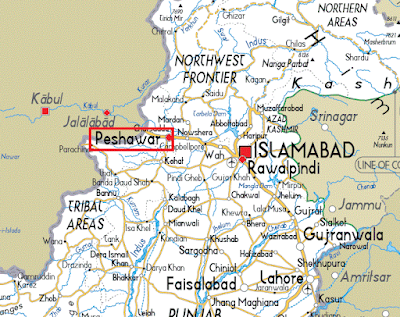
Peshawar, and the battle for Pakistan

 context of Peshawar Church Massacre


The Sunday 22 Sept 2013 terrorist attack at All Saint's Church, Peshawar, came as the government was reportedly preparing to broker peace with the Tehreek-e-Taliban Pakistan (TTP: the Pakistani Taliban).

Nawaz Sharif's Pakistan Muslim League-Nawaz (PML-N) party won Pakistan's May 2013 parliamentary elections on a platform that included brokering peace with the TTP.

At an All Parties Conference (APC) in Karachi on 9 September -- in which the US-led "War on Terror" and US drone attacks were blamed Pakistan's domestic terrorism -- PM Sharif won approval from the leaders of Pakistan's political parties to proceed with talks.

Emboldened by the scent of weakness, the TTP upped the ante.

On 14 September, TTP leader Hakimullah Mehsud issued two conditions for talks: the release of 50 jailed militant commanders, and the complete withdrawal and all 150,000 Pakistani military troops from the tribal areas of Khyber Pakhtunkhwa (formerly known as North West Frontier Province).

The very next day (15 Sept) the Khyber Pakhtunkhwa provincial government, headed by the Pakistan Tehreek-e-Insaf (PTI) party of Imran Khan -- who has long advocated for peace with the Taliban -- announced that the withdrawal of troops from Malakand Division would commence in October and that the civil administration would take over control of Swat and other districts accordingly.

ASSASSINATION IN UPPER DIR: 15 Sept 2013

Within hours, the TTP responded by assassinating Major General Sanaullah Khan Niazi, the General Officer Commanding (GOC) of Swat and Malakand Division. Killed along with him by a roadside bomb in the Upper Dir district near the Afghan border, were his right hand man, Lieutenant Colonel Tauseef, and Lance Naik Irfan Sattar.

PESHAWAR CHURCH MASSACRE: 22 Sept 2013


On Sunday 22 September, as up to 600 worshippers were mingling at the close of the service, two Islamic militants armed with automatic rifles and grenades entered the grounds of All Saint's Church, Peshawar. After slaughtering many, they detonated their explosive vests, triggering two huge explosions that blasted shrapnel through the believers. The death toll, presently 89, continues to rise; more than 150 were wounded, many critically. The internet images are shocking and deeply moving.

Two different wings of Tehreek-e-Taliban Pakistan (TTP) have claimed responsibility. A spokesman from TTP Jundullah claimed: 'They [Christians] are the enemies of Islam, therefore we target them. We will continue our attacks on non-Muslims on Pakistani land.' Later a spokesman from Junood ul-Hifsa claimed the attack was in response to US drone strikes. This was the most deadly terrorist attack on Pakistan's Christian community in modern history.

See: Taliban suicide attack on Pakistani church leaves dozens dead
Attack on congregation leaving service in Peshawar is most deadly in history of Pakistan's Christian community
By Jon Boone in Islamabad, The Guardian, Mon 23 Sept 2013


Excerpt:
"Explosions ripped through the congregation of 500 people, including many women and children, as the service at All Saints church was coming to an end and worshippers were about to receive a free meal of rice in the courtyard outside.

"Witnesses said the interior of the 130-year-old building was turned into a bloodbath, with severed limbs scattered around and the walls pockmarked with ball bearings used as shrapnel by the bombers.

"'I saw myself in the air and then on the ground inside a huge fire of ball,' said Sabir John, a worshipper who lost one of his arms in the blast. . ."

In a short BBC news video a BBC reporter talks with a father as he grieves over the coffin of his 11-year-old daughter. The reporter, listening intently, marvels that, 'somehow he manages to talk of forgiveness'.

PEACE TALKS OFF

On Monday 23 September, Prime Minister Nawaz Sharif called off plans for peace talks with the TTP. “We had proposed peace talks with the Taliban in good faith but . . . because of this attack, the government is unable to move forward with what it planned and envisaged,” he said.

It has been mooted, however, that PM Nawaz Sharif's appeal for peace talks was a farce designed purely to demonstrate the futility of peace talks. If this is true, then Sharif may have been gambling that talk of peace would actually trigger terrorism, giving him the grounds and political support for a full scale military assault on the tribal regions (primarily for the purpose of self-preservation) and/or appeals for military aid.

Meanwhile, the Taliban has no interest in peace with the Pakistani government, for not only would peace with the government actually be against TTP principles, but the TTP has no reason to broker for peace, for they believe they must and can win the battle. Indeed, as Sameera Rashid demonstrates so clearly, "Taliban militants are not an easy foe to talk to because of their strategic superiority over the law and order apparatus of Pakistan."

Likewise, senior military figures have no interest in peace with the Taliban -- especially if peace involves a military withdrawal and the release of militant prisoners. The Pakistani military has fought long and hard, losing many soldiers in the process, to bring a measure of security to Khyber Pakhtunkhwa. They are not about to surrender this territory back to the militants.

It is not outside the realm of possibility that Peshawar's Christians were sacrificed -- i.e. the attack may have been permitted (if not set up) by officials in either the military or the government or both -- to legitimise military action and/or requests for military aid.

While appalling, this is not even remotely far-fetched, as those who watch Pakistan and remember the assassination of Shahbaz Bhatti will well know. [Minorities Minister Shahbaz Bhatti was assassinated in broad daylight by militants on a motorbike who rode into Islamabad's most secure diplomatic precinct armed with automatic weapons, assassinated the minister in his car, and then escaped without a trace.]

Writing for Gatestone Institute on 25 Sept 2013, Raheel Raza comments: "In Pakistan, the Inter-Services Intelligence (ISI), considered to be one of the world's largest intelligence agencies, has not contained the violence unleashed upon Pakistan's minorities. According to some recent reports, there is a special squad, financed by petrodollars and sanctioned by the authorities, created exactly for the purpose of killing minorities -- and this is seemingly why nobody to date has been brought to justice. Recently there have also been massive jailbreaks, freeing hundreds of terrorists."

See: The Danger In Our Midst
by Raheel Raza, September 25, 2013

Writing in Asia Times online, Sameera Rashid blames Islamisation. "The Tehrik-i-Taliban (the TTP, also known as the Pakistani Taliban) and other militants didn't simply sprout out from nowhere. The process of Islamization, introduced ham-fistedly in the Muhammad Zia-ul-Haq era, impacted on the country's education system, legislation and the general moorings of society and gave rise to notion of an exclusivist Sunni Muslim identity."

Rashid notes that sectarian outfits and militant paramilitary organisations, supported by the security establishment to fight proxy wars have joined hands with the Taliban to fulfill their strategic designs. She also notes that Taliban sympathisers exist within the law enforcement agencies and are believed to be responsible for providing militants with maps and other forms of support. She insists the government must stop excusing the militants and blaming the West, and instead, make a serious effort to tackle the domestic causes of terrorism.

See: Delusional reality of Pakistani peace
By Sameera Rashid, 26 Sept 2013

A moving account of the Peshawar attack can be found of Sameera Rashid's blog
Dear Imran Khan, where were you when my church was attacked?
By Sameera Rashid, 24 September 2013

THE BATTLE FOR PAKISTAN: LAND FOR PEACE

In 2005, the then Prime Minister General Pervez Musharraf brokered peace with an alliance of al-Qaeda and Pakistani Taliban forces by ceding South Waziristan (Feb 2005) and then North Waziristan (Sept 2006). Once free and settled in their sanctuary, the jihadist promptly hoisted the black flag and declared the Islamic Emirate of Waziristan.

See Talibanistan: The Establishment of the Islamic Emirate of Waziristan
Pakistan's "truce with the Taliban is an abject surrender, and al Qaeda has an untouchable base of operations in Western Pakistan which will only expand if not checked
By Bill Roggio, September 5, 2006

PEACE TERMINATED

Then mid 2007 saw the stand-off at the radical Lal Masjid (Red Mosque) in the heart of the capital, Islamabad. On 10 July 2007, Pakistani forces stormed the mosque. Official government sources put the death toll at around 100, while Islamist sources claimed more than 2000 were "martyred". On 16 July 2007 the al-Qaeda and Pakistani Taliban alliance based in Waziristan announced the termination of the peace deal with the Pakistani government -- and The Battle for Pakistan resumed.

Full details see: The Battle for Pakistan
By Elizabeth Kendal, 30 Oct 2007

By April 2009, the al-Qaeda and Pakistani Taliban alliance had advance to within around 100 km (60 miles) of Islamabad (the capital of nuclear-armed Pakistan) and Rawalpindi (military headquarters).

See: Religious Liberty Prayer Bulletin (RLPB) 002
PAKISTAN: ISLAMABAD CHURCH ON THE THRESHOLD OF WAR
-- 'land-for-peace' brings Islamabad into al-Qaeda-Taliban's sights.
-- a special prayer bulletin for extraordinary times.

By Elizabeth Kendal, Wed 29 Apr 2009

In May 2009, the government launched a military offensive into Swat, liberating Mingora from Taliban control. Mullah Fazlullah, the commander of the Swat chapter of the Pakistani Taliban, fled into Afghanistan.

Since fleeing Swat, Mullah Fazlullah has organised terrorist activities from his base in Kunar and Nurustan areas of Afghanistan, where he reportedly enjoys the hospitality of the Governor of Kunar province. He reportedly controls between 1,000 and 1,500 diehard terrorists, most of who are linked to the Swat chapter of TTP.

THE BATTLE CONTINUES

Concerning the15 Sept 2013 assassination of Major General Sanaullah Khan Niazi in Upper Dir, analyst Bill Roggio notes that Gen. Sanaullah served as the senior military commander in Swat when it was ruled by the Taliban between 2007 and 2009, after the government negotiated multiple peace deals with Taliban commander Mullah Fuzlullah.  Roggio believes the 15 Sept 2013 assassination was "likely carried out by forces loyal to Fazlullah, who also commands Taliban fighters in Dir and in the greater Malakand Division, a region comprising the northern districts of Khyber Pakhtunkhwa province. Fazlullah, who is also known as Mullah Radio for his radical sermons that are broadcast throughout the northwest, is a senior Taliban commander who has opposed polio vaccinations. He has vowed to continue the fight to regain control of Swat and the surrounding districts. Last year, he ordered the assassination of Malala Yousufzai, the young schoolgirl who passionately spoke out against the Taliban in Swat, and accused her of violating sharia, or Islamic law."

Indeed, TTP spokesman Shahidullah Shahid has credited the assassination to TTP's Swat chapter, under the command of Mullah Fazlullah. "Our men did it," he said.

According to Awami National Party (ANP) spokesman, Senator Zahid Khan, militants have been returning to Swat and other parts of Malakand division and reinforcing their positions, emboldened by the provincial government's eagerness for "peace", talking advantage of the ruling Pakistan Tehreek-e-Insaf (PTI) party's "soft corner" towards militants.

TALIBAN SEES OPPORTUNITY

As a senior Western diplomat based in Islamabad notes: "The killing of General Niazi and the Peshawar suicide attack clearly send out a powerful message. The Taliban are saying they don't want peace talks."

In recent weeks, IHS Jane's has been told by both Pakistan's security officials and Western diplomats that the Taliban believe they have an opportunity to enlarge their influence in parts of Afghanistan and Pakistan once international coalition troops leave at the end of 2014.

"They [Taliban] are seeing themselves gain victory after victory. Their military strategy right now seems to suggest they see an opportunity to continue their fight and increase their influence," said one Pakistani security official.

CRACKDOWN ANTIPICATED; BACKLASH EXPECTED

During the government's 2009 military offensive against the Pakistani Taliban, persecution of Christians soared, particularly in Punjab, as madrassas-educated, thoroughly radicalised Muslims reacted violently against what they perceived as a US-backed war against Islam.

If the government is serious about protecting minorities (as it claims) -- security must be bolstered at all churches and throughout all Christian districts. Any state that regards its Christians as expendable is destined to be impoverished.

---------------------------------
Elizabeth Kendal is the author of
Turn Back the Battle: Isaiah Speaks to Christians Today 
(Deror Books, Dec 2012)

Thursday, March 7, 2013

Deepening divide leaves Pakistan staring into the abyss.

by Elizabeth Kendal

On Tuesday 19 February 2013, a senior police official confirmed to Agence France-Presse (AFP) that authorities had launched an investigation into blasphemy allegations against Pakistan's Ambassador to the USA, Shehrbano "Sherry" Rehman, on order from Pakistan's Supreme Court. 

See: Sherry Rehman, Pakistani Ambassador to the U.S., to be investigated for blasphemy.
By Hunter Stuart, The Huffington Post, 21 Feb 2013

The Supreme Court of Pakistan admitted the petition against Rehman on Thursday 17 January 2013. The petition was heard by a two-judge bench comprising Justice Anwar Zaheer Jamali and Justice Ejaz Afzal who directed City Police Officer Multan Amir Zulfiqar to take action in accordance with the law.

Multan's senior police superintendent, Ghulam Shabbir Jafri, confirms that the case has been registered and evidence is being collected.

As Farhan Bokhari reports for CBS News (21 Feb 2013): "The case promises to unleash another clash between conservative Muslims who vehemently back the country's Islamic laws, and those who dare to challenge them as outdated and in need of reform. . .

"The case also puts President Asif Ali Zardari's already-embattled government in an awkward position, as it tries to balance its own liberal leanings with continued pressure from conservative Islamic parties and regional populations that want the Islamic laws enforced strictly. It is added pressure that the governing Pakistan People's Party -- to which Zardari and Rehman both belong -- does not need with parliamentary elections expected in May.

"'This case is a powerful reminder of the internal divisions in Pakistan that have already caused much harm to this country,' a Western diplomat told CBS News on Thursday [21 Feb]. 'Given how divided Pakistan remains, it's practically impossible for President Zardari's government to either defend or oppose this case.'"

In an opinion piece for Pakistan's Daily Times, writer and advocate Qasim Rashid commences by noting that Ambassador Sherry Rehman's twitter bio declares: "Will take a bullet for the motherland but hope our children don't have to." Rashid then asks: "But what is an ambassador to do when that bullet comes from Pakistan and strikes her in the back?

"Last week, Pakistan took the unprecedented step and charged their own ambassador with blasphemy — a crime that carries the consequence of fine, prison time, and even execution. As Rehman valiantly fights to improve her nation's image, implores the US that her country is moderate and tolerant, and courageously defends Pakistan’s domestic and foreign policy, the motherland — of all places — proves her wrong."

Rashid comments that the "state-sanctioned persecution of Rehman is not a surprise; it is an inevitability and just the latest in a long trend."

Rashid notes that Pakistan has a history of state complicity in the persecution of Christians, Hindus, Sikhs, Ahmadis, as well as moderate reform-minded Muslims. He holds the Supreme Court responsible for the escalation in deadly violence, noting that in 1992, in the case of Zaheerudin v State, the Supreme Court ruled: "The [Ahmadis] who are non-Muslims want to pass off their faith as Islam? . . . [a] [Muslim] believer...will not tolerate a Government, which is not prepared to save him of such deceptions or forgeries. . ." Rashid asserts that with these words, the Supreme Court not merely champion the draconian blasphemy law, but it "figuratively shot its own constitution".

"And now," he asks, "as Pakistan shoots its own ambassador in the back, who will take a bullet for Sherry Rehman?"

Rashid pleads: "No other logical choice exists but to unite as one community against religious discrimination, oppression of conscience, and violence. As long as Pakistan's blasphemy law lives, those who stand up for freedom and tolerance will continue to fall at the hands of the Supreme Court-endorsed extremists."

But Pakistan's pro-freedom advocates need far more than "unity as one community". They also need massive and united international support. Ultimately, they need divine intervention. 

--------------------------------
BACKGROUND

The blasphemy petition against Ambassador Rehman has its roots in the Asia Bibi case.

On 8 November 2010, Christian woman Asia Bibi (45) was sentenced to death by hanging for allegedly blaspheming Islam's prophet, Muhammad. The sentence left Asia, her husband, Aashiq Fauji Masih (51), and their five children totally shattered.

See: Christian woman sentenced to death in Pakistan 'for blasphemy'
By Rob Crilly in Islamabad and Aoun Sahi in Lahore, The Telegraph, 9 Nov 2010

Member of the National Assembly (MNA) Shehrbano "Sherry" Rehman was one of three eminent Pakistani leaders -- along with Salman Taseer and Shahbaz Bhatti -- to rise in defence of Asia Bibi and challenge Pakistan's infamous blasphemy law.

After Asia Bibi's death sentence was handed down, Rehman submitted a bill to the National Assembly Secretariat seeking an end to the death penalty under the existing blasphemy law.

On 30 November 2010, she spoke publically against the death sentence, criticising the blasphemy law in an interview aired on a private television channel.

On 4 January 2011, Salman Taseer, the governor of Punjab province, was assassinated in Islamabad.   by one of his own security guards, the Islamist Mumtaz Qadri. Outside the court, the assassin Qadri was lionised and celebrated, not only by bearded Islamists, but by suit-clad lawyers

As threats mounted against Sherry Rehman, her own party, the Pakistan People's Party, pressured her to back down.  In February 2011, the then prime minister, Yousuf Raza Gilani, categorically stated that the government had no intention of amending the blasphemy law, leaving Rehman with no option other than to drop her bill.

On 2 March 2011, Shahbaz Bhatti, Federal Minister for Minorities Affairs and the only Christian in the Cabinet, was assassinated in a supposedly secure area of Islamabad.  Islamic militant group Tehreek-e-Taliban proudly claimed responsibility. In pamphlets found near the assassination Tehreek-e-Taliban stated, "Anyone who criticizes the blasphemy law has no right to live."  Two years on -- after one attempt to whitewash the killing -- no one has been tried for Bhatti's murder.

On 23 November 2011, after months of death threats, Prime Minister Yousaf Raza Gilani appointed Sherry Rehman to the position of Ambassador to the United States where she should presumably be safe from Islamist retaliation.

Shahid Ghauri, leader and spokesman for the Tehreek-e-Taliban, lambasted the appointment claiming Rehman was unfit for such a post on the grounds that "she tried to abolish the country's blasphemy laws."

"We are not satisfied with Sherry Rehman appointment because she is not fair with Islam or the country," he said while accusing her of spying for the US and advancing Jewish agendas. 

That same day, Multan businessman Fahim Akhtar Gill filed a petition in the Multan Bench of the Lahore High Court against the appointment of Rehman as Pakistan's Ambassador to the US claiming that in the course of her November 2010 televised interview -- where she criticised Pakistan's blasphemy law -- Rehman herself made comments that were tantamount to blasphemy.

Western diplomats assured CBS news that the case should not put Rehman in any danger, as she is outside of Pakistan.

However, a guilty verdict would leave Sherry Rehman unable to return to her homeland. Furthermore, a guilty verdict could be as effective as a fatwa, leaving her unsafe anywhere in the world. Should this happen, Sherry Rehman would doubtless join the growing list of noble and courageous defenders of freedom being forced to live their lives under suffocating police protection. 

Meanwhile, supporters of assassin Mumtaz Qadri continue to call for his release, or at least that he be tried in the Federal Shariat Court instead of Islamabad High Court (IHC) so the matter can be decided "in the light of teachings of Quran and Sunnah". Clearly they are confident that Islam would legitimise the killing and acquit the assassin. If this is permitted -- if Qadri is tried in the Federal Shariat Court on the spurious grounds that the killing of blasphemers is a matter pertaining to Islam and therefore must be decided according to Sharia -- then the future survival of Pakistan's minorities would be very tenuous indeed.

And after nearly four years in jail, Asia Bibi still has no word on whether she will be able to appeal her death sentence.  (Voice of the Martyrs Petition)

The battle for Pakistan continues.

UPDATE

On Saturday 9 March, up to 7000 local Muslims looted and burnt more than 160 homes, 18 shops and two churches in Joseph Colony -- a Christian colony in Badami Bagh, Lahore, in response to a blasphemy allegation.

See: PAKISTAN: THE BITTER FRUITS OF A RADICALISED SOCIETY
Religious Liberty Prayer Bulletin | RLPB 201 | Wed 13 Mar 2013
By Elizabeth Kendal

----------------------------------------

Elizabeth Kendal is author of
Turn Back the Battle: Isaiah Speaks to Christians Today
(Deror Books, Dec 2012)

Wednesday, September 5, 2012

Pakistan: religious hatred not being addressed


By Elizabeth Kendal

(1) Is Pakistan terminally ill?
(2) Rimsha Masih and the Mehrabad Conspiracy

INTRODUCTION

The blasphemy case against and cruel treatment of Rimsha Masih, an 11-14 year-old illiterate girl from a Christian colony in Islamabad's Mehrabad slum, has elicited revulsion and dismay both domestically and internationally.

Rimsha's arrest comes hot on the heels of Asia Bibi's death sentence and the assassinations of Salmaan Taseer and Shabaaz Bhatti; and immediately prior to the obscene torture-murder of the Christian boy Samuel Yacoub (11). Not since Dr John Joseph, Bishop of Faisalabad, poured out his own life in front of the Sahiwal court house on 6 May 1998 in protest of the death sentence handed down to Christian slum dweller Ayub Masih who was, like Rimsha, the victim of a malicious blasphemy accusation, has attention to Pakistan's sickness been so intense.

However, if Pakistan's authorities and Muslims elites manage to whitewash and sideline this case by making it all about child rights and mental capacity rather than intolerance, hatred and the blasphemy law; and if they fail to address the real issues of Islamisation, Sharia and the radicalisation of the masses; then nothing will change. Systematic religious hatred must be addressed and remedied before Christians, Shi'ites, Ahmadis and Hindus face genocide. 

For background on the Rimsha Masih case, see:

PAKISTAN: intolerance grows; child accused of blasphemy
Religious Liberty Prayer Bulletin | RLPB 173 | Wed 22 Aug 2012
AND the update:
Religious Liberty Prayer Bulletin | RLPB 174 | Wed 29 Aug 2012
under the subheading: "THE SHAME OF PAKISTAN".

-------------------------------------

IS PAKISTAN TERMINALLY ILL?

As passions soared over the arrest and cruel treatment of Rimsha Masih, British correspondent Rob Crilly opined that the international show of support for Rishma might actually endanger her life and risk undermining her case. "For although the law is rarely best carried out in secret," says Crilly, "Pakistan's archaic blasphemy laws fall apart entirely when conducted amid the blaze of publicity."

Crilly asserts: "Christian campaigners and democracy activists have turned Rimsha into a poster girl for their causes and are in danger of creating a martyr. Having propelled the issue into the open, creating headlines around the world, Pakistan's lawyers, judges and politicians have little room to manouevre. They are under intense pressure to act as good Muslims. Any leniency will be interpreted as a pro-blasphemy, anti-Islam stance. And all the while they will be reminded of Salman Taseer, the governor of Punjab, whose courageous support of Asia Bibi ended in a hail of bullets outside his favourite lunch spot.

"With the case in the spotlight, it will take a brave man now to do the right thing."

The reality however is this: in many cases the spotlight is often the only thing that enables or sometimes forces a man or woman or government to be brave and do the right thing.

Crilly seems totally oblivious to the fact that the courts are not Rimsha's greatest threat! Muslim mobs are straining at the bit, hankering to lynch this child, to burn her alive. The only reason she is alive today is because, after surviving a savage beating at the hands of the mob, she was arrested and placed in solitary confinement in a maximum security prison.

As terrible as her plight is, what it says about Pakistani society is far worse.

Absent a massive international public outcry, Rimsha would doubtless have been quietly sacrificed to appease the Islamists. She would either been quickly acquitted and handed over to the mob or placed at the mercy of Islamists inside the prison, to become, like so many before her, another religious minority death-in-custody statistic.

Absent a massive international public outcry, Rimsha's family will not survive. The international outcry needs to be so loud that the only way for Pakistan to secure US aid and avoid a public international shaming at the UN General Assembly will be to have Rimsha released and the family resettled in the West. The difficulty lies in effecting this coup in a manner that will limit the fallout from Pakistan's powerful Islamic fundamentalists.

Crilly has failed to see what many Pakistanis are beginning to see very clearly: Pakistani society is sick to its core.

Writing in Pakistan's Daily Times on 31 August, Farahnaz Ispahani of the National Assembly’s Standing Committee on Human Rights goes right to the heart of the matter: "Pakistan is continuing to become an intolerant society".

Ispahani believes that if Rimsha's case is treated as a child's rights or disability rights issue, then it will only "take the heat away from the real problem". As she intimates, this may well be the government's intention as it seeks to "'re-set', yet again, Pakistan-US ties" or prepare for the "forthcoming United Nations General Assembly meeting".

As Ispahani rightly notes, "The real problem continues to be the day-to-day persecution, harassment and murder of Christians, Ahmadis and Hindus under Pakistan's laws. . . Even after Rimsha has been freed, which we hope she will, the [Islamic Sharia, Hudood, blasphemy] laws opposed by most of the civilised world will still stand.

"The deep-rooted problem of oppression and intolerance of religious minorities, to which one may add the ongoing organised killings (which some plausibly call genocide) of Shias, needs greater resolve than the temporary solution of solving an individual case within the framework of flawed existing laws."

Also writing in Pakistan's Daily Times on 31 August, was Gulmina Bilal Ahmad. Citing the assassinations of Salaam Taseer and Shabaaz Bhatti, she makes the point that you simply cannot talk about the blasphemy law if you are in Pakistan; it is just too dangerous.

"The worst thing about the accusation of blasphemy," she writes, "is that more people die as a result of mob violence. Police in most of the cases are left with no option but to hand over the accused to the mob, which in most instances results in the death of the accused. More accused have died not due to the stringent blasphemy laws but due to the extreme behaviour of mobs.

"Let us take a look at this problem from the societal point of view," writes Ahmad. "Our society has grown insensitive to violence over a period of time. Certainly, there are various reasons for it. Unemployment, rising inflation and lack of security are some of the most obvious reasons that might lead to violent behaviour. But these problems are not specific to Pakistani society. There are other countries where the level of inflation and unemployment is even higher than ours but citizens of those countries do not grow violent.

"Once again, we have to put the blame on the radical shift that Pakistan went through during Zia’s regime. Strict laws were put in place, educational curriculums were altered, religious hatred, sectarian violence was purposely spread, and most importantly, Pakistan was pushed into the abyss of extremism. As a result, society as whole developed narrow views on religion and the interfaith harmony that existed earlier went down the drain."

What was the "radical shift" that occurred under Zia -- a "radical shift" that Ahmad dare not name?

After the Iranian Islamic (Shi'ite) Revolution (1979), Saudi Arabia spared no effort to establish Pakistan (and by extension, Afghanistan) as a Sunni Wahhabi bulwark on Iran's eastern border. In order to hem in the revolution, the US bolstered Iraq while Saudi Arabia bolstered Pakistan. Iraq went to war with Iran, while in Pakistan, Saudi-sponsored madrassas and mosques indoctrinated the masses with anti-Shi'ite, anti-Semitic and anti-Christian religious hatred and jihadist ideology, Islamising the masses along Wahhabi lines. The Taliban were a Pakistani creation, fashioned in Saudi-sponsored Pakistani madrassas for the jihad in Afghanistan (1980s). It was during these years, under the leadership of Sunni military dictator President General Zia ul-Haq (1977-1988), that Sharia Courts, Hudood punishments and blasphemy laws were introduced and Sunni supremacy used to fuel hatred and intolerance of all others.

As Ahmed notes, "The accusation of blasphemy over a period of time has also become an instrument of violence, a sort of violence that is so easy to commit and the best thing about it is that you can walk away from it free. . .

"It is sad," says Ahmed, "that Rimsha, who is also said to have an unstable mental condition, was accused of blasphemy. It will be wrong to state that residents of that area did not know about her condition. They did it because Muslims in that locality did not like living with Christians . . ."

See also: Mob Rule Replaces Rule of Law
by Shiraz Maher, Gatestone Institute
September 17, 2012

RIMSHA MASIH AND THE MEHRABAD CONSPIRACY

The Muslims of Mehrabad do not like living with Christians, not because the Christians are difficult to live with, but because, after decades Islamic fundamentalist indoctrination, the Muslims simply hate the Christians without a cause (John 15:18-25).

Talking to media on 24 August, Hafiz Mohammed Khalid Chishti, the local imam who handed Rimsha to the authorities, claimed that Rimsha's blasphemy was part of a deliberate Christian "conspiracy" to insult Muslims.

"The girl who burnt the Holy Quran has no mental illness and is a normal girl," Chishti told AFP. "She did it knowingly. This is a conspiracy and not a mistake. She confessed what she did."

Chishti had long been at the forefront of a dispute between the slum's Muslim and Christian communities, leading complaints over Christian prayers, singing and music that he maintains is provocative. Chishti is doubtless provoked by the fact that joyful Christian worship can be very attractive; consequently it may introduce fitna (temptation / doubt) into the Muslim community. And "fitna is worse than killing". (Qur'an. Sura 2:191)

After Rimsha was arrested, Chishti reportedly told Mehrabad's Christians, "All you chooras (a derogatory term for South Asian Christians) must leave here immediately or we will pour petrol on you and burn you alive." Chishti denies the accusation.

The Islamic pogrom that tore through Mehrabad in the wake of Rimsha's arrest forced the district's more than 500 Christian families to flee. On 28 August the Associated Press reported: "Over the weekend a group of about 300 [displaced Christians] cleared out a section of land in a forested part of an Islamabad neighborhood [along a sewerage line] and built the skeleton of a church from branches, complete with a cross, and were using it to hold prayer services.

"Christians in the area said Tuesday [28 Aug] that in the middle of the night, people burned their makeshift church to the ground. Then the group was evicted from the site.

"By midafternoon a group of about 150 Christians had gathered in the park a few hundred meters (yards) from the clearing where the church once stood. Many had nothing to eat until an aid group delivered some rice.

"'We are helpless. What can we do? We are just sitting here,' said Naseem Javed, who was holding her 3-year-old son in her arms. 'They don't even want us to have a place to pray'."

Though many of the displaced Christians any had previously vowed never to return, about half of Mehrabad's Christian families have since returned, although they do not feel even remotely safe.

On Thursday 30 August, after a medical report found that Rimsha was a minor with a mental capacity less than her age, prosecuting lawyer Rao Abdur Raheem accused the state of manipulating court proceedings and managing the crisis in an attempt to whitewash it for political reasons. He has accused the authorities of arranging to have doctors give a false account of Rimsha age and mental capacity, in order that she might be treated more leniently or even exonerated. "There are many Mumtaz Qadris in this country . . ." Raheem warned ominously, referring to the Islamist bodyguard who assassinated Punjab Governor Salmaan Taseer over his criticism of the blasphemy law.  "The girl is guilty," he declared. "If the state overrides the court, then God will get a person to do the job."

Later, sitting in his office beneath a large poster of Qadri, Raheem told the Guardian: "If the court is not allowed to do its work, because the state is helping the accused, then the public has no other option except to take the law into their own hands."

A Conspiracy Indeed!

In a surprise twist, Hafiz Mohammed Khalid Chishti was arrested on the evening of Saturday 1 September, after his deputy, Maulvi Zubair, and two other associates came forward accusing the imam planting burnt pages of the Quran in Rimsha's bag. Chishti denies the accusation, defiantly maintaining, "This is all fabrication."

Police investigator Munir Hussain Jaffri reports that Maulvi Zubair, Mohammad Shahzad and Awais Ahme told a magistrate that Chishti added pages from the Quran to the burnt pages brought to him by Rimsha's accuser. The three witnesses reportedly told the police that they had urged Chishti not to tamper with the evidence.

"They protested that he should not add something to the evidence and he should give the evidence to the police as he got it and should not do this," Jaffri said. They claim Chishti told them: "You know this is the only way to expel the Christians from this area."

As Jaffri notes, "By putting these pages in the ashes he also committed desecration of the Holy Koran." Consequently, now Chishti is being charged with blasphemy.

Right from the beginning, local Christians had maintained that Rimsha had been set-up as part of a conspiracy to expel the Christians. After Rimsha was arrested, a man from the community who did not want to be named told the Express Tribune, "The girl did not commit blasphemy. It was the cleric from a local mosque and some others who made up the issue to uproot us from Mehrabadia." He said the local Muslims object to Christians praying in their church and singing carols and hymns, even playing music at weddings. 

Tahir Naveed Chaudhry, Rimsha's lawyer from the All Pakistan Minority Committee, said they had always maintained the evidence was planted. "And now it is proved that the whole story was only designed to dislocate the Christian people," he said. Chaudhry believes the imam's arrest proves his client is innocent. He said he will now move to have the case thrown out.

Ali Dayan Hasan, head of Human Rights Watch in Pakistan, is absolutely correct in stating that the decision to act against the cleric was "unprecedented".

"What it indicates," says Hasan, "is a genuine attempt at investigation rather than blaming the victim, which is what normally happens in blasphemy cases. They are actually taking a look at incitement to violence and false allegations. It is a welcome and positive development."

Imam Chishti maintains he has been set-up; that it is all part of a political conspiracy and the accusations against him are false. Prosecuting lawyer Rao Abdur Raheem likewise maintains that Chishti's arrest is all part of a political conspiracy being driven by political elites for political interests. "This deliberate twist in the case is aimed at discouraging complaints under the blasphemy law," he said in court Sunday.

The reality probably looks something like this: consumed with hate, Chishti framed the poor, helpless and unwitting Rimsha in order to justify inciting the pogrom that drove the Christians out of Mehrabad. Then, with Islamic and international passions soaring, the government realised it had to find a solution that would both pacify Pakistan's Islamic fundamentalists and appease the West. Fortunately for them this case had all the right ingredients to make that very easy. With the case now being all about age, disability and evidence tampering, it is no longer has to be about blasphemy, intolerance and religious hatred at all and the government is off the hook.

Rimsha's bail hearing has been slated for Friday 7 September.

While she will doubtless be exonerated and released, we must resist the temptation to cry peace, peace when there is no peace! At this point, nothing has changed in Pakistan.

UPDATE:  At the bail hearing on Friday 7 Sept, Judge Mohammad Azam Khan announced to a packed courtroom, “The bail application has been accepted against two sureties of 500,000 rupees each.”

On Sunday 9 Sept, Rimsha was released from prison and transported under tight security in a bullet-proof police van to a helicopter that took her to a secret, undisclosed location where she was reunited with her family. The family remains in hiding as Islamic fundamentalists are still threatening to kill Rimsha.

The next hearing of the case will take place on Monday 17 September.


Wednesday, August 18, 2010

Islamic intolerance is devouring Pakistan

Islamic intolerance is escalating unchecked across Pakistan as Islamic fundamentalism emanating from mosques and madrassas cultivates hatred which is then fuelled by the impunity the persecutors enjoy.

As chaos and lawlessness escalate, religious intolerance and hatred are unleashed without restraint, and the situation for Christians deteriorates.

The following reports represent the tip of the iceberg. All are recent.
(Credit to Compass Direct News for their phenomenal reporting on the plight of Pakistan's minority Christians.)


KYBER PAKHTOONKHWA (formerly North West Frontier Province).

On 14 June, Samuel John, a Christian psychology professor at the University of Peshawar, was savagely bashed outside his home by a group of five students for refusing to convert to Islam. When his wife rushed to his aid, she too was beaten. Both required hospitalisation, with the professor in a critical condition. The police refuse to register a First Information Report (FIR), and John continues to be threatened with death unless he converts to Islam or leaves the University.

PUNJAB PROVINCE.

Sunil Masih, Shazia Masih and Nasir Naeem, three Christian 8th grade students in Danna village, southern Punjab, have long faced pressure from teachers to convert to Islam. On 16 June, after their parents complained, the principal backed his staff, agreeing that the students should convert to Islam or leave the school. When the police refused to help, the three Christian families fled the area.

On 19 June, Rehmat Masih (85), a Christian of Faisalabad district, was arrested and jailed after a hard-line Muslim named Muhammad Sajjid Hameed filed a false blasphemy charge against him. Hameed and Masih had both made application for the same parcel of land.

Christian policeman Jamshed Masih was recently transferred to the predominantly Muslim Mustafa Colony in Jhelum, south of Islamabad. However, local Muslims unwilling to have the Christian family living amongst them, immediately began conspiring against them.

On 21 June, a mob led by local Muslim religious leader Maulana Mahfooz Khan descended on the family's home after Masih had left for work. Sensing trouble brewing, Masih's wife, Razia, had already phoned her husband and asked him to come home urgently. Khan accused the eldest son (11) of blasphemy, drawing a crowd. As Razia pleaded for mercy someone in the crowd hit her on the head with a hard object, causing her to bleed and her children to cry. The agitated crowd began baying for blood, and by the time Jamshed Masih got home, his wife and four children lay murdered -- massacred. Masih tried to file a complaint, but the Station House Officer refused to register a FIR.

On 1 July Rev. Rashid Emmanuel (32) and Sajid Emmanuel (30), leaders of United Ministries Pakistan, were falsely accused of blasphemy. They were supposed to have written a blasphemous document and signed their names to it (a highly unlikely scenario in any case, except for someone with a death wish).

Over 10 and 11 July many hundreds of enraged Muslims marched through the predominantly Christian colony of Dawood Nagar. Spewing abuse and obscenities, they called for the immediate death of the two Christian brothers. According to Compass Direct News, while Islamic extremists led the protests, most participants appeared to be teenagers who pelted the main gate of the Waris Pura Catholic Church with stones, bricks and shards of glass and pounded the gate with bamboo clubs.

It was widely expected that the brothers would soon be exonerated as handwriting experts had notified police that the signatures on the papers denigrating Muhammad did not match those of the accused.

On 19 July 2010, the brothers were shot dead outside the Faisalabad courthouse by five masked men. The bodied of the slain brothers showed signs of torture. The killings have caused religious tensions in Faisalabad to soar.

In Farooqabad in eastern Punjab, on the night of 21 July, three Muslim co-workers of a Christian man allegedly raped his 16-year-old daughter at gunpoint. Then, on 29 July, after Masih complained to police, two other Muslims who work for his employer, kidnapped him and took him to the employer's farmhouse where they allegedly shackled and tortured Masih, leaving him in critical condition.

In Rawalpindi district, students from the local Jamia Islamia Madrassa have been harassing Christians in the villages around Gujar Khan. According to a local pastor, they routinely beat Christian children and throw stones at the church. 'They openly announce that "the Christians are our enemies, we should not talk to them, eat with them or do business with them".' (NOTE: the Qur'an repeatedly commands Muslims to maintain enmity towards and separation from Christians.) On 22 July, a 12-yr-old girl from a local Christian family was gang-raped by 7 or 8 madrassa students. A teacher who witnessed the incident overheard one of the 16-strong student-mob saying: 'We will teach these Christians a lesson they will never forget'.

When the girl's distraught parents subsequently went to the police station to file a complaint, the officer in charge refused to register it, yielding to local Muslim pressure. According to the Center for Legal Aid Assistance and Settlement (CLAAS), 'Such vicious incidents are not being stopped by the government, and day by day the rate of rapes of Christian girls is escalating instead of plunging.' (As would be expected when rape is rewarded with impunity.)

SINDH PROVINCE.

On 13 July 2010, Dr. Abdul Jabbar Meammon, his driver, another Muslim doctor and two other men, beat, tortured and gang-raped Christian trainee nurse Magdalene Ashraf at the Jinnah Postgraduate Medical Center, Karachi, Sind Province. In an effort to cover up their crime, the three Muslim men then attempted to kill Magdalene by throwing her out of a window on the hospital's 4th floor. While Magdalene survived the attack, she is a critical condition with serious head and shoulder injuries.

Magdlene told the Christian Lawyers' Foundation (CLF) that a nurse named Sajjad Fatima had set her up, sending her to Dr Meammon's room on false pretenses. When Magdalene entered Dr Meammon's office, he grabbed her. “When I resisted and tried to escape, nurse Fatima slapped both my cheeks and pushed me into Dr. Jabbar,” Ashraf said. “I cried out but no one arrived there to rescue me. They not only gang-raped me, they also tortured me physically and ruthlessly beat me.”

Dr Jabbar Meammon, a known sexual predator, has been charged with attempted murder. No-one has been charged with rape or assault. Meanwhile, as Dr Meammon and his legal team work on his contrary story (where he the victim!), Ashraf's family is receiving threats.

On 15 July, Pastor Aaron John, Rohail Bhatti, Salman John, Abid Gill and Shamin Mall were shot dead -- massacred -- and six others were wounded when a dozen masked men opened fire on them as they exited their church property in Sukkur, Sindh Province.

Students from a local madrassa (Qur'anic school) have been threatening the church since 2008, and according to reports, while the gunmen had young physiques like those of students, their manner of attack indicated they were trained militants.

The church members had been meeting to discuss security in the light of a threatening letter the church had received in May from Islamic extremist group Sip-e-Sahaba warning the Christians to leave the area because they were not welcome and were polluting the land.

The police and ambulance took 45 minutes to arrive.

A church member told Compass Direct News that, not only had the police refused to register a FIR in relation to the threats, they have also yielded to Muslim pressure and refused to register a FIR in relation to the Sukkur massacre.

FLOODS

Pakistan's devastating floods are the result of unprecedented monsoonal rains AND bad governance, for Pakistan has one of the highest rates of deforestation in the world.

Pakistan today has less than 5 percent forest cover. (Five percent is the official government figure, but the Food and Agriculture Organization of the United Nations says forests only amount to about 2.5 percent of the country's total area.)

The floods have wiped out millions of homes AND, accord to TIME magazine, some 17 million acres of agricultural land have been submerged, and more than 100,000 animals have perished.
A humanitarian crisis of monumental proportions is unfolding.

Further to this, Bishop Humphrey Peters of Peshawar warns that aid is unlikely to reach marginalised minority Christians.

Meanwhile, the people's anger, hunger and desperation, combined with the government's virtual collapse in credibility, and the Army's diversion into rescue and relief, provides the al-Qaeda-Taliban with a phenomenal window of opportunity. As TIME magazine notes, it will be difficult -- suicidal in fact -- for the government to crack down on Islamic fundamentalist and militant groups -- like the Falah-e-Insaniat Foundation, an Islamic "charity" with alleged links to the banned Lashkar-e-Taiba -- when these groups are extending aid and assistance to the displaced and are receiving donations from the "urban middle class of Punjab, who are turning increasingly to religious conservatism".

Is the battle for Pakistan essentially already over?

In a 4 Aug 2010 column for Dawn (Pakistan), Rafia Zakaria (a US-based attorney who teaches constitutional history and political philosophy) writes that while the Pakistani army might be having some military successes against the Pakistani Taliban, the Taliban's "social project of producing a radicalised Pakistan attracted to literal and intolerant interpretations of faith is flourishing. Examples of such societal radicalisation abound, a notable one being the lack of public outcry against the rampant persecution of minorities who do not fit into the idealised mould of the Sunni Muslim Pakistani citizen."

See: Everyday intolerance
By Rafia Zakaria, for Dawn, Wednesday, 04 Aug 2010

In lamenting the Islamisation of Pakistan, Zakaria notes not only the persecution of religious minorities -- Christians, Ahmadis and Hindus -- but also the banning of Facebook (deemed blasphemous, the ban was supported by 70% of Pakistanis), and the banning of Teray Bin Laden, a comedy film that pokes fun at Al Qaeda leader Osama Bin Laden and features Pakistani pop star Ali Zafar. "The affinity for bans suggests the increasing prevalence of a worldview that wants to eliminate perspectives that are repugnant, rather than develop intellectual arguments against them."

Zakaria deplores the Islamisation of college campuses, noting that some have banned "Western dress", and decries the rise of Islamic vigilantism.

Zakaria expresses a widely held fear that, "while the Pakistani military may be winning the territorial conflict, the war for the Pakistani psyche may already have been lost."


This post is an extended version of Religious Liberty Prayer Bulletin | RLPB 069 | Wed 18 Aug 2010, "PAKISTAN: SITUATION CRITICAL".

Tuesday, October 30, 2007

The Battle for Pakistan.

Date: Tuesday 30 October 2007
Subj: The Battle for Pakistan.
To: World Evangelical Alliance Religious Liberty News & Analysis
From: WEA RLC Principal Researcher and Writer, Elizabeth Kendal


THE BATTLE FOR PAKISTAN

On May 2007, WEA RLC released a News & Analysis posting entitled "Pakistan in Crisis: Situation Critical" (link 1), which examined Pakistan's escalating sectarianism (Sunni vs Shi'ite) and Islamisation (both of which fuel Islamic zeal and intolerance) and lawlessness (which facilitates criminal activity and intensifying religious persecution). The situation is most severe in the Taliban and al-Qaeda-administered and influenced tribal agencies and districts of North Western Frontier Province (NWFP). (Link 2)

WEA RLC's May posting also contained a section entitled "The Islamisation and Talibanisation of Islamabad" which focused on the stand-off at the radical Lal Masjid (Red Mosque) in the heart of the capital, Islamabad.

As was widely reported in mainstream news, rising tensions at the Lal Masjid mosque culminated on 3 July 07 in street battles between security forces and militants. On 4 July Pakistani security forces laid siege to the mosque, demanding an unconditional surrender and the release of hostages and human shields. The mosque's senior cleric, Maulana Abdul Aziz was arrested as he tried to sneak out of the mosque dressed in a burqa and high-heels. (The government's televising of this image enraged Islamists!)

Aziz' brother, Abdul Rashid Ghazi, subsequently took over as mosque chief and the siege continued until 10 July when last-ditch negotiations failed and security forces stormed the mosque. Death toll estimates vary widely, from the official government estimate of around 100 dead to the Islamist claim that more than 2,000 were "martyred". Abdul Rashid Ghazi was killed in the military operation.

As soon as the government forces laid siege to the Lal Masjid, jihadists in north-western tribal regions cranked up their terrorist actions against the Pakistani Army. On 16 July 07 the Taliban and al-Qaeda alliance in Waziristan terminated their "peace deal" with the government. The subsequent violence and terror has claimed hundreds of lives including those of at least 200 soldiers.

Army morale is low as this a very unpopular fight with many believing the army is fighting its own people at America's behest. Not only are the huge losses demoralising, but many soldiers find it difficult to feel motivated about killing fellow Pakistanis and Muslims. Several weeks ago 300 soldiers surrendered to a band of some 30 tribal mujahideen in South Waziristan without firing a single shot. Whilst a few have been released, virtually all of them remain captive.

Since the highly-organised bombing of Benazir Bhutto's motorcade on18 October the government has declared its intent to unleash all-out war on the militants.

A battle for Pakistan -- a nuclear armed state -- has commenced and the outcome is far from certain. Religious liberty and the security for Christians hangs in the balance and the prospects, especially in the short and medium term, are bleak.

WHAT WILL THE PAKISTAN ARMY BE UP AGAINST?
- the Taliban and al-Qaeda mujahideen of The Islamic Emirate of Waziristan.


Whilst the US bombing and invasion of Afghanistan in October 2001 toppled the Taliban, most of al-Qaeda's core leadership survived and relocated to Pakistan's Federally Administered Tribal Areas (FATA).

In 2003 the Pakistani Army was given the responsibility of eliminating al-Qaeda and Taliban elements from the border regions of Pakistan. Over the years however a soaring death toll has included the loss of at least 1,000 soldiers as well as the execution-style murders of around 150 anti-Taliban tribal leaders. All this has taken its toll on Army morale and weakened public resolve. (Unofficial estimates are that Pakistan has lost more soldiers in the FATA than the US has in Iraq, i.e. over 3,000).

In a short-sighted attempt to extricate himself from a sticky position, President Musharraf brokered a series of "peace deals" with the Taliban-al-Qaeda-tribal alliance. In February 2005, South Waziristan was ceded to the Taliban-al-Qaeda alliance and on 5 September 2006, North Waziristan was ceded. While Musharraf's capitulation brought him some (temporary) peace, it also established the two Waziristans as the most secure Taliban and al-Qaeda-run terrorist sanctuary and administrative and training base in the world.

Tarique Niazi elaborated on the "peace deal" in Terrorism Monitor (5 Oct 2006): "The deal offers amnesty to Taliban militants and 'foreigners' (a reference to Afghan-Arabs who are members of al-Qaeda) in North Waziristan for a pledge that they would desist from mounting cross-border attacks into Afghanistan; assaulting Pakistani security forces, public servants, state property, tribal leaders and journalists; and carrying heavy weapons (DAWN, 6 September 2006). They will, however, be allowed to travel across the border into Afghanistan on a 'business trip' or a 'family visit' and carry 'light' weapons such as AK-47s.

"It binds the government to cease ground and air assaults against the Taliban and resolve all future disputes according to the Rivaaj (tribal customs). It further obligates the government to redeploy its troops from North Waziristan to their designated camps and forts, and dismantle all 12 checkpoints that were set up to hunt al-Qaeda and Taliban militants (DAWN, 6 September 2006)."

Niazi also reported that subsequent to signing the deal, the government set free 132 Taliban fighters who had been jailed for terrorist violence (Daily Times, 8 September 2006), returned their seized weapons (including 24 AK-47s), restored their impounded property and reinstated their forfeited privileges, including government allowances. Additionally, the government approved a cash compensation of 230 million rupees ($3.8 million) for the material losses suffered by tribesmen (DAWN, 9 September 2006). (Link 3)

Policy and military analysts Daveed Gartenstein-Ross and Bill Roggio gave a bleak assessment to the Weekly Standard (2 Oct 2006): "Together, these events [ceding territory and releasing prisoners] may constitute the most significant development in the global war on terror in the past year." (Link 4)

Their article in the Weekly Standard describes the Waziristan Accord as the "unconditional surrender of Waziristan". Concerning the signing ceremony they write: "Taliban fighters searched government negotiators and military officers for weapons before allowing them to enter the meeting, which took place in a soccer stadium in the North Waziristan capital of Miranshah. According to three separate intelligence sources, heavily armed Taliban were posted as guards around the ceremony, and al-Qaeda's black flag hung over the scoreboard.

"Immediately after the Pakistani delegation left, al-Qaeda's flag was run up the flagpole of abandoned military checkpoints, and the Taliban began looting leftover small arms. The Taliban also held a 'parade' in the streets of Miranshah. Clearly, they view their 'truce' with Pakistan as a victory. It is trumpeted as such on jihadist websites."

Whilst President Musharraf and US President Bush portrayed the Waziristan Accord as a victory, it was in reality nothing less than the ceding of territory to a hostile enemy entity. As soon as the territory was ceded, al-Qaeda declared "The Islamic Emirate of Waziristan" and established a governing Shura council. The Waziristan Accord provided the Taliban-al-Qaeda alliance an autonomous mini-state within a state, a safe-haven, a sanctuary from where they could consolidate, strategise, recruit, train, deploy, enforce their writ and expand their sphere of influence.

Eric Sayers, in a report for the Washington based Center for Security Policy, quotes Bill Roggio: "The destruction of al-Qaeda's safe haven in Afghanistan during Taliban rule has essentially been negated by the rise of Talibanistan in western Pakistan." (Link 5)

Sayers adds (writing in February 2007, link 5): "According to NATO statistics, since the signing of the Waziristan Accord in September 2006, attacks into Afghanistan along the border with Waziristan have increased by almost 300 percent. Consequentially, US military deaths in the region were almost double during this period, in comparison to what they were during the same period the previous year. Further emphasising the strategic importance of the sanctuaries, recent reports have indicated the al-Qaeda fighters wounded in Afghanistan are being treated for their wounds in Bajaur hospitals." [Bajaur, the suspected home of al-Qaeda deputy Ayman al-Zawahiri, has also been ceded to the Taliban-al-Qaeda alliance. The Bajaur Accord was signed on 17 March 2007. (Link 6)]

Bill Roggio of Long War Journal subsequently reported (23 October 2007): "Within months the North Waziristan Accord was followed by agreements in Bajaur, Swat, and Mohmand agencies. News from the tribal agencies of Kurram, Orakzai, and Khyber has gone dark. These tribal agencies are very likely under Taliban control. Open source reporting indicates all or portions of the settled districts . . . of Dera Ismail Khan, Laki Marwat, Tank, Khyber, Bannu, Hangu, Kohat, Charsadda, Dir, Mardan, and even the provincial seat of Peshawar are under Taliban influence to some degree or another." (Link 7 -- which includes a map showing degrees of Taliban control in NWFP.)

From its sanctuary in The Islamic Emirate of Waziristan, the Taliban-al-Qaeda alliance has been able to progress from a position of besieged weakness to one of organised strength. Not only are they now having a profound impact on international terrorism and the jihads in Afghanistan and Iraq, they are also now able to launch a genuinely threatening insurgency in Pakistan.

"COME TO JIHAD, to the people of Pakistan."
- Osama bin Laden beckons.


In late September 2007, Osama bin Laden released an audio message entitled "Come to Jihad, to the people of Pakistan". (Link 8)

Replete with Qur'anic quotations, it informs the people of Pakistan that it is their moral and Islamic duty to respond to the "Lal Masjid massacre" by joining with the Muslims following "true Islam" and waging jihad against the kuffaar (unbeliever) government of Pakistan, the Army and their supporters.

In his message bin Laden likens Musharraf's invasion of and "massacre" at the Lal Masjid to the destruction of and slaughter at the Babri Mosque in Ayodhya, India, by Hindutva forces in 1992. He says the events at the Lal Masjid demonstrate that Musharraf is aligned with infidels against the Muslims. Therefore, he says, rebellion against Musharraf is obligatory. Bin Laden beckons those who have been "led astray" and are now supporting Musharraf or democracy or peace, particularly the Pakistani Army, which he says is supposed to be protecting the Muslims against the kuffaar (unbelievers), not allowing themselves to be tools and weapons in the hands of the kuffaar against the Muslims.

In his speech bin Laden condemns Muslims who spill the blood of fellow Muslims, warning that there is never any excuse: "Compulsion is not legally valid as the soul forced to kill is not better than the soul of the one killed." He appeals directly to soldiers, recommending they resign from their positions in the Pakistani Army, disassociate themselves from Musharraf and enter "true Islam", because, he says, "the government and army have become enemies of the Ummah [community of Muslims]. . . all of them have pledged to the cross worshippers to fight true Islam and its people. . . and permitted American cross worshipper forces to use the air, soil and water of Pakistan, the country of Islam, to kill the people of Islam in Afghanistan and then in Waziristan."

He concludes with an ominous promise: "We in the al-Qaeda organisation call on Allah to witness that we will retaliate for the blood of Maulana abd al-Rasheed Ghanzi. . ." and other slain Muslims, "champions of Islam in Waziristan".

THE BATTLE FOR PAKISTAN
- The prize: the Intelligence Services (ISI), the Army, the state, the nuclear arsenal.
- The outcome: that will depend primarily on Army and government resolve.

Mark Sappenfield writes for the Christian Science Monitor (22 October 2007): "Bowing to international pressure, President Pervez Musharraf has restarted an offensive in the remote tribal areas that are rapidly becoming a hub of global terrorism. Yet early indications are that, no matter who is in charge, the Pakistani Army is ill-suited -- and perhaps incapable -- of doing the job." (Link 9)

As noted by M K Dar (Former Joint Director of Intelligence Bureau, India (Link 10)) for more than two decades now powerful elements within the Pakistani Army and intelligence services have supported Sunni fundamentalist organisations and employed Islamic militants as proxies in their conflicts against India in Kashmir and against Soviet and now Western-backed forces in Afghanistan.

It must also be noted also that foreign forces with their own agendas have encouraged and assisted this for the purpose of fighting proxy wars, including the Saudis (to subdue the Shiites) and the US (to fight the Soviets). Consequently, over the past more than two decades, the well trained and supplied ISI, the rank and file military, the Mullahs and the militants have become very close knit.

Because the conflict in the north-western tribal regions is unpopular and a high casualty rate is guaranteed, many experts do not expect the government's renewed offensive in the north-west to continue long term. Sappenfield writes: "If it does, the Army 'will get divided vertically', with officers remaining loyal to headquarters and the rank and file becoming increasingly alienated, says Ayesha Siddiqa, author 'Military Inc.', a book about the Pakistani Army. 'Cracks are appearing,' she adds."

While officers might see this as an opportunity to further entrench military control over Pakistan, an alternative scenario could be that if officers feel that military domination of Pakistan is under threat because genuine democracy is in sight, they might desert Musharraf for the Taliban for pragmatic as much as ideological reasons. There are many unknowns.

Syed Saleem Shahzad writes for Asia Times Online that a Pakistani security official, who spoke to Asia Times Online on condition of anonymity, said the goal of the government's counterinsurgency is "to pacify the Waziristans once and for all". (Link 11)

Shahzad writes: "Lining up against the Pakistani Army will be the Shura (council) of Mujahideen comprising senior al-Qaeda and Taliban commanders, local clerics and leaders of the fighting clans Wazir and Mehsud (known as the Pakistani Taliban)." He quotes the Pakistani security official as saying, "If the planned battle is successful and Waziristan is pacified, the global Islamic resistance would be back where it was in 2003, when it had fighters but no centralised command or bases to carry out organised operations."

Shahzad reports: "The safety of Taliban and al-Qaeda assets in Waziristan is a matter of life and death and, therefore, the militants have devised a forward strategy to target the Pakistani cities of Lahore, Karachi and Islamabad, hoping to break the will of the Pakistani armed forces. The Pakistani military, meanwhile, is trying to break the will of the militants with ongoing bombing raids.

"Underscoring the seriousness with which the military is planning for the coming battle, it is reported that Shi'ite soldiers from northern Pakistan are being sent to the Waziristans. In the past, the Pakistani Army has been plagued by desertions of Pashtun and Sunni troops who refuse to fight fellow Pashtuns or Sunnis." [Shi'ites will supposedly have fewer problems killing Sunnis. The sectarian element could however, just introduce another layer to the conflict.]

This issue of a morally conflicted and fracturing army is without a doubt one of the greatest threats as increasingly more and more soldiers are questioning the Islamic credentials of their mission. After a major army offensive in South Waziristan in 2004 in which some 500 officers and soldiers refused to fight, "500 leading religious scholars signed a fatwa, a religious judgment, ruling that militants killed in the action are 'martyrs'. The same fatwa forbade the public to pray for the dead government soldiers." Earlier this year the General Headquarters (GHQ) of the Pakistani Army attempted to solicit a fatwa to its own advantage from the Council of Islamic Ideology (CII) but was unable to do so. (Link 12) How many soldiers will heed bin Laden's call?

In July, Ayesha Siddiqa (author of 'Military Inc.') wrote an article entitled "Life after Lal Masjid" where she ominously likened the siege and storming of the Lal Masjid to the "Indian army's June 1984 attack against the Golden Temple and the dissident Jarnail Singh Bhindranwale. In both situations," she says, "the rebels were created by the establishment to be later killed at the government's hands. . . It is hoped, however, that the Lal Masjid operation does not result in the assassination of a leader and the killing of hundreds of innocent people like it occurred in India in October-November 1984." (Link 13)

On 18 October, Benazir Bhutto narrowly escaped assassination and more than 130 people were killed and hundreds were wounded when her motorcade was targeted by terrorists. This is doubtless only the beginning of the terror. Al-Qaeda will seek to eliminate all bulwarks against Sharia and Taliban control of Islamabad. We can expect to see terrorist incidents and assassinations proliferate in Pakistan. Christians ("cross worshippers" as bin Laden calls them) are destined to be targeted, as the militants view them not only as expendable kuffaar and stains to be removed, but as the targets most likely to attract Western attention, breast beating and pressure for more "peace deals".

Al-Qaeda's goal is nothing less than control of a nuclear-armed Islamic state, complete with intelligence services and an Islamist Army, for the purpose of administering and waging international Islamic jihad. A long and bloody battle for Pakistan has begun.

Elizabeth Kendal

Links

1) Pakistan in Crisis: Situation Critical
WEA RLC News & Analysis, 22 May 2007
By WEA RLC Principal Researcher and Writer, Elizabeth Kendal

2) Pakistan: War and unprecedented persecution in NWFP
WEA RLC News & Analysis, 29 Oct 2007

3) Pakistan's Peace Deal with Taliban Militants
By Tarique Niazi for Terrorism Monitor, Volume 4, Issue 19 (5 October 2006)
http://www.jamestown.org/terrorism/news/article.php?articleid=2370153

4) Pakistan Surrenders. The Taliban control the border with Afghanistan.
by Daveed Gartenstein-Ross & Bill Roggio. 2 Oct 2006. http://www.weeklystandard.com/Content/Public/Articles/000/000/012/738ijawx.asp

5) The Islamic Emirate of Waziristan and the Bajaur Tribal Region:
The Strategic Threat of Terrorist Sanctuaries. By Eric Sayers, Feb 2007
http://www.centerforsecuritypolicy.org/modules/newsmanager/center%20publication%20pdfs/waziristan.pdf

6) Pakistan signs the Bajaur Accord
By Bill Roggio (Military analyst) 17 March 2007
http://www.longwarjournal.org/archives/2007/03/pakistan_signs_the_b.php

7) Crunch Time in Pakistan, By Bill Roggio, 23 October 2007
http://www.longwarjournal.org/archives/2007/10/crunch_time_in_pakis.php
(Includes a map showing areas of Taliban-al-Qaeda rule and areas under threat.)

8) Come To Jihad, To The People Of Pakistan
26 Sept 2007. Translated From Urdu By Ahmed Al-Marid | Jihad Unspun
http://www.jihadunspun.com/intheatre_internal.php?article=109033&list=/home.php

9) Pakistan's Army: Unprepared to tackle terrorism? 22 October 2007
By Mark Sappenfield , Staff writer, The Christian Science Monitor
http://www.csmonitor.com/2007/1022/p04s01-wosc.html

10) Militants' sway in tribal areas. 23 Oct 2007
M K Dar (Former Joint Director of Intelligence Bureau)
http://www.centralchronicle.com/20071023/2310301.htm

11) Pakistan plans all-out war on militants
By Syed Saleem Shahzad 19 Oct 2007
http://www.atimes.com/atimes/South_Asia/IJ19Df01.html

12) Troop Defections Threaten Pakistan's Operations in Tribal Regions
By Tarique Niazi, for Terrorism Focus, Volume 4, Issue 4 (6 March 2007)
http://www.jamestown.org/terrorism/news/article.php?articleid=2370270

13) Pakistan after Lal Masjid
Ayesha Siddiqa, 17 July 2007
http://www.rediff.com/news/2007/jul/17guest.htm