Wednesday, November 20, 2013
Central African Republic (CAR): Violence linked to Sudan and Iran
-- revelations bode ill for Christians in CAR
By Elizabeth Kendal
'The seeds are present for a genocide,' warns UNICEF goodwill ambassador Mia Farrow upon her return from a week-long visit to CAR (14 Nov 2013).
Her words echo those of Adama Dieng, the UN Secretary-General's Special Adviser for the Prevention of Genocide. As Martin Plaut reports in an article entitled, Why the threat of genocide hangs over the Central African Republic (New Statesman, 4 Nov 2013):
"The word genocide does not easily trip off the tongue of senior United Nations staff. But now it's been used by Adama Dieng, the UN special official with special responsibility to advise the UN on the prevention of genocide. He warned that the Central African Republic (CAR) – a byword for human rights abuses for decades – is slipping towards a bloodbath.
"'We are seeing armed groups killing people under the guise of their religion,' Dieng told reporters briefing the UN Security Council on Friday [1 Nov]. 'My feeling is that this will end with Christian communities, Muslim communities killing each other which means that if we don't act now and decisively I will not exclude the possibility of a genocide occurring.'"
Fuse Lit Under Sectarian Tinderbox
Central African Republic has been spiralling into total anarchy ever since 24 March 2013, when Seleka -- an alliance of well-armed local and foreign Islamic militias -- seized control of the capital Bangui.
For background see:
Religious Liberty Monitoring (RLM), label: Central African Republic (CAR).
(RLM always gives special attention to religious dimension and impact)
Human Rights Watch (HRW) 18 September 2013
“I Can Still Smell the Dead”
The Forgotten Human Rights Crisis in the Central African Republic
Amnesty International (AI) 29 October 2013
Central African Republic: Violence of security forces now out of control
The Seleka coalition of [Islamic] armed groups has committed human rights violations on an unprecedented scale
Excerpt from the AI report can be found here: AllAfrica.com (29 Oct)
photo: Jovachi Mongonou, 9, had both legs amputated after he suffered severe shrapnel wounds when Seleka soldiers shelled a church in Bangui in April 2013.
Contrary to reports, Seleka does not rape, loot and kill indiscriminately. Rather, Seleka attacks Christians and spares Muslims. Consequently, Seleka terror has caused traditional community trust to evaporate, creating a sectarian tinderbox.
After months of terror, with no relief in sight, an organised armed response is emerging out of the mostly Christian communities of northern CAR. Most villages have long had defence militias to protect residents from bandits. Known as anti-balaka (literally anti-machete) these groups, now large and angry, are out to avenge Seleka crimes. Armed with home-made weapons and adorned with colourful fetishes / juju (occult charms), these anti-balaka militias have begun attacking not just Seleka bases, but local Muslim communities. Muslims (includes Seleka) in turn enact reprisals on Christian communities.
Seleka might be responsible for turning CAR into a sectarian tinderbox, but by attacking local Muslims -- just because they are Muslims -- the anti-balaka militias have lit a fuse. Unless the flame is quickly stamped out, then a wildfire -- i.e. genocide -- is all but guaranteed.
The violence that engulfed Ouham prefecture in September, where some 170,000 people have been displaced, is but a foretaste of what could engulf the nation if action is not taken.
Peter Bouckaert, the emergencies director at Human Rights Watch, spent early November travelling the region with photographer Marcus Bleasdale. Bouckaert writes: 'In the early morning of Sept. 6, anti-balaka forces working with military elements loyal to [ousted president] Bozizé carried out a series of brutal surprise and near-simultaneous attacks on Seleka bases and Muslim communities in several villages around Bossangoa, killing dozens. Muslim males, regardless of age, faced death.'
The BBC reports that on 9 September, Moustapha Mohamed's father, a village chief in nearby Bouce, was killed by a 'Christian' militia that was attacking local Muslims. Mohamed praises his Christian neighbours who alerted many Muslims that armed groups were coming after them. Subsequently, however, on the same day, Muslims organised reprisal attacks against Christians. By the time the violence had finished, at least 14 were dead (three Muslims) and some 485 homes had been burned. Aukin Nountabaye, a priest in the Bouca diocese, narrowly escaped when Muslims stormed his church. He fled Bouca, walking for four days to reach Bangui.
Bouckaert writes that around Bossangoa, Ouham's capital, it is possible to drive for hours without seeing a single person, on roads that are littered with bundles of belongings dropped by those fleeing for their lives. At one point Bouckaert and Bleasdale stop to tend to a crying toddler who has been separated from his parents in the chaos of flight. Fortunately his terrified and distraught parents emerge from the bush to find him.
Even in the bush it is not safe -- grave are everywhere for the displaced are stalked by infection and malaria, enemies just as merciless as Seleka.
'Those who have made it to Bossangoa,' writes Bouckaert, 'live in desperate conditions: Every structure and inch of space around the town's Catholic church -- its seminary, guest house, school, library, storage rooms, soccer pitch, and the surrounding fields -- have been taken over by displaced people, all Christians.'
On 25 October, the UNHCR put the number sheltering in the Catholic Mission at 37,000. A further 2,700 are sheltering in the hospital and 728 Muslims are holed-up in a local school. Around 1000 ethnic Fula (Muslims) have been occupying the airstrip without access to shelter, clean water, food and sanitation.
Recommended reading/viewing:
'We Live and Die Here Like Animals'
The Central African Republic has suffered a horrific collapse. But is the worst violence between the country's Muslims and Christians yet to come?
BY PETER BOUCKAERT | NOVEMBER 13, 2013
Running from Rebels (Photo essay)
A look inside the war-ravaged Central African Republic.
PHOTOS BY MARCUS BLEASDALE | NOVEMBER 13, 2013
Central African Republic: Religious tinderbox
BBC, 4 Nov 2013
includes video: The BBC's Laeila Adjovi reports from Bossangoa, where Christians have fled their homes.
'Risk of Genocide' in Central African Republic
CBN: video interview with correspondent George Thomas, 8 Nov 2013
NEW: Unspeakable horrors in a country on the verge of genocide
Militias in the Central African Republic are slitting children's throats, razing villages and throwing young men to the crocodiles. What needs to happen before the world intervenes?
By David Smith in Bossangoa
The Guardian, Saturday 23 November 2013
------------------------------------------------------------
VIOLENCE LINKED TO SUDAN AND IRAN
------------------------------------------------------------
In July 2013, Defense & Foreign Affairs Strategic Policy (7, 2013) published a report by terrorism analyst Yossef Bodansky entitled: Iran and Sudan Begin Moves to Dominate Central and Western Africa.
The full report can be found here (World Tribune) and here (ISPSW Strategy Series - pdf).
For your convenience, I have republished (below) the portion that relates specifically to CAR.
Bodansky reveals that the situation in CAR is not merely the result of a local power grab. Rather, it is a regional issue central to Sudan and Iran's plot to dominate the region and exploit its riches. The link between CAR's self-appointed president Michel Djotodia and Khartoum is strong, and Seleka includes a large contingent of Sudanese janjaweed from Darfur, Sudan, where Djotodia was radicalised. According to Bodansky, weapons for this surge into Central and Western African come from Iran, via Sudan.
Clearly there will be no quick fixes, no easy solutions.
Furthermore, the conflict has begun to spill into Cameroon, which opens out to the gas and oil-rich Gulf of Guinea.
Tensions grow between CAR and Cameroon
By Konye Obaji Ori, The Africa Report, 19 Nov 2013
Cameroon tightens borders after CAR rebels kill two
Business Ghana, 18 Nov 2013
Cameroon says army repulses attack from Central African Republic
Defenceweb - Reuters, 18 Nov 2013
France's decision not to support the French-speaking Christian majority in CAR, but to literally stand aside as local and foreign Arabic-speaking Islamic rebels seized power in a violent coup, will prove to have been extremely short-sighted and misguided indeed -- a strategic mega-blunder for which CAR's Christians will pay a terrible price.
-----------------------------------------------------
Defense & Foreign Affairs Strategic Policy
Analysis by Yossef Bodansky, Senior Editor, July 2013
Iran and Sudan Plan and Begin to Execute Moves to Dominate Central and Western Africa
The Central African Republic has become a key player, working under Sudanese and Iranian direction, in jihadist action, geared to take advantage of the West's declining influence in Western and Central Africa, even if it challenges the interests of their traditional ally, the People's Republic of China.
Extract (to END):
The governments of Iran and Sudan are preparing for a major strategic surge into western Africa, into both the Sahel and the shores of the Gulf of Guinea.
The moves have already gained momentum and challenge Iran’s and Sudan’s major sponsor, the People’s Republic of China (PRC), as well as the declining West.
The ultimate objective of this surge is to consolidate control and/or influence over this extensive region and its considerable oil, gas, uranium, and other minerals (rare metals and rare earth) reserves.
[. . .]
Meanwhile, hectic preparations were, by late June 2013, taking place in Khartoum for the escalation of the surge into western Africa. Both Iran and Sudan consider the Central African Republic (CAR) a crucial venue because the CAR permits movement westward around the chaos in Darfur and the French presence in N’Djamena. Moreover, Bangui provides quick access to the Gulf of Guinea, as well as to the sub-Sahelian east-west roadway which passes through the region’s main capitals — those which Khartoum has been recently courting — all the way to Dakar.
On June 17, President Omar Bashir of Sudan and President Michel Djotodia of the Central African Republic oversaw in Khartoum a series of secret multi-national discussions which would now facilitate a dramatic break-out westward for Sudan, Iran, the CAR and their allies.
Djotodia is the first Muslim to lead the CAR, significant since only 15 percent of the population is Muslim and most of them practice tribally-influenced offshoots of Islam. Djotodia, in contrast, was a councilor in the CAR Embassy in Sudan but based in Darfur where he was converted to Islamism-jihadism by his Sudanese hosts. He is convinced in the Sudanese tenet that a strong jihadist kernel is indispensable to ensuring the loyalty and cohesion of any revolutionary movement irrespective of its openly declared ideology or policy.
Indeed, the key internal security and intelligence positions in Djotodia’s Seleka coalition are held by fellow jihadists and their own stalwart tribal-jihadist militias. Hence, Djotodia is convinced he is beholden to Bashir’s Sudan for his own ascent to power. Little wonder that the CAR’s Christian majority fear that Djotodia and his Muslim allies from the north intend to impose an Islamist regime on the nation.
Back in early 2013, Khartoum convinced Djotodia to renege on his understandings with Paris and Bangui: the January 2013 Libreville Agreement. The Seleka coalition launched a new offensive which culminated in their occupation of Bangui on March 24, 2013, and the overthrow of then-President François Bozizé. During the offensive, the Seleka forces also attacked the AU forces, killing several South African and Ugandan troops.
Djotodia did not forget Khartoum, and soon after assuming power in Bangui started sending quantities of CAR diamonds to his friends in the Khartoum-backed Janjaweed militias in Darfur to help fund their genocidal struggle.
Subsequently, Djotodia moved quickly to transform the CAR into a “grey zone” at the heart of Africa.
The CAR is being transformed from a de facto haven for various armed groups, due to lack of governance in the remote areas, into a willing and active sponsor and facilitator of revolutionary groups and criminal networks in order to further undermine regional stability. Thus, while Lord’s Resistance Army (LRA) groups of varying size were tolerated in parts of the CAR since 2008, the growing cooperation between Bashir and Djotodia changed the importance and rôle of the LRA. In late April 2013, Joseph Kony was invited to Sudan and promised supplies and shelter in return for military cooperation in both the CAR and Uganda.
The CAR is thus becoming a hub of subversion in the heart of the Africa with geopolitical ramifications extending far beyond the borders and capabilities of the CAR itself.
Thus, the June 17-18, 2013, visit to Khartoum by Djotodia and his delegation constituted a major upgrade of the CAR’s role in, and contribution to, the Iran-Sudan alliance. In their first private meeting, Bashir assured Djotodia of Sudan’s commitment to supporting and economically sustaining the CAR in return for the CAR’s playing a greater role in the continental designs of Iran and Sudan. Djotodia agreed wholeheartedly, setting the tone for the subsequent discussions between numerous senior officials.
Sudanese and Central African senior intelligence officials discussed how to better utilize the LRA in order to force the Ugandan forces out of the CAR.
Sudan’s ultimate objective is to use LRA forces based in the CAR in order to destabilize the Republic of South Sudan, and then use its territory to have LRA forces reach and destabilize Uganda. Kony has already committed to pursuing Sudan’s strategy. Sudan and the CAR agreed in Khartoum that the first step in this endeavor would be flying LRA forces currently being sheltered, trained and equipped in Sudan to Tambura (in the eastern CAR, off Tumbura, South Sudan).
The Sudanese and Central African Republic senior intelligence officials also met in Khartoum with counterparts from Chad in order to upgrade and refine the tripartite security cooperation deal between their countries. Back in 2012, the three countries agreed to form a joint force in order to monitor their common borders and ostensibly “prevent rebel attacks”. As amended and refined in Khartoum, the tripartite security cooperation deal between Sudan, Chad, and the CAR now regiments and facilitates the flow of convoys with military aid and supplies westward shielded and secured from Western forces and their local allies.
Most important is the groundbreaking regional security agreement discussed and committed to on June 17 by a large group of senior officials co-chaired by Bashir and Djotodia. The Sudanese delegation was led by Defense Minister Abdelraheem Muhammad Hussein, Presidential assistant and veteran intelligence senior official Nafie Ali Nafie, and National Intelligence and Security Services chief Mohamed Atta al-Mawla Abbas. Also around the table were delegations of senior intelligence and security forces officials from the Central African Republic, Chad, Egypt, Mali, and Mauritania.
The delegations discussed and agreed on close strategic cooperation to restore Arab-Muslim preeminence to the entire region of West Africa. The representatives committed to the consolidation of mutually loyal and supportive regimes, as well as to assisting other regional countries to establish Muslim-dominated governments and to have them join their alliance. The senior officials discussed practical modalities for jointly breaking away from stifling Western influence and demands for reforms. They agreed on cooperation in resolving security and economic crises and suppressing democratic opposition forces.
Significantly, all countries present also committed to helping Egypt and Sudan in their “sacred struggle” to sustain the Arab rights to and dominance over the Nile waters.
Thus, the June 17 agreement constituted a major and strategically profound shift in the regional posture and assertiveness. If implemented, West Africa will not be the same.
Thus, as the West — led by the U.S. and France — is contemplating the surge into the Sahel in order to contain AQIM and other jihadist and tribal insurrections, the real challenge will be the Iranian-Sudanese surge aimed to transform the entire West Africa and deny it to the West. Al Qaida in the Islamic Maghreb (AQIM) and the other insurgencies will be but instruments of a grand strategic design and surge.
END
--------------------------------------------
Elizabeth Kendal is the author of
Turn Back the Battle: Isaiah Speaks to Christians Today
(Deror Books, Dec 2012)

Wednesday, October 2, 2013
India, election 2014: The Modi Operandi of Narendra Modi
By Elizabeth Kendal
In mid September, the Hindu nationalist Bharatiya Janata Party (BJP) anointed Gujarat Chief Minister Narendra Modi as its prime ministerial candidate. A sectarian figure and hardline Hindu nationalist, Modi gained notoriety in 2002, when, as Chief Minister of Gujarat, he failed to intervene in Hindu pogroms that left as many as 2000 Muslims dead. On top of this, the Gujarat Freedom of Religion Act, enacted by Modi in 2003, is one of India's most draconian anti-conversion laws.
To shift attention away from his image as a sectarian figure and rabid Hindu nationalist, Modi is exploiting Gujarat's massive development and marketing himself as India's most successful pro-business administrator -- an economic 'saviour' who will raise the living standards of all Indians. As he is well aware, Indians are tired of hardship and poverty.
Aware too that the BJP must win the confidence of minorities if it is to win with a majority in the next general election, Modi is holding out the "Gujarat model" of economic development as the means by which he and the BJP will raise the living standards of minorities across the nation -- something Congress has consistently failed to achieve. Indeed Modi is blaming Congress for the hardship and backwardness suffered by minorities, when in reality the blame belongs squarely with the systematic racism and crippling discrimination perpetuated by the Hindu caste system.
See: BJP eyes minorities to become majority party
Party to argue Congress rule is to blame for backwardness among minorities, dispel 'anti-minority' image
2 Oct 2013
Analysts have long regarded Modi as too sectarian, too controversial and too stained by events such as the 2002 pogroms to ever be accepted by the electorate -- especially by minorities (who are fearful of him) and by the educated middle classes (who should know better). It seems, however, that most Muslims would rather see economic development than the return of the Babri Masjid; more jobs and opportunities than more reservation (affirmative action). By standing on the pedestal of Gujarat's record -- economic development -- and offering the people exactly what they want -- a better life -- it appears Modi may have found the winning formula.
At a BJP rally in Gujarat on Tuesday 17 Sept, Modi managed to persuade some 40,000 Muslims to join the party.
At a rally in New Delhi on Sunday 29 Sept, the charismatic Modi spoke to a crowd of more than 200,000 who responded to his lofty promises with 'frenzied' excitement. It was, writes political analyst Sanjay Singh, 'a public rally, the likes of which it had not seen in many decades.'
Another political analyst, Anil Padmanabhan, observes (29 Sept) that Modi is connecting with youths and 'rapidly becoming a national phenomenon. . . Modi has transcended his party and become a personality.'
". . . the BJP should sail into power".
In a piece published in The Australian (18 Sept), Amanda Hodge gives voice to the prevailing view:
"Under Mr Modi, Gujarat has earned an international reputation for its business-friendly administration, and an ability to keep the lights on in a country plagued by power shortages. . .
"After the Congress Party-led government's disastrous second term - five years marred by corruption on a grand scale, parliamentary paralysis and sharp economic decline - the BJP should sail into power.
"Seven months from a general election, the Congress Party is rudderless. The once-respected octogenarian Prime Minister, Manmohan Singh, is widely derided as an ineffective puppet leader.
"Rahul Gandhi, the heir apparent for whom Singh is said to be warming the chair, has shown scant enthusiasm for a job that has already claimed the lives of his grandmother Indira and father Rajiv.
"With the rupee at historic lows and GDP growth estimates for the year down to 5.3 per cent, India needs a leader who can re-set its growth path."
GENERAL ELECTION: April-May 2014
India, the world's largest democracy, will hold a general election for the 16th Lok Sabha -- the House of the People / the lower house of federal parliament -- by the end of May 2014. It will be intensely competitive and many parties will compete to put representatives in the 552-seat legislative assembly. Each Member of Parliament will be directly elected by their constituents in a "first-past-the-post" system. Voting will be conducted in four phases.
STRATEGIC UTTAR PRADESH
Narendra Modi will spend all of October and up to mid November campaigning in Utter Pradesh -- India's strategic heartland and the home of Hinduism. Nine mega-rallies are being planned.
The northern state is 80.6 percent Hindu, 18.5 percent Muslim and around 0.1 percent Christian. It is India's most populous state, accounting a massive 80 parliamentary seats.
Analysts are expecting the BJP to do well in Uttar Pradesh (UP), regaining seats lost in 2009, and even picking up new seats. Most believe the recent Muslim-Hindu clashes in Muzaffarnagar and Shamli districts of UP -- clashes that left 44 dead and thousands of Muslims and Hindu Jats displaced -- will work in the BJP's favour.
[Jats are a non-elite, peasant people. Most Jat tribes are classified as OBCs (Other Backward Castes). Traditionally in Uttar Pradesh, Muslims and Hindu Jats have together voted for the democratic socialist Samajwadi Party (SP). In Western UP, the Rashtriya Lok Dal (RLD) (English: National People's Party) is supported mostly by Jats. There has long existed a Muslim-Jat alliance aimed at keeping the sectarian and elitist, Hindu-nationalist BJP out of power. ]
Rikhi Chakrabarty writes: "While SP, the ruling party in UP, is being blamed by Muslims for failing to protect them and, in some cases, for a collusive role in fomenting riots, the jats seem to be going with other Hindus and are looking up to BJP's Narendra Modi as their saviour from the state government's 'misrule'.
"Needless to say, these fresh pulls could have a deep impact in the coming Lok Sabha election. It is clear that the riots have benefited the BJP the most. It is also clear that the losers are Samajwadi Party and RLD."
According to political analyst Sanjay Singh, "The emerging social equations are such that BJP is back in the reckoning in UP, the state that sends 80 MPs to Lok Sabha, one-seventh of its total strength."
Government rattled
The government is clearly rattled, as the Indian Express reports: "Prime Minister Manmohan Singh on Tuesday [1 Oct] called for all secular forces to 'combine' and take on the 'onslaught' of BJP's prime ministerial candidate Narendra Modi, indicating that he emerged as a threat to the country's secular fabric. . ."
PM Singh told reporters that during the time that was left before the elections, the Congress-led UPA government would seek to "better manage" the economy in the hope that it might be able to deliver improved growth.
"On whether he felt that his government had performed well enough for the voters to decide in favour of the Congress, Singh struck an optimistic note, saying he hoped the voters will be 'generous' and 'tolerant', while conceding that there may have been areas where UPA could have fallen short."
The BJP immediately struck back, decrying the government's move to give "a blatant communal angle to everything".
"It is they who have created the real communal divide," BJP spokesperson Sudhanshu Trivedi said.
STRATEGY VS REALITY
The modi operandi of Narendra Modi
It appears that BJP's election strategy will be to talk solely about economic development, holding out the prospect of raised living standards across the board. Then, when the government or anyone else warns of sectarianism / communalism, the BJP will feign offense and accuse them of sectarianism. Brilliant!
Narenrda Modi is a very clever wolf in sheep's clothing, inviting hungry lambs to come feed in his grassy field. So tempting! Feed they might; but not for long -- for Modi is a sheep-eating wolf through and through.
India's April-May 2014 general election may well prove pivotal.
Campaigning is already well underway and gathering momentum -- as must the prayers of Christians who should be praying that the Lord will intervene in grace and mercy to save India from such a fate.
--------------------------------------
Elizabeth Kendal is the author of
Turn Back the Battle: Isaiah Speaks to Christians Today
(Deror Books, Dec 2012)
In mid September, the Hindu nationalist Bharatiya Janata Party (BJP) anointed Gujarat Chief Minister Narendra Modi as its prime ministerial candidate. A sectarian figure and hardline Hindu nationalist, Modi gained notoriety in 2002, when, as Chief Minister of Gujarat, he failed to intervene in Hindu pogroms that left as many as 2000 Muslims dead. On top of this, the Gujarat Freedom of Religion Act, enacted by Modi in 2003, is one of India's most draconian anti-conversion laws.
To shift attention away from his image as a sectarian figure and rabid Hindu nationalist, Modi is exploiting Gujarat's massive development and marketing himself as India's most successful pro-business administrator -- an economic 'saviour' who will raise the living standards of all Indians. As he is well aware, Indians are tired of hardship and poverty.
Aware too that the BJP must win the confidence of minorities if it is to win with a majority in the next general election, Modi is holding out the "Gujarat model" of economic development as the means by which he and the BJP will raise the living standards of minorities across the nation -- something Congress has consistently failed to achieve. Indeed Modi is blaming Congress for the hardship and backwardness suffered by minorities, when in reality the blame belongs squarely with the systematic racism and crippling discrimination perpetuated by the Hindu caste system.
See: BJP eyes minorities to become majority party
Party to argue Congress rule is to blame for backwardness among minorities, dispel 'anti-minority' image
2 Oct 2013
Analysts have long regarded Modi as too sectarian, too controversial and too stained by events such as the 2002 pogroms to ever be accepted by the electorate -- especially by minorities (who are fearful of him) and by the educated middle classes (who should know better). It seems, however, that most Muslims would rather see economic development than the return of the Babri Masjid; more jobs and opportunities than more reservation (affirmative action). By standing on the pedestal of Gujarat's record -- economic development -- and offering the people exactly what they want -- a better life -- it appears Modi may have found the winning formula.
At a BJP rally in Gujarat on Tuesday 17 Sept, Modi managed to persuade some 40,000 Muslims to join the party.
At a rally in New Delhi on Sunday 29 Sept, the charismatic Modi spoke to a crowd of more than 200,000 who responded to his lofty promises with 'frenzied' excitement. It was, writes political analyst Sanjay Singh, 'a public rally, the likes of which it had not seen in many decades.'
Another political analyst, Anil Padmanabhan, observes (29 Sept) that Modi is connecting with youths and 'rapidly becoming a national phenomenon. . . Modi has transcended his party and become a personality.'
". . . the BJP should sail into power".
In a piece published in The Australian (18 Sept), Amanda Hodge gives voice to the prevailing view:
"Under Mr Modi, Gujarat has earned an international reputation for its business-friendly administration, and an ability to keep the lights on in a country plagued by power shortages. . .
"After the Congress Party-led government's disastrous second term - five years marred by corruption on a grand scale, parliamentary paralysis and sharp economic decline - the BJP should sail into power.
"Seven months from a general election, the Congress Party is rudderless. The once-respected octogenarian Prime Minister, Manmohan Singh, is widely derided as an ineffective puppet leader.
"Rahul Gandhi, the heir apparent for whom Singh is said to be warming the chair, has shown scant enthusiasm for a job that has already claimed the lives of his grandmother Indira and father Rajiv.
"With the rupee at historic lows and GDP growth estimates for the year down to 5.3 per cent, India needs a leader who can re-set its growth path."
GENERAL ELECTION: April-May 2014
India, the world's largest democracy, will hold a general election for the 16th Lok Sabha -- the House of the People / the lower house of federal parliament -- by the end of May 2014. It will be intensely competitive and many parties will compete to put representatives in the 552-seat legislative assembly. Each Member of Parliament will be directly elected by their constituents in a "first-past-the-post" system. Voting will be conducted in four phases.
STRATEGIC UTTAR PRADESH
Narendra Modi will spend all of October and up to mid November campaigning in Utter Pradesh -- India's strategic heartland and the home of Hinduism. Nine mega-rallies are being planned.
The northern state is 80.6 percent Hindu, 18.5 percent Muslim and around 0.1 percent Christian. It is India's most populous state, accounting a massive 80 parliamentary seats.
Analysts are expecting the BJP to do well in Uttar Pradesh (UP), regaining seats lost in 2009, and even picking up new seats. Most believe the recent Muslim-Hindu clashes in Muzaffarnagar and Shamli districts of UP -- clashes that left 44 dead and thousands of Muslims and Hindu Jats displaced -- will work in the BJP's favour.
[Jats are a non-elite, peasant people. Most Jat tribes are classified as OBCs (Other Backward Castes). Traditionally in Uttar Pradesh, Muslims and Hindu Jats have together voted for the democratic socialist Samajwadi Party (SP). In Western UP, the Rashtriya Lok Dal (RLD) (English: National People's Party) is supported mostly by Jats. There has long existed a Muslim-Jat alliance aimed at keeping the sectarian and elitist, Hindu-nationalist BJP out of power. ]
Rikhi Chakrabarty writes: "While SP, the ruling party in UP, is being blamed by Muslims for failing to protect them and, in some cases, for a collusive role in fomenting riots, the jats seem to be going with other Hindus and are looking up to BJP's Narendra Modi as their saviour from the state government's 'misrule'.
"Needless to say, these fresh pulls could have a deep impact in the coming Lok Sabha election. It is clear that the riots have benefited the BJP the most. It is also clear that the losers are Samajwadi Party and RLD."
According to political analyst Sanjay Singh, "The emerging social equations are such that BJP is back in the reckoning in UP, the state that sends 80 MPs to Lok Sabha, one-seventh of its total strength."
Government rattled
The government is clearly rattled, as the Indian Express reports: "Prime Minister Manmohan Singh on Tuesday [1 Oct] called for all secular forces to 'combine' and take on the 'onslaught' of BJP's prime ministerial candidate Narendra Modi, indicating that he emerged as a threat to the country's secular fabric. . ."
PM Singh told reporters that during the time that was left before the elections, the Congress-led UPA government would seek to "better manage" the economy in the hope that it might be able to deliver improved growth.
"On whether he felt that his government had performed well enough for the voters to decide in favour of the Congress, Singh struck an optimistic note, saying he hoped the voters will be 'generous' and 'tolerant', while conceding that there may have been areas where UPA could have fallen short."
The BJP immediately struck back, decrying the government's move to give "a blatant communal angle to everything".
"It is they who have created the real communal divide," BJP spokesperson Sudhanshu Trivedi said.
STRATEGY VS REALITY
The modi operandi of Narendra Modi
It appears that BJP's election strategy will be to talk solely about economic development, holding out the prospect of raised living standards across the board. Then, when the government or anyone else warns of sectarianism / communalism, the BJP will feign offense and accuse them of sectarianism. Brilliant!
Narenrda Modi is a very clever wolf in sheep's clothing, inviting hungry lambs to come feed in his grassy field. So tempting! Feed they might; but not for long -- for Modi is a sheep-eating wolf through and through.
India's April-May 2014 general election may well prove pivotal.
Campaigning is already well underway and gathering momentum -- as must the prayers of Christians who should be praying that the Lord will intervene in grace and mercy to save India from such a fate.
--------------------------------------
Elizabeth Kendal is the author of
Turn Back the Battle: Isaiah Speaks to Christians Today
(Deror Books, Dec 2012)
Thursday, September 26, 2013
Peshawar, and the battle for Pakistan
context of Peshawar Church Massacre
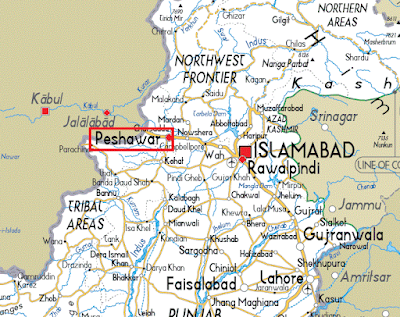
Nawaz Sharif's Pakistan Muslim League-Nawaz (PML-N) party won Pakistan's May 2013 parliamentary elections on a platform that included brokering peace with the TTP.
At an All Parties Conference (APC) in Karachi on 9 September -- in which the US-led "War on Terror" and US drone attacks were blamed Pakistan's domestic terrorism -- PM Sharif won approval from the leaders of Pakistan's political parties to proceed with talks.
Emboldened by the scent of weakness, the TTP upped the ante.
On 14 September, TTP leader Hakimullah Mehsud issued two conditions for talks: the release of 50 jailed militant commanders, and the complete withdrawal and all 150,000 Pakistani military troops from the tribal areas of Khyber Pakhtunkhwa (formerly known as North West Frontier Province).
The very next day (15 Sept) the Khyber Pakhtunkhwa provincial government, headed by the Pakistan Tehreek-e-Insaf (PTI) party of Imran Khan -- who has long advocated for peace with the Taliban -- announced that the withdrawal of troops from Malakand Division would commence in October and that the civil administration would take over control of Swat and other districts accordingly.
ASSASSINATION IN UPPER DIR: 15 Sept 2013
Within hours, the TTP responded by assassinating Major General Sanaullah Khan Niazi, the General Officer Commanding (GOC) of Swat and Malakand Division. Killed along with him by a roadside bomb in the Upper Dir district near the Afghan border, were his right hand man, Lieutenant Colonel Tauseef, and Lance Naik Irfan Sattar.
PESHAWAR CHURCH MASSACRE: 22 Sept 2013
On Sunday 22 September, as up to 600 worshippers were mingling at the close of the service, two Islamic militants armed with automatic rifles and grenades entered the grounds of All Saint's Church, Peshawar. After slaughtering many, they detonated their explosive vests, triggering two huge explosions that blasted shrapnel through the believers. The death toll, presently 89, continues to rise; more than 150 were wounded, many critically. The internet images are shocking and deeply moving.
Two different wings of Tehreek-e-Taliban Pakistan (TTP) have claimed responsibility. A spokesman from TTP Jundullah claimed: 'They [Christians] are the enemies of Islam, therefore we target them. We will continue our attacks on non-Muslims on Pakistani land.' Later a spokesman from Junood ul-Hifsa claimed the attack was in response to US drone strikes. This was the most deadly terrorist attack on Pakistan's Christian community in modern history.
See: Taliban suicide attack on Pakistani church leaves dozens dead
Attack on congregation leaving service in Peshawar is most deadly in history of Pakistan's Christian community
By Jon Boone in Islamabad, The Guardian, Mon 23 Sept 2013
The Sunday 22 Sept 2013 terrorist attack at All Saint's Church, Peshawar, came as the government was reportedly preparing to broker peace with the Tehreek-e-Taliban Pakistan (TTP: the Pakistani Taliban).
Nawaz Sharif's Pakistan Muslim League-Nawaz (PML-N) party won Pakistan's May 2013 parliamentary elections on a platform that included brokering peace with the TTP.
At an All Parties Conference (APC) in Karachi on 9 September -- in which the US-led "War on Terror" and US drone attacks were blamed Pakistan's domestic terrorism -- PM Sharif won approval from the leaders of Pakistan's political parties to proceed with talks.
Emboldened by the scent of weakness, the TTP upped the ante.
On 14 September, TTP leader Hakimullah Mehsud issued two conditions for talks: the release of 50 jailed militant commanders, and the complete withdrawal and all 150,000 Pakistani military troops from the tribal areas of Khyber Pakhtunkhwa (formerly known as North West Frontier Province).
The very next day (15 Sept) the Khyber Pakhtunkhwa provincial government, headed by the Pakistan Tehreek-e-Insaf (PTI) party of Imran Khan -- who has long advocated for peace with the Taliban -- announced that the withdrawal of troops from Malakand Division would commence in October and that the civil administration would take over control of Swat and other districts accordingly.
ASSASSINATION IN UPPER DIR: 15 Sept 2013
Within hours, the TTP responded by assassinating Major General Sanaullah Khan Niazi, the General Officer Commanding (GOC) of Swat and Malakand Division. Killed along with him by a roadside bomb in the Upper Dir district near the Afghan border, were his right hand man, Lieutenant Colonel Tauseef, and Lance Naik Irfan Sattar.
PESHAWAR CHURCH MASSACRE: 22 Sept 2013
Two different wings of Tehreek-e-Taliban Pakistan (TTP) have claimed responsibility. A spokesman from TTP Jundullah claimed: 'They [Christians] are the enemies of Islam, therefore we target them. We will continue our attacks on non-Muslims on Pakistani land.' Later a spokesman from Junood ul-Hifsa claimed the attack was in response to US drone strikes. This was the most deadly terrorist attack on Pakistan's Christian community in modern history.
See: Taliban suicide attack on Pakistani church leaves dozens dead
Attack on congregation leaving service in Peshawar is most deadly in history of Pakistan's Christian community
By Jon Boone in Islamabad, The Guardian, Mon 23 Sept 2013
Excerpt:
"Explosions ripped through the congregation of 500 people, including many women and children, as the service at All Saints church was coming to an end and worshippers were about to receive a free meal of rice in the courtyard outside.
"Witnesses said the interior of the 130-year-old building was turned into a bloodbath, with severed limbs scattered around and the walls pockmarked with ball bearings used as shrapnel by the bombers.
"'I saw myself in the air and then on the ground inside a huge fire of ball,' said Sabir John, a worshipper who lost one of his arms in the blast. . ."
In a short BBC news video a BBC reporter talks with a father as he grieves over the coffin of his 11-year-old daughter. The reporter, listening intently, marvels that, 'somehow he manages to talk of forgiveness'.
PEACE TALKS OFF
On Monday 23 September, Prime Minister Nawaz Sharif called off plans for peace talks with the TTP. “We had proposed peace talks with the Taliban in good faith but . . . because of this attack, the government is unable to move forward with what it planned and envisaged,” he said.
It has been mooted, however, that PM Nawaz Sharif's appeal for peace talks was a farce designed purely to demonstrate the futility of peace talks. If this is true, then Sharif may have been gambling that talk of peace would actually trigger terrorism, giving him the grounds and political support for a full scale military assault on the tribal regions (primarily for the purpose of self-preservation) and/or appeals for military aid.
Meanwhile, the Taliban has no interest in peace with the Pakistani government, for not only would peace with the government actually be against TTP principles, but the TTP has no reason to broker for peace, for they believe they must and can win the battle. Indeed, as Sameera Rashid demonstrates so clearly, "Taliban militants are not an easy foe to talk to because of their strategic superiority over the law and order apparatus of Pakistan."
Likewise, senior military figures have no interest in peace with the Taliban -- especially if peace involves a military withdrawal and the release of militant prisoners. The Pakistani military has fought long and hard, losing many soldiers in the process, to bring a measure of security to Khyber Pakhtunkhwa. They are not about to surrender this territory back to the militants.
It is not outside the realm of possibility that Peshawar's Christians were sacrificed -- i.e. the attack may have been permitted (if not set up) by officials in either the military or the government or both -- to legitimise military action and/or requests for military aid.
While appalling, this is not even remotely far-fetched, as those who watch Pakistan and remember the assassination of Shahbaz Bhatti will well know. [Minorities Minister Shahbaz Bhatti was assassinated in broad daylight by militants on a motorbike who rode into Islamabad's most secure diplomatic precinct armed with automatic weapons, assassinated the minister in his car, and then escaped without a trace.]
Writing for Gatestone Institute on 25 Sept 2013, Raheel Raza comments: "In Pakistan, the Inter-Services Intelligence (ISI), considered to be one of the world's largest intelligence agencies, has not contained the violence unleashed upon Pakistan's minorities. According to some recent reports, there is a special squad, financed by petrodollars and sanctioned by the authorities, created exactly for the purpose of killing minorities -- and this is seemingly why nobody to date has been brought to justice. Recently there have also been massive jailbreaks, freeing hundreds of terrorists."
See: The Danger In Our Midst
by Raheel Raza, September 25, 2013
Writing in Asia Times online, Sameera Rashid blames Islamisation. "The Tehrik-i-Taliban (the TTP, also known as the Pakistani Taliban) and other militants didn't simply sprout out from nowhere. The process of Islamization, introduced ham-fistedly in the Muhammad Zia-ul-Haq era, impacted on the country's education system, legislation and the general moorings of society and gave rise to notion of an exclusivist Sunni Muslim identity."
Rashid notes that sectarian outfits and militant paramilitary organisations, supported by the security establishment to fight proxy wars have joined hands with the Taliban to fulfill their strategic designs. She also notes that Taliban sympathisers exist within the law enforcement agencies and are believed to be responsible for providing militants with maps and other forms of support. She insists the government must stop excusing the militants and blaming the West, and instead, make a serious effort to tackle the domestic causes of terrorism.
See: Delusional reality of Pakistani peace
By Sameera Rashid, 26 Sept 2013
A moving account of the Peshawar attack can be found of Sameera Rashid's blog
Dear Imran Khan, where were you when my church was attacked?
By Sameera Rashid, 24 September 2013
THE BATTLE FOR PAKISTAN: LAND FOR PEACE
In 2005, the then Prime Minister General Pervez Musharraf brokered peace with an alliance of al-Qaeda and Pakistani Taliban forces by ceding South Waziristan (Feb 2005) and then North Waziristan (Sept 2006). Once free and settled in their sanctuary, the jihadist promptly hoisted the black flag and declared the Islamic Emirate of Waziristan.
See Talibanistan: The Establishment of the Islamic Emirate of Waziristan
Pakistan's "truce with the Taliban is an abject surrender, and al Qaeda has an untouchable base of operations in Western Pakistan which will only expand if not checked
By Bill Roggio, September 5, 2006
PEACE TERMINATED
Then mid 2007 saw the stand-off at the radical Lal Masjid (Red Mosque) in the heart of the capital, Islamabad. On 10 July 2007, Pakistani forces stormed the mosque. Official government sources put the death toll at around 100, while Islamist sources claimed more than 2000 were "martyred". On 16 July 2007 the al-Qaeda and Pakistani Taliban alliance based in Waziristan announced the termination of the peace deal with the Pakistani government -- and The Battle for Pakistan resumed.
Full details see: The Battle for Pakistan
By Elizabeth Kendal, 30 Oct 2007
By April 2009, the al-Qaeda and Pakistani Taliban alliance had advance to within around 100 km (60 miles) of Islamabad (the capital of nuclear-armed Pakistan) and Rawalpindi (military headquarters).
See: Religious Liberty Prayer Bulletin (RLPB) 002
PAKISTAN: ISLAMABAD CHURCH ON THE THRESHOLD OF WAR
-- 'land-for-peace' brings Islamabad into al-Qaeda-Taliban's sights.
-- a special prayer bulletin for extraordinary times.
By Elizabeth Kendal, Wed 29 Apr 2009
In May 2009, the government launched a military offensive into Swat, liberating Mingora from Taliban control. Mullah Fazlullah, the commander of the Swat chapter of the Pakistani Taliban, fled into Afghanistan.
Since fleeing Swat, Mullah Fazlullah has organised terrorist activities from his base in Kunar and Nurustan areas of Afghanistan, where he reportedly enjoys the hospitality of the Governor of Kunar province. He reportedly controls between 1,000 and 1,500 diehard terrorists, most of who are linked to the Swat chapter of TTP.
THE BATTLE CONTINUES
Concerning the15 Sept 2013 assassination of Major General Sanaullah Khan Niazi in Upper Dir, analyst Bill Roggio notes that Gen. Sanaullah served as the senior military commander in Swat when it was ruled by the Taliban between 2007 and 2009, after the government negotiated multiple peace deals with Taliban commander Mullah Fuzlullah. Roggio believes the 15 Sept 2013 assassination was "likely carried out by forces loyal to Fazlullah, who also commands Taliban fighters in Dir and in the greater Malakand Division, a region comprising the northern districts of Khyber Pakhtunkhwa province. Fazlullah, who is also known as Mullah Radio for his radical sermons that are broadcast throughout the northwest, is a senior Taliban commander who has opposed polio vaccinations. He has vowed to continue the fight to regain control of Swat and the surrounding districts. Last year, he ordered the assassination of Malala Yousufzai, the young schoolgirl who passionately spoke out against the Taliban in Swat, and accused her of violating sharia, or Islamic law."
Indeed, TTP spokesman Shahidullah Shahid has credited the assassination to TTP's Swat chapter, under the command of Mullah Fazlullah. "Our men did it," he said.
According to Awami National Party (ANP) spokesman, Senator Zahid Khan, militants have been returning to Swat and other parts of Malakand division and reinforcing their positions, emboldened by the provincial government's eagerness for "peace", talking advantage of the ruling Pakistan Tehreek-e-Insaf (PTI) party's "soft corner" towards militants.
TALIBAN SEES OPPORTUNITY
As a senior Western diplomat based in Islamabad notes: "The killing of General Niazi and the Peshawar suicide attack clearly send out a powerful message. The Taliban are saying they don't want peace talks."
In recent weeks, IHS Jane's has been told by both Pakistan's security officials and Western diplomats that the Taliban believe they have an opportunity to enlarge their influence in parts of Afghanistan and Pakistan once international coalition troops leave at the end of 2014.
"They [Taliban] are seeing themselves gain victory after victory. Their military strategy right now seems to suggest they see an opportunity to continue their fight and increase their influence," said one Pakistani security official.
CRACKDOWN ANTIPICATED; BACKLASH EXPECTED
During the government's 2009 military offensive against the Pakistani Taliban, persecution of Christians soared, particularly in Punjab, as madrassas-educated, thoroughly radicalised Muslims reacted violently against what they perceived as a US-backed war against Islam.
If the government is serious about protecting minorities (as it claims) -- security must be bolstered at all churches and throughout all Christian districts. Any state that regards its Christians as expendable is destined to be impoverished.
---------------------------------
Elizabeth Kendal is the author of
Turn Back the Battle: Isaiah Speaks to Christians Today
(Deror Books, Dec 2012)
"Explosions ripped through the congregation of 500 people, including many women and children, as the service at All Saints church was coming to an end and worshippers were about to receive a free meal of rice in the courtyard outside.
"Witnesses said the interior of the 130-year-old building was turned into a bloodbath, with severed limbs scattered around and the walls pockmarked with ball bearings used as shrapnel by the bombers.
"'I saw myself in the air and then on the ground inside a huge fire of ball,' said Sabir John, a worshipper who lost one of his arms in the blast. . ."
In a short BBC news video a BBC reporter talks with a father as he grieves over the coffin of his 11-year-old daughter. The reporter, listening intently, marvels that, 'somehow he manages to talk of forgiveness'.
PEACE TALKS OFF
On Monday 23 September, Prime Minister Nawaz Sharif called off plans for peace talks with the TTP. “We had proposed peace talks with the Taliban in good faith but . . . because of this attack, the government is unable to move forward with what it planned and envisaged,” he said.
It has been mooted, however, that PM Nawaz Sharif's appeal for peace talks was a farce designed purely to demonstrate the futility of peace talks. If this is true, then Sharif may have been gambling that talk of peace would actually trigger terrorism, giving him the grounds and political support for a full scale military assault on the tribal regions (primarily for the purpose of self-preservation) and/or appeals for military aid.
Meanwhile, the Taliban has no interest in peace with the Pakistani government, for not only would peace with the government actually be against TTP principles, but the TTP has no reason to broker for peace, for they believe they must and can win the battle. Indeed, as Sameera Rashid demonstrates so clearly, "Taliban militants are not an easy foe to talk to because of their strategic superiority over the law and order apparatus of Pakistan."
Likewise, senior military figures have no interest in peace with the Taliban -- especially if peace involves a military withdrawal and the release of militant prisoners. The Pakistani military has fought long and hard, losing many soldiers in the process, to bring a measure of security to Khyber Pakhtunkhwa. They are not about to surrender this territory back to the militants.
It is not outside the realm of possibility that Peshawar's Christians were sacrificed -- i.e. the attack may have been permitted (if not set up) by officials in either the military or the government or both -- to legitimise military action and/or requests for military aid.
While appalling, this is not even remotely far-fetched, as those who watch Pakistan and remember the assassination of Shahbaz Bhatti will well know. [Minorities Minister Shahbaz Bhatti was assassinated in broad daylight by militants on a motorbike who rode into Islamabad's most secure diplomatic precinct armed with automatic weapons, assassinated the minister in his car, and then escaped without a trace.]
Writing for Gatestone Institute on 25 Sept 2013, Raheel Raza comments: "In Pakistan, the Inter-Services Intelligence (ISI), considered to be one of the world's largest intelligence agencies, has not contained the violence unleashed upon Pakistan's minorities. According to some recent reports, there is a special squad, financed by petrodollars and sanctioned by the authorities, created exactly for the purpose of killing minorities -- and this is seemingly why nobody to date has been brought to justice. Recently there have also been massive jailbreaks, freeing hundreds of terrorists."
See: The Danger In Our Midst
by Raheel Raza, September 25, 2013
Writing in Asia Times online, Sameera Rashid blames Islamisation. "The Tehrik-i-Taliban (the TTP, also known as the Pakistani Taliban) and other militants didn't simply sprout out from nowhere. The process of Islamization, introduced ham-fistedly in the Muhammad Zia-ul-Haq era, impacted on the country's education system, legislation and the general moorings of society and gave rise to notion of an exclusivist Sunni Muslim identity."
Rashid notes that sectarian outfits and militant paramilitary organisations, supported by the security establishment to fight proxy wars have joined hands with the Taliban to fulfill their strategic designs. She also notes that Taliban sympathisers exist within the law enforcement agencies and are believed to be responsible for providing militants with maps and other forms of support. She insists the government must stop excusing the militants and blaming the West, and instead, make a serious effort to tackle the domestic causes of terrorism.
See: Delusional reality of Pakistani peace
By Sameera Rashid, 26 Sept 2013
A moving account of the Peshawar attack can be found of Sameera Rashid's blog
Dear Imran Khan, where were you when my church was attacked?
By Sameera Rashid, 24 September 2013
THE BATTLE FOR PAKISTAN: LAND FOR PEACE
In 2005, the then Prime Minister General Pervez Musharraf brokered peace with an alliance of al-Qaeda and Pakistani Taliban forces by ceding South Waziristan (Feb 2005) and then North Waziristan (Sept 2006). Once free and settled in their sanctuary, the jihadist promptly hoisted the black flag and declared the Islamic Emirate of Waziristan.
See Talibanistan: The Establishment of the Islamic Emirate of Waziristan
Pakistan's "truce with the Taliban is an abject surrender, and al Qaeda has an untouchable base of operations in Western Pakistan which will only expand if not checked
By Bill Roggio, September 5, 2006
PEACE TERMINATED
Then mid 2007 saw the stand-off at the radical Lal Masjid (Red Mosque) in the heart of the capital, Islamabad. On 10 July 2007, Pakistani forces stormed the mosque. Official government sources put the death toll at around 100, while Islamist sources claimed more than 2000 were "martyred". On 16 July 2007 the al-Qaeda and Pakistani Taliban alliance based in Waziristan announced the termination of the peace deal with the Pakistani government -- and The Battle for Pakistan resumed.
Full details see: The Battle for Pakistan
By Elizabeth Kendal, 30 Oct 2007
By April 2009, the al-Qaeda and Pakistani Taliban alliance had advance to within around 100 km (60 miles) of Islamabad (the capital of nuclear-armed Pakistan) and Rawalpindi (military headquarters).
See: Religious Liberty Prayer Bulletin (RLPB) 002
PAKISTAN: ISLAMABAD CHURCH ON THE THRESHOLD OF WAR
-- 'land-for-peace' brings Islamabad into al-Qaeda-Taliban's sights.
-- a special prayer bulletin for extraordinary times.
By Elizabeth Kendal, Wed 29 Apr 2009
In May 2009, the government launched a military offensive into Swat, liberating Mingora from Taliban control. Mullah Fazlullah, the commander of the Swat chapter of the Pakistani Taliban, fled into Afghanistan.
Since fleeing Swat, Mullah Fazlullah has organised terrorist activities from his base in Kunar and Nurustan areas of Afghanistan, where he reportedly enjoys the hospitality of the Governor of Kunar province. He reportedly controls between 1,000 and 1,500 diehard terrorists, most of who are linked to the Swat chapter of TTP.
THE BATTLE CONTINUES
Concerning the15 Sept 2013 assassination of Major General Sanaullah Khan Niazi in Upper Dir, analyst Bill Roggio notes that Gen. Sanaullah served as the senior military commander in Swat when it was ruled by the Taliban between 2007 and 2009, after the government negotiated multiple peace deals with Taliban commander Mullah Fuzlullah. Roggio believes the 15 Sept 2013 assassination was "likely carried out by forces loyal to Fazlullah, who also commands Taliban fighters in Dir and in the greater Malakand Division, a region comprising the northern districts of Khyber Pakhtunkhwa province. Fazlullah, who is also known as Mullah Radio for his radical sermons that are broadcast throughout the northwest, is a senior Taliban commander who has opposed polio vaccinations. He has vowed to continue the fight to regain control of Swat and the surrounding districts. Last year, he ordered the assassination of Malala Yousufzai, the young schoolgirl who passionately spoke out against the Taliban in Swat, and accused her of violating sharia, or Islamic law."
Indeed, TTP spokesman Shahidullah Shahid has credited the assassination to TTP's Swat chapter, under the command of Mullah Fazlullah. "Our men did it," he said.
According to Awami National Party (ANP) spokesman, Senator Zahid Khan, militants have been returning to Swat and other parts of Malakand division and reinforcing their positions, emboldened by the provincial government's eagerness for "peace", talking advantage of the ruling Pakistan Tehreek-e-Insaf (PTI) party's "soft corner" towards militants.
TALIBAN SEES OPPORTUNITY
As a senior Western diplomat based in Islamabad notes: "The killing of General Niazi and the Peshawar suicide attack clearly send out a powerful message. The Taliban are saying they don't want peace talks."
In recent weeks, IHS Jane's has been told by both Pakistan's security officials and Western diplomats that the Taliban believe they have an opportunity to enlarge their influence in parts of Afghanistan and Pakistan once international coalition troops leave at the end of 2014.
"They [Taliban] are seeing themselves gain victory after victory. Their military strategy right now seems to suggest they see an opportunity to continue their fight and increase their influence," said one Pakistani security official.
CRACKDOWN ANTIPICATED; BACKLASH EXPECTED
During the government's 2009 military offensive against the Pakistani Taliban, persecution of Christians soared, particularly in Punjab, as madrassas-educated, thoroughly radicalised Muslims reacted violently against what they perceived as a US-backed war against Islam.
If the government is serious about protecting minorities (as it claims) -- security must be bolstered at all churches and throughout all Christian districts. Any state that regards its Christians as expendable is destined to be impoverished.
---------------------------------
Elizabeth Kendal is the author of
Turn Back the Battle: Isaiah Speaks to Christians Today
(Deror Books, Dec 2012)