Sunday, April 14, 2019

Papua: The Christian Crisis in Eastern Indonesia

(NOTE: The western half of the island of New Guinea, Papua was formerly known as Irian Jaya)
-- by Elizabeth Kendal

The U.N. High Commissioner for Human Rights, Michelle Bachelet was taken by surprise on Friday 25 January when exiled Papuan independence leader Benny Wenda walked into her office.

The delegation from Vanuatu, which was in Geneva for a scheduled Universal Periodic Review (UPR), had requested and been granted a private meeting with Ms Bachelet.  Ravina Shamdasani, deputy spokeswoman at the U.N. Human Rights Office, explains what took place:

“During this meeting, one member of the Vanuatu delegation, Mr. Benny Wenda, presented the high commissioner with a petition. This was not actually a meeting arranged with Mr. Wenda for that purpose,” she said, adding that Ms Bachelet “was not aware” in advance.

The petition, which Indonesia has banned, carries over 1.8 million Papuan signatures collected in secret and at great risk.

As Australian journalist and author John Martinkus explains, the petition “calls on the UN to review the controversial 1969 vote that transferred control of West Papua to Indonesia. The Act of Free Choice vote, often referred to as the Act of No Choice by its detractors, saw 1026 people – selected by the Indonesian military – vote on behalf of their fellow West Papuans to give up sovereignty for Indonesian citizenship.

“The petition also asks for West Papua to be placed back on the UN decolonisation list. This would mean the possibility of a referendum on Papuan sovereignty, which Papuans have been hoping for since a similar referendum in East Timor, now Timor-Leste, resulted in its independence from Indonesia in 1999.”

In September 2017, Benny Wenda took the petition to New York, where the UN General Assembly was in session, with the hope of getting it into the hands of the United Nations Special Committee on Decolonisation.

Unfortunately, the committee’s chair, Rafael Ramirez (Venezuela), claimed not to have received the petition, before adding that it could not be accepted anyway, as Papua “is not on the agenda” and “Indonesia is a very good friend of ours”.

See: Papua (eastern Indonesia): a desperate and risky plea
Religious Liberty Prayer Bulletin (RLPB) 426, 4 Oct 2017.

Needless to say, Mr Wenda’s 25 January coup has infuriated Indonesia. Indonesia’s Ambassador to the UN, Hasan Kleib, strongly condemned Vanuatu for essentially sneaking Wenda in and helping him get access to Bachelet.

“(They) deliberately deceived the High Commission by taking manipulative steps through the infiltration of Benny Wenda into the Vanuatu delegation,” Kleib fumed.

Mr Wenda with petition (25 January 2019, Geneva) Image: twitter

Unfortunately, in this battle for human rights, the Papuans have very few international friends. Australia, America and the United Kingdom – economically influential democracies that should be advocating for human rights in Papua – are more interested in keeping Indonesia out of China’s sphere of influence. And so the human rights of the mostly-Christian indigenous Papuans are sacrificed on the altar of good relations with Indonesia, for geo-strategic and economic gain.

The Trans-Papua Highway

One of Indonesia most controversial development projects is the Trans-Papua Highway, or Trans-Papuan Economic Corridor. The enormously expensive Trans-Papua Hwy will traverse Papua’s long-untraversable highlands, linking industries, mines and oil and gas hubs, while ploughing through pristine tropical rainforest, the world heritage listed Lorentz National Park and vast tracts of customary lands belonging to indigenous Papuans.

short film: Global Roadmap
For more information see:
Ill-advised' Papua highway imperils indigenous rights, rainforests
Rina Chandran, Thomson Reuters Foundation, 4 Feb 2019
also: Yale Environment 360

Writing in The Saturday Paper (9 Feb 2019), Australian journalist and author John Martinkus gives voice to Papuan fears.  “The 4000-kilometre road, will stretch from West Papua’s largest city, Sorong, through the Papuan mountains and forest to the town of Merauke in Indonesia’s east. Indonesian president Joko Widodo claims the road, the Trans-Papua Highway, will bring commerce and development to these remote regions. However, the highlanders see the road as a threat, which will bring Indonesian migrants and the military to the region. Many fear greater access to the highlands will destroy their way of life, as they believe it did for lowlanders living on the coast. As construction of the highway has progressed, it has catalysed many West Papuans to take up arms in opposition.”

And as Martinkus notes, “This escalation of the independence movement, one of the world’s longest-running insurgencies, brings with it the potential of an even deadlier conflict, for both sides.”

Martinkus explains that when he was in Papua in 2002, independence fighters were armed mostly with sticks, spears, bows and arrows, and maybe the odd hunting rifle. “Today,” he warns, “many West Papuan fighters are armed with Indonesian-produced weapons, bought or stolen from Indonesian soldiers.”

The fighters, he explains, are “the children of those killed, imprisoned and forced to flee during deadly confrontations with the Indonesian military in Papua’s remote central highlands. Growing up, these young Papuans also watched on as Grasberg – the world’s largest goldmine – has wreaked havoc on the environment of West Papua while generating billions for its co-owners, Freeport-McMoRan and the Indonesian government. Now adults, they have deeply held frustrations about perceived exploitation of their lands by the Indonesian government.”

Bloodshed in Nduga

On 2 December 2018, rebels affiliated with the West Papua Liberation Organization (WPLO) – a militant wing of the Free Papua Movement – abducted 25 construction workers working on the Trans-Papua Hwy in Nduga province, in the central highlands, north of the Freeport Grasberg mine. The next day the rebels took their captives to a nearby hilltop and shot them, killing 19 and injuring 4, who pretended to be dead to escape.

The WPLO claim that the laborers were actually armed Indonesian soldiers (TNI) who had attacked them. Reportedly, on 1 December, Papuans had spotted one of the laborers taking photographs of the Papuans as they raised the banned Morning Star flag in commemoration of the 1 December 1971 declaration of Papuan independence.

As would be expected, a heavy influx of TNI forces descended on Nduga province; retaliation has been swift and hard. While the military claims to be hunting the rebels responsible for the killings, the crackdown has forced some 32,000 mostly-Christian indigenous Melanesian Papuans to flee their homes. Many are struggling to survive in the jungle; at least nine women have given birth. In the Mbua district, two school children were shot dead by Indonesian security forces (TNI). Across Nduga region, the TNI has damaged or destroyed at least 34 schools and churches; it has also seized the SION GKI Mapenduma church for use as a military base. Those who have fled say they are too afraid to return to their homes.  Women and children are dying in the forest and camps for want of food and medical treatment.

Reports and photos have emerged of victims with deep burns. Canisters have been found which lend support to local claims that the TNI has been dropping explosive devices containing white phosphorous from helicopters.

As Chairman of the United Liberation Movement for West Papua (ULMWP), Benny Wenda has condemned the use of chemical weapons by the Indonesian military on Papuan civilians. He said the ULMWP has received numerous reports regarding the use of chemical burn-causing weapons on villages in the Nduga region. “We have photos of burned limbs, dead bodies and empty munitions canisters.”

Naturally the TNI denies this. In fact the TNI is denying there has been any destruction at all, claiming it is all a ‘hoax’.

Father John Djonga has called for the Indonesian government to allow access to media, humanitarian organisations and a UN human rights mission.

Benny Wenda urged all Papuans to boycott the general elections on 17 April. “We respect Indonesia’s right to hold elections in its own territory,” he said, “but we will oppose the elections of the coloniser when they are forced upon us. We have tried participating in the elections of the colonial master before – but we are still killed, tortured and discriminated against every day.”

Recommended: War in West Papua
By John Martinkus, The Saturday Paper, 9 February 2019

Papua’s Christian Crisis 

As Indonesia drifts from Pancasila to Islamisation, the human rights situation in Papua takes on a whole new urgency. These are watershed days. The future of a Christian people is in the balance.

--------------
Post-script

While searching for more details on the situation in Papua, I came across the following feature article in the Jakarta Globe. It might represent a still small Indonesian voice, but it is encouraging.  It also offers some insight into Papua for those who are unfamiliar with this closed land.

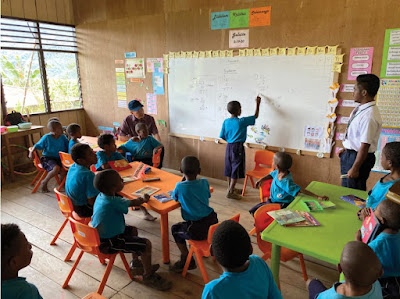
Giving Hope to the Children of Papua
By Primus Dorimulu, Jakarta Globe, 6 March 2019

And for a wonderful article on this ministry by Christianity Today's Jeremy Weber, see:

In the mountains of Papua, missionaries and Indonesian professionals serve the lost together.
JEREMY WEBER
Christianity Today, 23 NOVEMBER 2020

YPHP founder James Riady joins Mek students in Nalca for a math class.
image: Jeremy Weber

-------------

Elizabeth Kendal is an international religious liberty analyst and advocate. She serves as Director of Advocacy at Canberra-based Christian Faith and Freedom (CFF), and is an Adjunct Research Fellow at the Arthur Jeffery Centre for the Study of Islam at Melbourne School of Theology.

She has authored two books: Turn Back the Battle: Isaiah Speaks to Christians Today (Deror Books, Melbourne, Australia, Dec 2012) which offers a Biblical response to persecution and existential threat; and After Saturday Comes Sunday: Understanding the Christian Crisis in the Middle East (Wipf and Stock, Eugene, OR, USA, June 2016).

See www.ElizabethKendal.com 

Thursday, April 11, 2019

Indonesia: from Pancasila to Islamisation

Vale traditional Indonesian values
-- by Elizabeth Kendal

Indonesians will go to the polls on Wednesday 17 April to elect a president and vice-president, a weak 136-seat Senate, a powerful 575-seat House of Representatives, provincial legislatures and local councils.

Recommended:
Six Things You Should Know About the Indonesian Elections
By Tim Mann, University of Melbourne

Excerpt:
“According to the KPU [Indonesian Electoral Commission], about 40 per cent of eligible voters are millennials aged 17 to 35 years old. And many of them will be voting for the first time. So the new millennial vote is considered the key to victory. . .

“Young voters are far from a homogenous group and many of those who are well connected online also hold deeply conservative views.

“One survey of school and university students by Jakarta’s State Islamic University in late 2017 found that 33 percent of young Muslims believed that acts of intolerance against minorities were ‘not a problem’ and 34 percent even believed that non-believers should be killed.”

Presidential Poll: Close and Profoundly Polarising

Background:
Indonesia: “sword” of weaponised Islam revealed 
Religious Liberty Prayer Bulletin (RLPB) 469, 22 Aug 2018.

Polling indicates that the incumbent President Joko Widodo (57, also known as Jokowi) will be returned as president with the conservative Islamic cleric Ma’ruf Amin (76) as his Vice-President. However, the gap between Jokowi and his perpetual rival, the controversial former Suharto-era military commander Prabowo Subianto (68), has narrowed. Subianto and his running mate, the telegenic billionaire businessman Sandiaga Uno (49), have pitched their message not only to the poor who feel left behind by Jokowi’s pro-development and pro-foreign investment policies, but to the more hard-line and intolerant, Jokowi-hating fundamentalist Islamists. Pundits expect the race to be not only close, but profoundly polarising. 

John McBeth reports for Asia Times Online (9 April), “The demarcation line between voters is clear: those who support Widodo, an avowed pluralist, don’t see Islam as the basis of the state. But those who favor deeper Islamisation are behind Prabowo.”

Jakarta-based Amanda Hodge is the South East Asia correspondent for The Australian. She comments (9 April) that the differences between the two presidential candidates were on display in the two political rallies that took place on Sunday 7 April. 

“While challenger and former Suharto-era military commander Prabowo Subianto’s 150,000-strong morning rally at a Jakarta stadium was an angry sermon against corruption and foreign plunderers to a sea of Islamic white, Jokowi’s afternoon carnival celebrated a vast diversity of ethnicities, races and religions.

“So stark has Indonesia’s polarisation along identity lines become this election, former president Susilo Bambang Yudhoyono [SBY] – whose Democrats Party backs Prabowo’s bid – ¬issued a weekend warning of the importance of governing for all. ‘As a former president, I would hate Indonesia to be divided into those who are pro-Pancasila and pro-caliphate,’ he wrote in a letter to party leaders, referring to Indonesia’s founding philosophy of unity in diversity. ‘If such polarisation continues in this campaign, I worry that this nation will indeed be divided into two opposing sides who will forever be in conflict with each other.’

Hodge confirms (8 April),  “Prabowo and his 49-year-old billionaire equities-dealer running mate, Sandiaga Uno, are polling higher among urban youth – a significant voter pool in a country where almost 40 per cent of the 192 million voters are under 35.

“Prabowo has also cornered the conservative Islamic vote, which will no doubt welcome exiled cleric Rizieq Shihab’s endorsement by video-link yesterday from Mecca. The Islamic Defenders Front [FPI] leader, who fled the country in 2017 after he was charged with pornography offences and insulting the state ideology, urged voters to stage a ‘constitutional jihad’ at the ballot box and change their president.”

The Prabowo Subianto-Sandiaga Uno ticket has also won support from the now-banned Indonesian Hizbut Tahrir (HTI) which supports the establishment of a caliphate and the adoption of Islamic Sharia law.

In truth, these hardline Islamists have no love for Subianto or Uno, both of whom are nominal Muslims at best. But while their affection for Subianto and Uno is luke-warm and pragmatic, but their hatred for Joko Widodo red-hot and supreme.

Meanwhile, the pro-development Jokowi-Ma’ruf ticket has secured the backing of Indonesia’s largest Islamic organisation, the Nahdlatul Ulama (NU). This is unsurprising considering Ma’ruf Amin was NU Supreme Leader until he stepped down in September 2018 in order to enter politics. Instead he will serve as a member of NU’s advisory board.

As noted by Tim Mann (University of Melbourne), “voter dissatisfaction has led to a growing movement of people declaring that they would rather sit the election out or ‘donkey vote’ (golput) than vote for either of the candidates on offer”.

Indeed, according to a recent survey by Indikator Politik, at least 20 percent of Indonesia’s roughly 192 million registered voters will abstain from voting in the presidential poll due to the deep dissatisfaction they feel with regards to the candidates.

These are voters who would never vote for Subianto, primarily on account of his penchant for authoritarianism and alleged human rights abuses as a Kopassus general. But they also feel let down by Jokowi, and not only because he has failed to deliver on many of his promises. Many who would have voted for Jokowi will now be non-voters or golongan putih (golput) precisely because Jokowi’s vice-presidential running mate is Ma’ruf Amin, the cleric who, as NU Supreme Leader, testified against the ethnic Chinese Christian Governor of Jakarta, Basuki Tjahaja Purnama (Ahok) in the controversial blasphemy trial two years ago [See: Ahok’s Blasphemy, Religious Liberty Monitoring (29 Nov 2016)]. 

Recommended:
Jokowi’s ideological shift has not gone unnoticed
By Endy Bayuni, The Jakarta Post, 10 April 2019

Excerpts:
“Bidding for his reelection in the April 17 presidential race, the incumbent Joko “Jokowi” Widodo has focused his attention more on winning the hearts and minds of conservative voters, reflected among other means by his choice of running mate and giving concessions to the military. . .

“Jokowi’s apparent ideological shift may be more for expediency to ensure victory, but voters from his traditional support base to the left of the political spectrum fear it could have major policy implications for his next administration.

“Many have declared through social media memes that they will not vote, making clear they did not endorse the shift, but that they would not give their vote to the challenger who is even further to the right, embracing hard-line Islamic groups.

“How far to the right of the political spectrum is Jokowi shifting? Will he be able to resist pressures from Muslim conservatives and the military who want to have more say in his next government?

“Almost assured of election victory, Jokowi’s political fate is now very much in the hands of those on the left of the political spectrum. If there are enough of them too angry to vote because of his shift to the right, they could well deliver victory to Prabowo.”
 
Presidential Poll: “The Islamists Have Already Won”

Recommended:
Indonesia’s Next Election Is in April. The Islamists Have Already Won.
How religion has come to dominate our politics.
An opinion piece for New York Times, by Eka Kurniawan, 14 Feb 2019

Renown Indonesian novelist Eka Kurniawan believes that by nominating Ma’ruf as his Vice President, Jokowi “has built a Trojan horse for his opponents outside the walls of his own city”.

In comparing the 2019 election to that of 2014, Mr Kurniawan notes, “This year, it seems, the decisive issue will be the candidates’ professed commitment to Islam.”

According to Mr Kurniawan, “polarisation has deepened since Jakarta’s gubernatorial election two years ago.

“Mr. Prabowo and the rest of the opposition evidently learned a lot from Mr. Basuki’s [Ahok’s] downfall. In 2014, they ran an antiquated campaign based on the supposed resurgence of communism and the Indonesian Communist Party, and failed. The [2017] Jakarta election has taught them that tapping Muslim values is an effective way to galvanize popular support.

“With the Islamization of Indonesian society now evidently being mobilized toward political ends, Mr. Joko must proceed with caution. Yet he may have gone too far.

“To give a good impression to Muslim voters, Mr. Joko has been presenting himself as a pious leader who worships diligently. He has even become a prayer imam and makes frequent visits to Islamic boarding schools. He has also closed his eyes and ears to certain cases brought on religious grounds, knowing that any statement could inflame grass-roots Muslims. . .”

Concerning Ma’ruf Amin, Mr Kurniawan says, “He isn’t just conservative; he is intolerant. He forbids the exchange of Christmas greetings. He rejects the Ahmadiyya, an alternative Islamic sect. He condemns L.G.B.T. activities. He wants to limit houses of worship for non-Muslims.

“Mr. Joko might remain in power, but we don’t have to wait until April to find out the real outcome of this race. No matter who ends up being president, conservative Islamic groups, backed by radical groups, will win — have already won — the election.”

Recommended:
What might Jokowi’s vice presidential pick mean for religious freedom?
By Dr Budhy Munawar Rachman,
for Indonesia at Melbourne [University], 14 August 2018

Excerpt/conclusion
“When Jokowi was elected [in 2014], many hoped for a reversal of the intolerance that had been allowed to develop under his predecessor [Susilo Bambang Yudhoyono]. There have been some limited improvements over the last four years, but the core concerns remain – religious minorities are still not able to fully enjoy the religious freedom they are guaranteed under the Constitution.

“Shi’a and Ahmadiyah Muslims still face discrimination. Accusations of blasphemy are still used against minorities who demonstrate religious understandings or practices that differ from the majority. Minorities still face extreme difficulty building houses of worship.

“If Jokowi is re-elected, the chances of this trend reversing are slim. Under Ma’ruf, MUI has been unwilling to accept arguments in support of minorities based on their constitutional right to religious freedom, instead relying on conservative religious interpretations that benefit the majority Muslim community. With Ma’ruf as vice president, things could well become a lot worse for minorities than they already are.”

-------------------------------------------------------------

Elizabeth Kendal is an international religious liberty analyst and advocate. She serves as Director of Advocacy at Canberra-based Christian Faith and Freedom (CFF) and is an Adjunct Research Fellow at the Arthur Jeffery Centre for the Study of Islam at Melbourne School of Theology.

She has authored two books: Turn Back the Battle: Isaiah Speaks to Christians Today (Deror Books, Melbourne, Australia, Dec 2012) which offers a Biblical response to persecution and existential threat; and After Saturday Comes Sunday: Understanding the Christian Crisis in the Middle East (Wipf and Stock, Eugene, OR, USA, June 2016).

See www.ElizabethKendal.com 

Tuesday, December 4, 2018

Australia: Will Religious Liberty Slide into Oblivion?

by Elizabeth Kendal

Australia’s ruling Liberal National coalition/Party (LNP) has been riven by a ferocious internal culture war. It is a war that pits conservatives (routinely described in the media as extreme, radical, reactionary and “far-right”) against progressives (routinely described in the media as moderates and centrists despite being as far left as the far left on many social issues).

This war has resulted in two changes of prime minister in five years. After the federal polls of 2013 resulted in the election of an LNP  conservative (with a 17 seat majority), an intra-party coup in September 2015 put the party in the hands of progressives. That government was re-elected in 2016 with one seat majority, before a counter coup led by conservatives in August 2018 left the government in chaos. Tensions were resolved (somewhat) through party’s election of a compromise candidate: Scott Morrison, a conservative who had served as Minister for Immigration and Border Protection in the Abbott (conservative) government, and as treasurer in the Turnbull (progressive) government.

More critically, the war has led to the loss of two LNP Members of Parliament. One seat was lost in October through a bi-election which saw Dr Kerryn Phelps – a progressive LGBT activist, running as an independent – elected in Turnbull’s formerly safe Liberal seat. Another seat was lost on 27 November when MP Julia Banks (progressive) treacherously defected to the crossbench. Having been re-elected in July 2016 with a one seat majority, these were two seats the LNP could not afford to lose. Now, as it navigates its way to the next federal election (slated for May 2019), the LNP must proceed as a minority government.

Eager to humiliate the LNP ahead of the 2019 polls the opposition is doing all in its power to hinder the government’s agenda on multiple fronts. High on the list is the issue of religious freedom.

The Status of Religious Freedom in Australia

Throughout the nation’s short history, the idea that religious freedom is a fundamental and universal human right has simply been taken for granted. Consequently, no legislation has ever been enacted to protect religious freedom. As far as legislation goes, religious freedom only exists in negative terms – through exemptions in anti-discrimination law. The religious exemptions became a necessity after the law’s list of protected attributes was expanded to include attributes such as gender identity and sexual orientation.  Strip the religious exemptions away, and religious freedom is not protected.

In the absence of legislation to protect religious freedom, and despite the deference shown to “international standards” [i.e. the Universal Declaration of Human Rights (UDHR, 1948) and the International Covenant on Civil and Political Rights (ICCPR, 1966)], “equality” and “non-discrimination” have come to be viewed as the benchmarks by which rights are established.

This leaves religious liberty and faith communities in a precarious position, especially now that same-sex marriage / “marriage equality” has been legalised and therefore legitimised as good and as a right. Unable to claim minority (and therefore protected) status, Christians are particularly vulnerable. The fact that devout, Bible-believing Christians doubtless are a minority and exist in large numbers within ethnic minorities is irrelevant.

HOSTILITY RISES

Hostility quietly simmered and rose over several years as the national debate over “marriage equality” ran parallel to the federal government’s Royal Commission into Institutional Responses into Child Sexual Abuse. 

Launched in November 2012 by then Prime Minister Julia Gillard, the Royal Commission was necessitated by the lack of justice, absence of resolution and lingering, festering pain caused by the scandal of child sexual abuse in the Church.

See: Royal Commission Timeline 

The Royal Commission investigated numerous institutions, including schools, residential care facilities, sporting clubs and detention facilities as well as religious institutions of all creeds and denominations. While all the reports were shocking, revealing a deep social sickness, it was the reports of sexual abuse in the Church – especially those alleged to have been committed or covered-up by some of the Church’s most respected figures – that captivated the attention of mainstream media and seized popular imagination. Quite apart from the enormous financial cost of redress, the primary consequence of the Royal Commission for the Church is that the Church’s moral authority has been shredded and will doubtless remain rubbish for generations to come.

The Royal Commission handed down its findings and recommendations on 15 December 2017, just one week after the Australian parliament voted to legalise same-sex marriage and one month after the postal plebiscite in which 61.6 percent of Australian voters expressed support for “marriage equality”.

In a very real sense, the Australian Church has been driven into exile.

The Case of White Magazine

On 17 November 2018, Christians Luke and Carla Burrell announced that after 12 years of successful business, White magazine would cease publication. The popular wedding magazine became economically nonviable after LGBTQ activists, who had become aware that the magazine did not feature same-sex couples, launched an aggressive campaign against it. The campaign drove off advertisers, frightened staff and included threats of physical harm (including a threat to torch the Burrell’s home).

Official statement by White magazine: Farewell (17 Nov 2018)

In Australia we take threats by LGBTQ activists very seriously. In December 2016, Eternity House – the headquarters of the Australian Christian Lobby (ACL) – was firebombed by an LGBTQ activist who was seriously burned in the process. Canberra police were quick to clean up the scene and whitewash the attack as a failed suicide attempt with no ideological motive, something ACL rejected from the outset. This official narrative was confirmed as false when the accused – IT manager and LGBT activist Jaden Duong – testified in court that he researched how to make a bomb and targeted ACL headquarters precisely because he disliked ACL’s “position on sexuality”. [The accused committed suicide before the trial could conclude.]

The Rise of Lawfare

In the two years since its founding in September 2016, the Australia Christian Lobby’s Human Rights Law Alliance has been involved in some 50 cases of lawfare against Christians. Initiated (generally) by leftists and LGBTQ activists, these cases involve “everyday Christians” who have been targeted for their beliefs.

ACL Managing Director Martyn Iles elaborates (Nov 2018): “There is the story of a university student who was suspended for praying with another student [see Josh’s story]; a general manager dismissed for his beliefs regarding Safe Schools [a supposedly anti-bullying programme, designed by an openly Marxist LGBTQ activist, which teaches gender fluidity, moral relativism and has been likened to LGBTQ grooming] and the case of David van Gend who was hauled in front of the Medical Board all for posting two tweets [challenging] gender ideology.”

Madeline (18)
In September 2017 (i.e. during the same-sex marriage postal plebiscite campaign) Madeline (18), a children’s party entertainer based in Canberra, updated her Facebook profile image to include the official “It’s ok to vote no” frame. For this, Madeline was immediately sacked on the grounds that her “homophobic views” comprised “hate speech” which was “detrimental to the business”.

Indeed numerous workers, including teachers and other professionals, have been disciplined, sacked or have lost their accreditation simply for expressing their position on same-sex marriage. While most cases are quickly resolved after the accused Christians receive legal advice, the trend is undeniable: intolerance is escalating.

The Case of Jason Tey

Jason Tey with his family
(WAToday, Jan 2018)
One of the most shocking and troubling cases relates to the internationally recognised, ward-winning, Perth-based wedding photographer Jason Tey.  A conservative Christian, Jason Tey was taken to the Western Australian Equal Opportunity Commission after he agreed to photograph the children of a same-sex couple, but disclosed a conflict of belief in case the couple felt more comfortable hiring someone else.

As Martyn Iles notes, “[Jason Tey] did not refuse service. He offered to do the job despite his conflict. The conciliation conference failed, and he is now before Western Australia’s State Administrative Tribunal.”

Tey describes the action against him as “a kick in the guts because I work so hard for my business to be a positive influence and to provide a living for my family.”

The Emergence of Thought Crime

As Iles points out, the cases of White Magazine and Jason Tey “cross a concerning threshold”.

“They are not for overt actions which may be considered discriminatory.  They are for two things previously deemed part of our inherent freedoms – in the case of White (Magazine), for doing nothing, for their silence. In the case of Tey, for merely stating his beliefs. Nothing more than that.”

Iles warns that Australia is facing “a quiet crisis of freedom”.

“We are at the stage where anything less than total affirmation [of LGBTQ ideology] is worthy of vicious attack. We’re spiralling into an Orwellian nightmare.”

The State of Victoria

It must be noted that Ground Zero for lawfare has been the south-eastern state of Victoria. Consequently, the 24 November re-election of the Andrews Labor government (described by Andrews as “the most progressive government in the nation”) –  despite its pre-election promise to double the deficit – bodes ill for religious freedom in Victoria.

During its previous term, the Andrews-led Labor government legalised euthanasia and assisted suicide, removed religious instruction from Victorian classrooms, imposed compulsory gender ideology on state secondary colleges, and criminalised  the act of offering to assist women seeking abortion within 150 meters of an abortion clinic [see Kathy’s story].

During 2016 the Andrews Labor government also tried to strip religious exemptions from anti-discrimination law so as to deny religious schools the right to select staff who uphold their values. It also tried to amend the Births, Death and Marriages Registration Act so as to enable transgender, gender diverse and intersex adults and children to alter the record of sex in their Victorian birth registration without having to undergo sex affirmation surgery and be unmarried . . . so long as they have not altered the record of their sex with the 12 months preceding the date of application. Fortunately, thanks to the tireless work of Christian lobbyists, the government came up one vote short in both cases.

It will not have that problem now, having won re-election in a landslide. Doubtless religious freedom will be back on the agenda in 2019.

RELIGIOUS FREEDOM IN THE BALANCE

In November 2017, in the wake of the same-sex marriage postal plebiscite, the Australian government commissioned a Religious Freedom Review and appointed former-MP Philip Ruddock  to lead an Expert Panel tasked with examining whether Australian law adequately protects the human right to religious freedom.  Submissions were received, and after one extension, the panel delivered its report to the Prime Minister on 18 May 2018. Seven months later, the report has still not been released.

In early October, with patience wearing thin, excerpts of the “Ruddock Review” were leaked to the media. Lacking context and detail, the leaked excerpts were “mischievously” misrepresented to create anti-Christian hysteria.

The Ruddock Review concluded that religious exemptions for religious bodies should remain in place but with constraints. Specifically, the Ruddock Review recommends that schools have a publicly available policy outlining their position and explaining how that policy will be enforced. Schools must then provide a copy of their policy in writing to all employees, prospective employees, students, prospective students, and the parents of all current and prospective students. Finally, in all they do, schools must have regard to the best interests of the child.

Christian schools were unconcerned as most have these procedures in place already. Furthermore, it is precisely because Christian schools are committed to advancing the best interests of the child, that no gay student has ever been expelled from any Australian Christian school.

However, mainstream media misreported the leak as evidence that the government plans to give Christian schools permission to summarily expel gay students and sack gay teachers. Across the land impassioned calls rang out to “end discrimination of gay children”!

As Sydney Anglican Archbishop Glenn Davies rightly assessed, “The enemies of religious freedom have been hard at work. The selective and distorted leaking of the recommendations of the Ruddock Review has been nothing more than anti-religious activism masquerading as journalism.”

On 12 October, Prime Minister Scott Morrison (an evangelical Christian) assured the public that the government “does not support expulsion of students from religious non-state schools on the basis of their sexuality”. Driven in part by panic and the urgent need to restore confidence, he then proposed that the LNP government could have legislation to ban the [hypothetical] practice in place within a fortnight. All that was required was that religious exemptions be removed from anti-discrimination law. Cognisant of the consequences, religious schools let out a collective gasp.

Capitalising on the community outrage whipped up by the mischievous misreporting, the Greens introduced a bill to the Senate on 16 October, to “amend the Sex Discrimination Act 1984 to remove the exemption for religious educational institutions to discriminate against students and teachers on the basis of gender, sexual orientation, gender identification, marital or relationship status or pregnancy; and Fair Work Act 2009 to ensure that religious exemptions from anti-discrimination provisions do not extend to educational institutions.”

The language of the Greens’ Discrimination Free Schools Bill 2018 is so broad that it would include not just faith-based schools, but Sunday schools and theological colleges as well.

LNP senators objected, insisting that “existing exemptions for schools … should not be eroded unless adequate protections for religious freedom are afforded in their place”. They insisted that “religious schools and religious universities [must be] permitted to operate in accordance with the doctrines, tenets and beliefs of their particular faith. To do any less would have the practical effect of depriving religious institutions of the ability to teach their beliefs and operate consistently with their ethos.”

For more details on the Greens’ Bill see:
Submission: Inquiry into Legislative Exemptions that Allow Faith-Based Educational Institutions to Discriminate Against Students, Teachers and Staff. By Mark Sneddon,
Institute for Civil Society (I4CS), 21 November 2018.

On 27 November, Liberal MP Julia Banks (progressive) defected to the crossbench reducing the Morrison-led LNP government to minority government.

On 29 November, Labor introduced a Bill to the Senate claiming the government was “dragging its heels” on the issue of ending discrimination against gay children. Labor’s Sex Discrimination Amendment (Removing Discrimination Against Students) Bill 2018 “amends the Sex Discrimination Act 1984 to remove the capacity of bodies established for religious purposes that provide education to directly discriminate against students on the basis of their sexual orientation, gender identity or intersex status.”

Australia’s Attorney-General Christian Porter warned that “Labor’s bill represents radical change because it provides no legislative ability for schools to act in accordance with their beliefs and the tenets of their faith.

“It completely removes the ability of religious educational institutions to maintain their ethos through what they teach and the rules of conduct they impose on students.”

As Paul Kelly, Editor-at-Large at The Australian explains (29 Nov): “The Attorney-General lays a charge at Labor’s door — that the opposition is denying the legitimate rights of the one million Australians in religious school communities in order to grandstand on gay rights.

“The Labor bill moved by opposition Senate leader Penny Wong has a good prospect of passing the Senate, given that chamber agreed with Labor’s procedural motion for a Senate vote on Monday to pass this law as quickly as possible.

“Every sign is that the religious schools are broken and prey to radical change. Their will to -defend their centuries-old, faith-based teaching mission is compromised by their terror of being labelled homophobic, while their parental communities do not comprehend what is happening.

“There is universal agreement that the law allowing schools to remove students because of sex or gender be repealed. That is not the issue, though it is constantly presented as the issue. The real debate is about the remaining protections for religious schools.

Kelly continues: “Porter’s warning is fundamental — that under the guise of protecting gay students the national parliament is moving towards the undermining of religious education in Australia. . .

“The reality is that a critical shift in that balance [of rights] can undermine an education system whose legal protections are fragile.

“It is absurd to believe activists will not test a new legal structure.” (emphasis mine) 

For more on Labor’s Bill see:
ALP’s Bill to Severely Limit Freedom of Religious Schools and Colleges and Religious Education in Churches, Mosques, Temples, by Mark Snedden, Institute for Civil Society (I4CS), 30 Nov 2018

ALP Bill on religious schools and students
by Neil Foster, Law and Religion in Australia, 29 Nov 2018

Final Sitting Week before Christmas

On Monday 3 December – the start of the final sitting week before Christmas – Labor’s Bill was debated in the Senate for three and half hours. It had been agreed that debate would be limited and a vote taken that would send the Bill to the Lower House. However, after securing the support of two crossbenchers, government Senate Leader Mathias Cormann successfully moved a motion to delay consideration of the Bill until 2019 on the grounds that more time is required to guarantee protections. Labor MPs were furious.

Since then, Prime Minister Scott Morrison and Labor leader Bill Shorten have both introduced Bills into the House of Representatives in an effort to get legislation through before Christmas. Debate continues and the situation is fluid. [For updates, see: Law and Religion in Australia]

Riding the Progressive Wave

Regardless of what Labor may or may not be able pull off this week, current polls indicate that Labor will win the next federal election (presently slated for May 2019) in a landslide. Riding the progressive wave that has swept up Australia’s urban elites, Labor (historically the party of the “worker”) will doubtless campaign on a platform of removing religious exemptions from anti-discrimination law so as to guarantee “equality” and “non-discrimination”. In the absence of any legislation to protect religious freedom, the stripping of religious exemptions would leave Christian institutions without rights and defenceless.

Paul Kelly, Editor-at-Large at The Australian observes (30 Nov), “The country is changing decisively against the Liberals [conservatives].” The Morrison government might be “on the verge of a fiscal victory with a budget surplus and growth economy”, but who cares? “The fiscal issue is so yesterday’s politics.”


-------------------------------------------------------------

Elizabeth Kendal is an international religious liberty analyst and advocate. She serves as Director of Advocacy at Canberra-based Christian Faith and Freedom (CFF), and is an Adjunct Research Fellow at the Arthur Jeffery Centre for the Study of Islam at Melbourne School of Theology.

She has authored two books: Turn Back the Battle: Isaiah Speaks to Christians Today (Deror Books, Melbourne, Australia, Dec 2012) which offers a Biblical response to persecution and existential threat; and After Saturday Comes Sunday: Understanding the Christian Crisis in the Middle East (Wipf and Stock, Eugene, OR, USA, June 2016).

See www.ElizabethKendal.com